On this page
If you are in Class 9 in 2026-27, your science book is new. NCERT's Exploration, first published in April 2026, is the new Grade 9 science textbook, and its Chapter 3, Tissues in Action, starts on page 28.
What is Tissues in Action in Class 9 about?
The chapter defines a tissue as a group of cells, similar in structure, that work together to do one job. It places tissues in a ladder: cells, tissues, organs, organ systems, organism. Splitting jobs between tissues is called division of labour, and it makes a many-celled body more efficient.
Plant and animal tissues differ: plants stay put and need rigid, walled cells, while most animals move and their wall-less cells can change shape.
How do plants grow in length, girth and after cutting?
Growth comes from meristematic tissue, made of small, thin-walled cells with a big nucleus, dense cytoplasm, vacuoles generally absent and little or no space between them, according to the NCERT chapter. There are three kinds:
Apical meristem, at root and shoot tips: growth in length.
Lateral meristem, a ring of dividing cells in the stem: growth in girth.
Intercalary meristem, at the base of an internode or just above a node: regrowth of grass and hedges after cutting.
Cells that stop dividing specialise into permanent tissue; this change is called differentiation. Simple permanent tissues have one cell type: parenchyma (living, loosely packed, stores food), collenchyma (living, corners thickened with pectin, so stems bend) and sclerenchyma (mostly dead, walls thickened with lignin, as in coconut husk). Xylem and phloem are complex permanent tissues; our explainer on why xylem and phloem are called complex tissues goes deeper, and meristematic vs permanent tissue compares the two groups side by side. All of these sit in three tissue systems: dermal, ground and vascular.
What does the onion root experiment show?
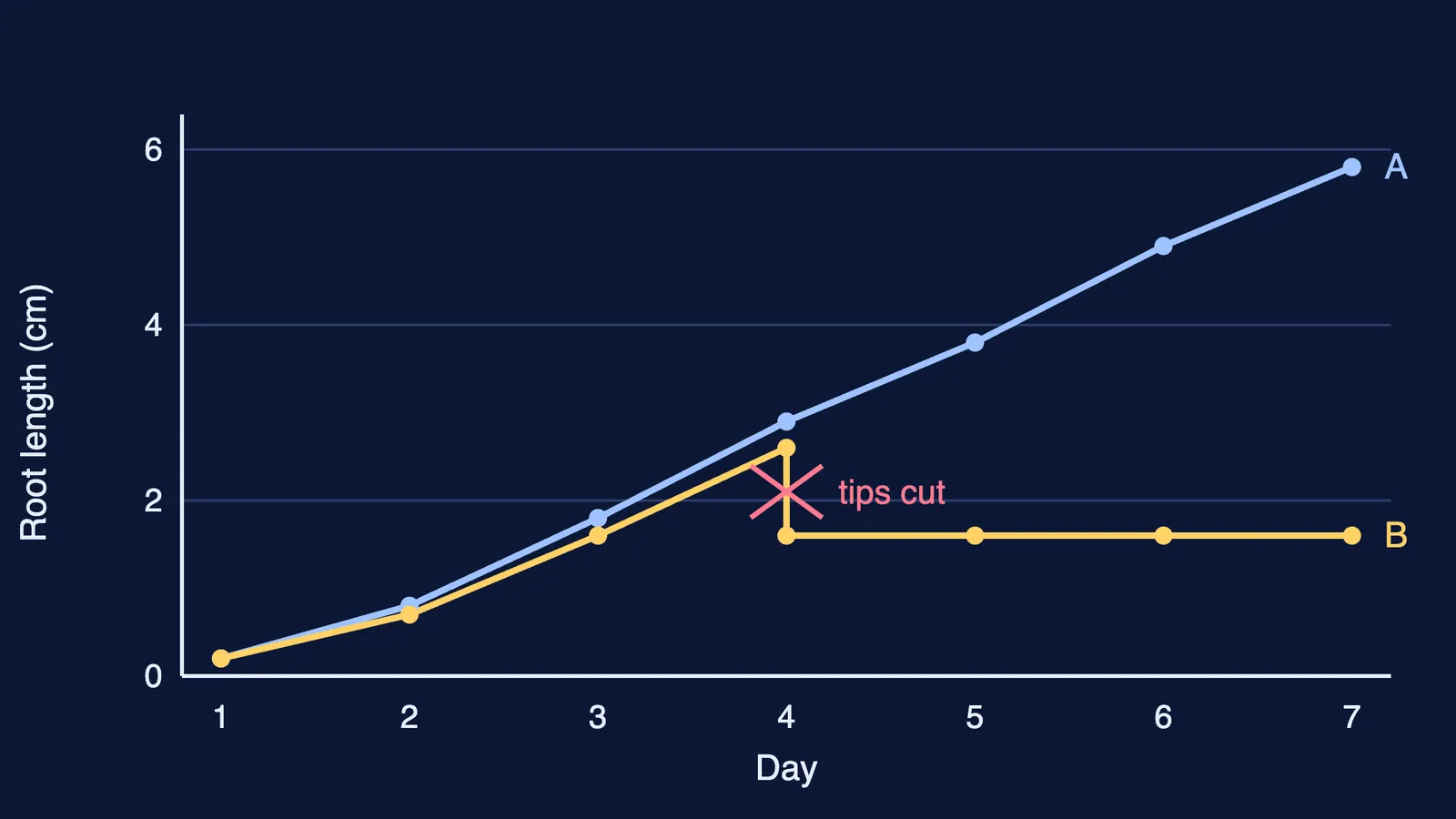
The chapter grows roots from two onions in water, then cuts about 1 cm off the root tips in one jar. Its graph (Fig. 3.2 in the chapter, redrawn in our image above) gives these values, read approximately off the printed grid:
Jar A, tips left alone: 2.9 cm on day 4, 5.8 cm on day 7.
Growth rate for Jar A: (5.8 - 2.9) / 3 days, about 1 cm a day.
Jar B: about 2.6 cm on day 4, 1.6 cm once the tips are cut, and still 1.6 cm on day 7, so no further growth.
The activity says to cut on day 3; the graph shows the drop at day 4. Only the tip differed, so the dividing cells live in the tip: the apical meristem.
Which animal tissues and joints are in the new chapter?
The chapter covers four animal tissues:
Epithelial: tightly packed cells that cover and line organs. Thin, flat single layers allow exchange in lungs and blood vessels; many layers protect skin and mouth.
Connective: blood (plasma is about 55% of its volume, cells and platelets 45%), bone, cartilage, tendons (muscle to bone) and ligaments (bone to bone). Our post on cartilage vs bone compares their matrix and cells.
Muscular: skeletal (striated, unbranched, many nuclei, voluntary), smooth (spindle-shaped, one nucleus, involuntary) and cardiac (branched, one nucleus, faint striations, heart only).
Nervous: neurons, with a cell body, dendrites and an axon.
The chapter also has a full section on the musculoskeletal system and four joint types: ball and socket (shoulder), hinge (elbow, knee), pivot (skull on the backbone) and fixed (skull bones). The chapter says the adult skeleton is about 12 to 15 per cent of body weight. For a 50 kg adult, that is 50 x 0.12 = 6 kg to 50 x 0.15 = 7.5 kg of bone.
How many marks does Tissues in Action carry in CBSE 2026-27?
CBSE does not give the chapter its own marks. In the CBSE Class IX Science curriculum for 2026-27, Chapter 3 is part of Unit I, World of Living, which carries 27 of the 80 theory marks together with Chapters 2, 11 and 12. CBSE suggests 13 periods for tissues, and one practical asks you to identify plant tissues and muscle types on prepared slides. The same document sets the theory paper at 50% knowledge, 30% application and 20% analysis questions, so expect case-based questions too.
What mistakes cost marks in this chapter?
Putting the intercalary meristem at the tip. It sits at the base of the internode.
Calling all of xylem dead. Xylem parenchyma is living.
Swapping lignin and pectin. Lignin hardens sclerenchyma; pectin gives collenchyma its bend.
Mixing up tendon and ligament.
Giving cardiac muscle many nuclei. It has one per cell, with branched fibres.
Forgetting that blood is a connective tissue with a fluid matrix.
If one keeps tripping you up, the Fermi Concept Library has every concept in biology with its own lesson, so you can fix the gap before the test. Not sure where to begin? Fermi's AI tutor works out what you already know and builds a plan for the session.