

On this page
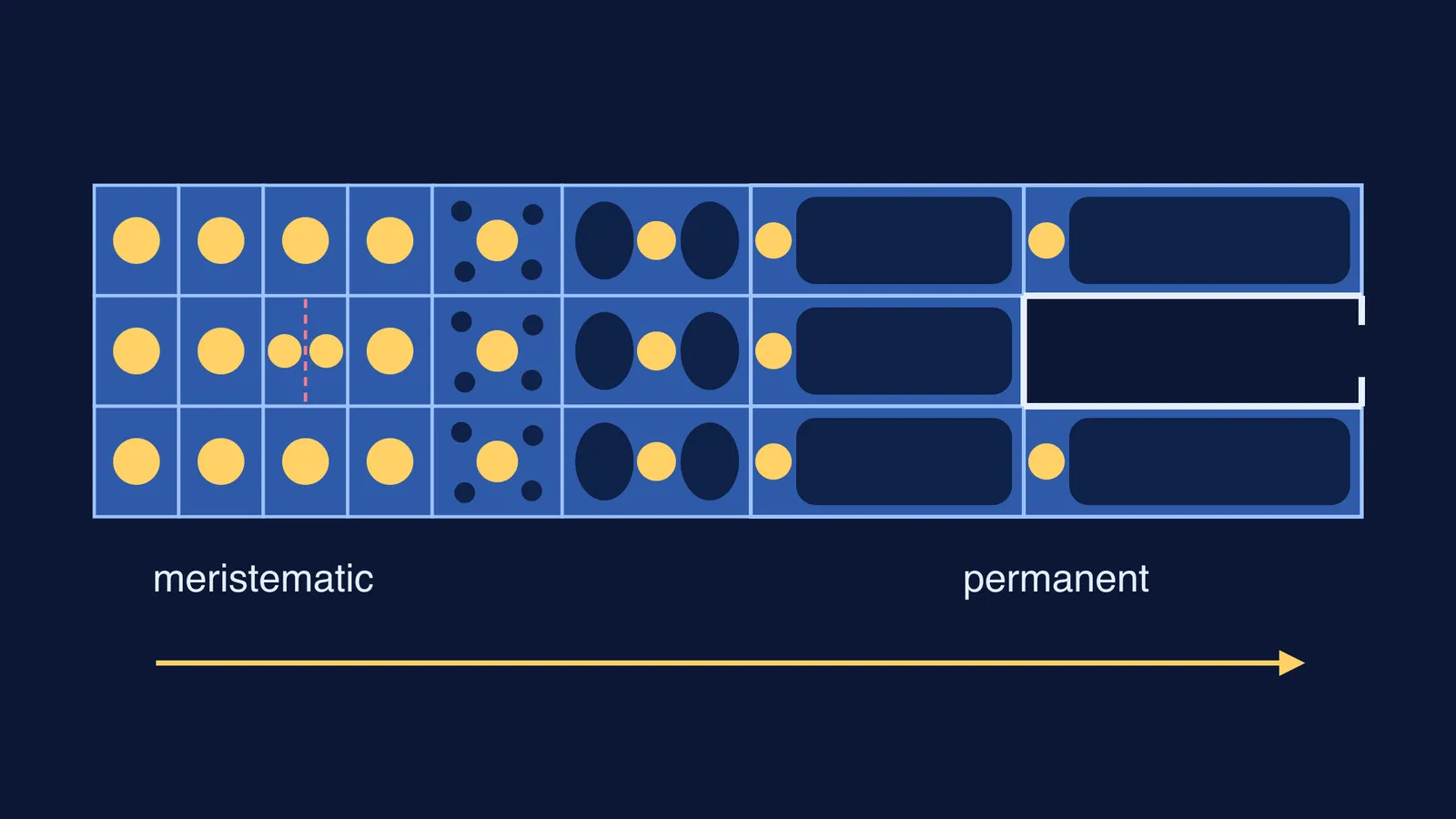
A plant grows only in certain zones, and the cells there look different from the rest. Those zones are meristematic tissue. Everything else is permanent tissue: cells that have stopped dividing and taken up a job. Picture one cell of each kind and the usual exam questions on this topic get much easier.
What is the difference between meristematic and permanent tissue?
OpenStax Biology 2e, a free university textbook, puts it in two lines. Meristematic tissue cells are undifferentiated or incompletely differentiated, and they keep dividing and adding to the plant's growth. Permanent tissue consists of plant cells that are no longer actively dividing.
The rest follows from that. The Wikipedia article on meristems describes meristematic cells as small, with thin primary walls, small or no vacuoles, and dense protoplasm filling the whole cell, with no intercellular spaces.
A living permanent cell such as parenchyma looks different. Parenchyma cells are generally large, with large central vacuoles, according to the Wikipedia article on ground tissue, and OpenStax notes that a plant cell's large central vacuole occupies most of the cell's volume.
Side by side:
Division: meristematic cells keep dividing; permanent cells have stopped.
Cytoplasm: dense and filling the cell, against sharing the cell with a large vacuole.
Vacuoles: small or absent, against one large central vacuole.
Walls: thin primary walls, against walls that may be unevenly thickened or lignified, depending on the tissue.
Job: making new cells, against storage, support, protection or transport.
Where is meristematic tissue found in a plant?
OpenStax names three positions:
Apical meristems sit at the tips of stems and roots and make the plant longer.
Lateral meristems make a maturing plant thicker.
Intercalary meristems occur only in monocots, at the bases of leaf blades and at nodes.
The two lateral meristems to know are the vascular cambium, which forms secondary xylem to the inside and secondary phloem to the outside, and the cork cambium, which produces cork cells (bark) in woody plants, as the OpenStax chapter on stems explains. For each type in more detail, see our guide to apical, intercalary and lateral meristems.
These small zones build the whole plant. A 2024 review by Lindsay, Swentowsky and Jackson opens by calling meristems “stem cell-containing structures that produce all plant organs”.
Is permanent tissue dead?
Not necessarily, and this is a common slip in answers. “Permanent” means a cell has stopped dividing and specialised, not that it has died. The OpenStax chapter on stems is clear:
Parenchyma, the most common plant cells, are found in the stem, the root, the inside of the leaf and the pulp of fruit.
Collenchyma cells are elongated, with unevenly thickened walls, and are alive at maturity.
Sclerenchyma cells also give support, but many are dead at maturity, with secondary walls thickened with lignin.
Parenchyma cells usually remain alive after they mature, according to the Wikipedia article on ground tissue. The complex tissues split the same way: xylem cells are dead at functional maturity, while phloem conducting cells are alive, according to OpenStax. Our explainer on parenchyma, collenchyma and sclerenchyma takes the simple permanent tissues one by one.
How do you tell them apart in a diagram or exam question?
Run any cell through these four checks, in order:
Does dense cytoplasm fill the cell, with small or no vacuoles? Yes points to meristematic.
Are the cells small and thin-walled, packed with no gaps between them? Yes points to meristematic.
Does one large vacuole take up most of the cell? Then it is permanent and living, often parenchyma.
Is the cell empty, with thick lignified walls? Then it is permanent and dead, such as a xylem tracheid or many sclerenchyma cells.
Worked example. A question shows three cells. Cell A is small and square, packed with dense cytoplasm, no visible vacuole, and neighbours touching on every side. Cell B is large, with a central vacuole filling most of it. Cell C is long and empty, with thick, lignified walls. A passes checks 1 and 2, so it is meristematic, from a growing point such as a root or shoot tip. B matches check 3: a living permanent cell, probably parenchyma. C matches check 4: a dead permanent cell, such as a xylem tracheid.
For a three-mark “differentiate” answer, write paired points, not two separate paragraphs: “Meristematic cells divide; permanent cells do not. Meristematic cells have dense cytoplasm and few or no vacuoles; living permanent cells usually have a large central vacuole. Meristematic tissue sits at growing points such as root and shoot tips; permanent tissue makes up the rest of the plant body.”
If the idea itself feels shaky, the Fermi Concept Library gives each biology concept its own lesson and its place in the map, so you can see how meristems relate to the ideas around them. For practice, the Fermi Problem Library has worked problems with a step-by-step solver that explains the reasoning rather than printing an answer.
Next, follow these tissues into roots, stems and leaves in our guide to the anatomy of flowering plants.


