On this page
Timeline and Sources of History is Chapter 4 of NCERT's new Class 6 Social Science book, Exploring Society: India and Beyond (code fees1, First Edition June 2024). It opens Theme B, Tapestry of the Past, and comes just before India, That Is Bharat (NCERT, fees1 contents). CBSE publishes no separate 2026-27 curriculum for Classes 6 to 8; they follow the NCERT book, and the chapter is assessed by the school.
What does Timeline and Sources of History cover?
The chapter is built around three big questions: how we measure historical time, how sources help us understand history, and how early humans lived (NCERT Chapter 4 PDF).
History is the study of the human past, a tiny recent part of the Earth's story.
Geologists, palaeontologists, anthropologists and archaeologists each study a different slice of that past.
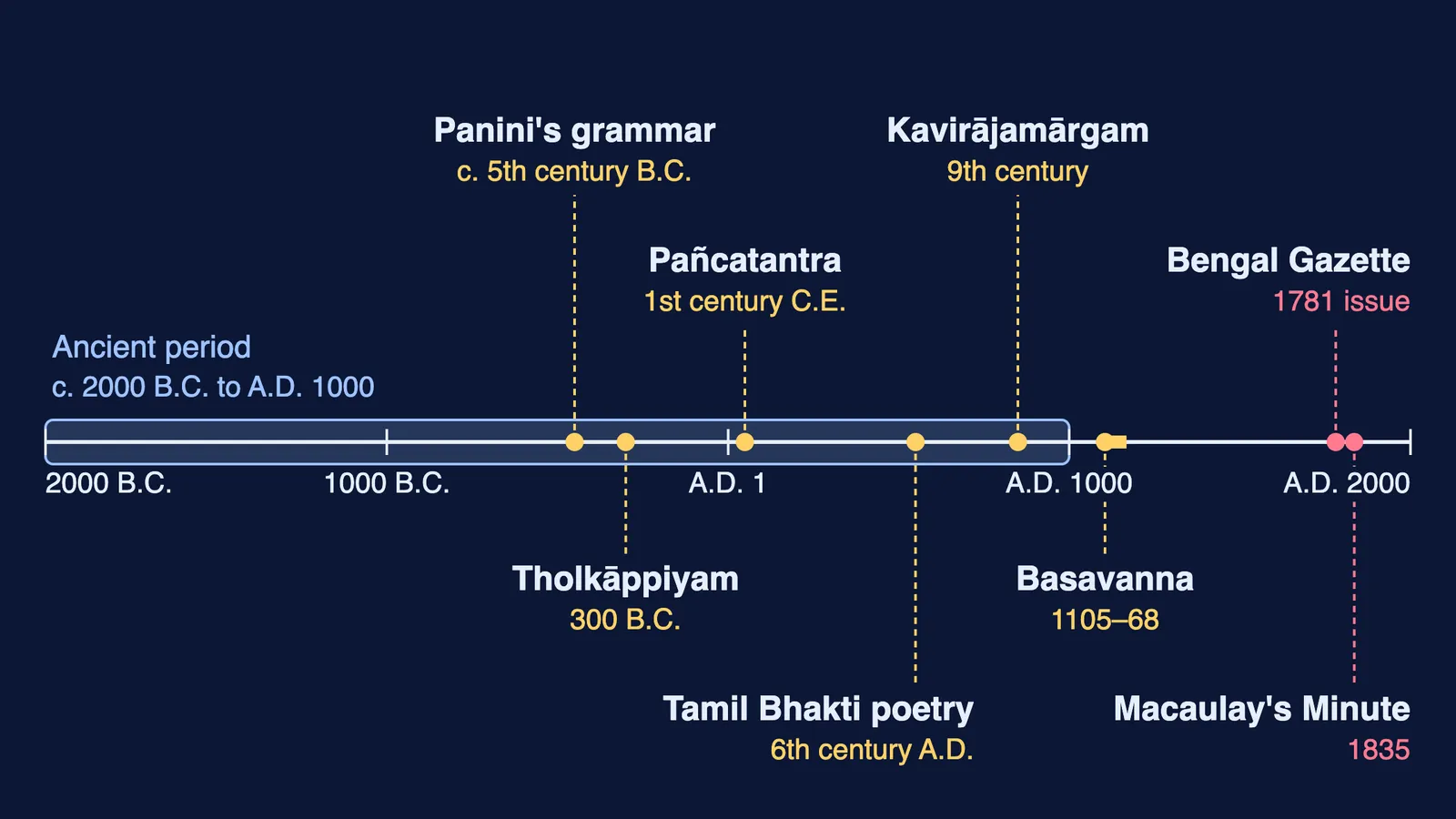
A timeline shows dates and events in order.
The last section follows early humans from hunting and gathering to farming villages, pottery and metal (copper first, then iron).
How do BCE and CE work, and why is there no year zero?
The Gregorian calendar, used worldwide today, counts years forward from the conventional year of Jesus' birth (NCERT). Those years were once marked AD and are now called CE, or Common Era. Years before that point are counted backwards, once marked BC and now called BCE, or Before Common Era.
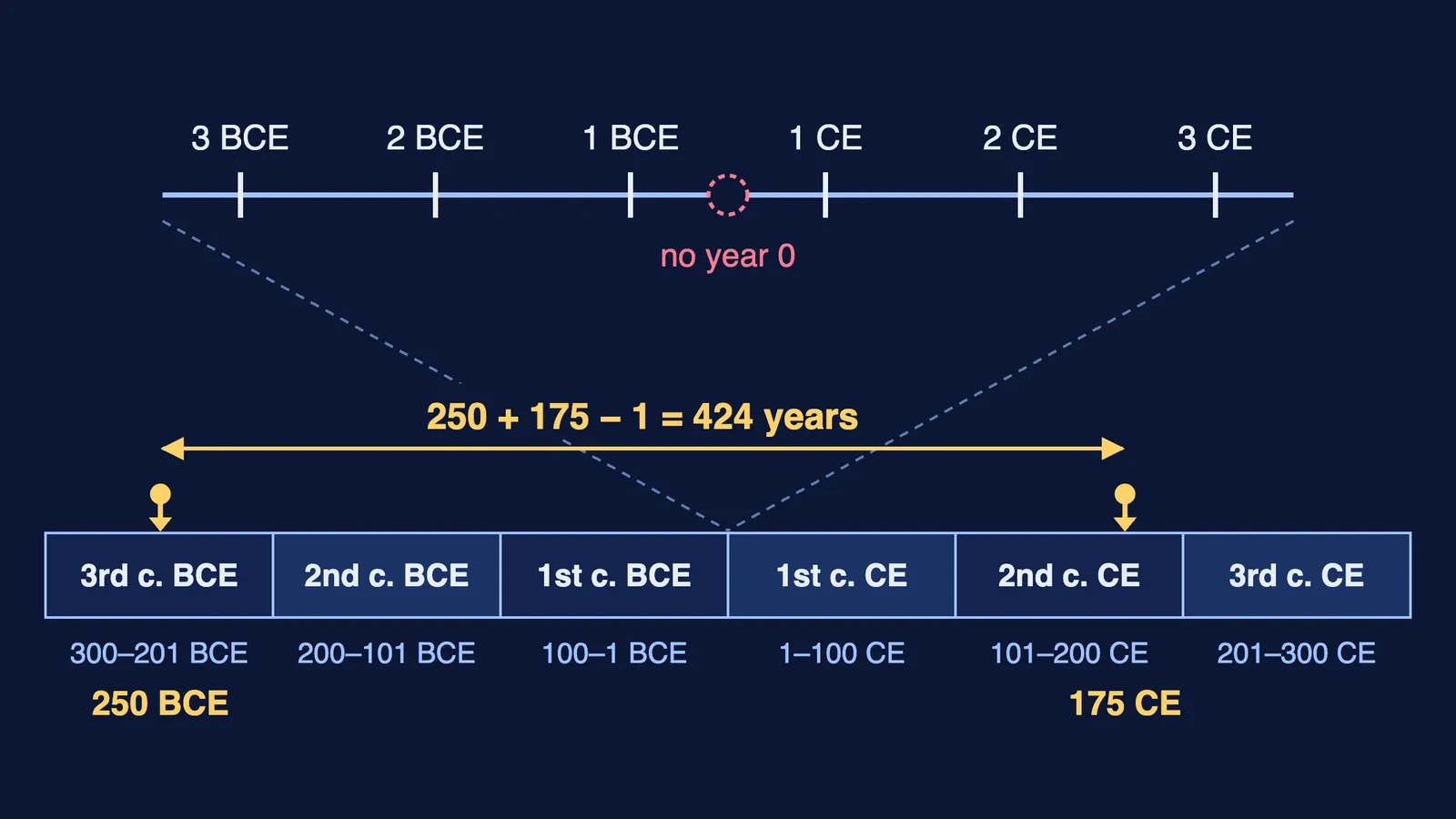
There is no year 0: 1 BCE is followed directly by 1 CE. So to find the gap between a BCE year and a CE year, add the two numbers and subtract 1. The book checks this with the Buddha, born around 560 BCE: from 2024 CE that is 2,583 years ago.
How are centuries and millenniums counted?
A decade is 10 years, a century is 100 years and a millennium is 1,000 years (NCERT). CE centuries are counted from 1 CE, so the 21st century runs from 2001 to 2100. BCE centuries are counted back from 1 BCE, so the 3rd century BCE covers 300 BCE to 201 BCE. Millenniums work the same way: the 3rd millennium CE began in 2001, and the 1st millennium BCE runs from 1 BCE back to 1000 BCE.
A note on the text: where it defines a millennium (page 65), the book says "centuries" are counted every 1,000 years; it means millenniums.
What are the sources of history?
A source of history is any place, person, text or object that tells us about a past event or period (NCERT). The chapter's diagram sorts them into four groups:
Oral: folklore and genealogies (family histories).
Literary: Indian literature such as the Vedas and Itihasas, poems, plays and scientific texts, plus foreign accounts like travelogues and chronicles.
Archaeological: inscriptions (manuscripts, copper plates, coins), structures such as monuments and mounds, and finds from excavations such as tools, pottery and burials.
Artistic: paintings, sculptures and panels.
The book compares sources to jigsaw pieces: sometimes they fit, sometimes they clash and historians must judge which to trust. Over roughly the last 50 years, scientific studies of ancient climates, excavated materials and genetics have added fresh evidence. Our guide to what books and burials tell us shows two of these source types at work.
Worked example: dating an imaginary find
Suppose a museum labels one coin 250 BCE and another 175 CE (both made up; the diagram above plots them).
Years between them: one BCE and one CE, so add and subtract 1: 250 + 175 − 1 = 424 years.
Century of the first coin: 250 falls between 300 and 201 BCE, so the 3rd century BCE.
Century of the second coin: 175 falls between 101 and 200 CE, so the 2nd century CE.
Millennium: both lie in the 1st millennium, one BCE and one CE.
Same-side check: a third coin from 700 BCE is 700 − 250 = 450 years older than the first.
Years ago into a date: 5,000 years before 2026 CE is 5,000 − 2,026 + 1 = 2975 BCE.
We checked every figure by hand and with a short script.
Practice questions and how this chapter connects
These questions are our own; the marks are our suggestion.
What do BCE and CE stand for? (1 mark)
How many years passed between 130 BCE and 90 CE? Show your working. (2 marks)
Name the century and the millennium of 1450 CE. (2 marks)
Give one example each of an oral, a literary and an archaeological source. (3 marks)
Two sources describe the same event differently. How might a historian decide which one to trust? (3 marks)
The early-humans section leads into Chapter 6, The Beginnings of Indian Civilisation. The older textbook covers similar ground in on the trail of the earliest people, and parents can find memory tips in helping a child learn history dates.
Stuck on BCE sums the night before a class test? Fermi's AI tutor works out what you already know and builds a plan for the session.