

On this page
Looking for On the Trail of the Earliest People? In the NCERT Our Pasts I edition we checked (2021-22), it is Chapter 2, From Hunting-Gathering to Growing Food, covering the earliest people and the first farmers together. Books change, so check which syllabus your school follows.
Who were the earliest people in India?
According to the NCERT Class 6 chapter, we know about people who lived in the subcontinent as early as two million years ago. We call them hunter-gatherers.
A hunter-gatherer is someone who gets food by hunting wild animals, catching fish and birds, and gathering fruits, roots, nuts, seeds, leaves, stalks and eggs.
They probably made tools of stone, wood and bone, but stone tools have survived best. These cut meat and bone, scraped bark and skins, and chopped fruit and roots; some may have been fixed to handles to make spears and arrows.
Why did hunter-gatherers move from place to place?
The NCERT chapter gives four reasons. Remember them as Food, Animals, Seasons, Water:
Food runs out: staying too long would use up the plants and animals nearby.
Animals move: deer and wild cattle wander in search of grass and leaves, so hunters followed them.
Seasons change: plants and trees bear fruit in different seasons.
Water dries up: seasonal rivers and lakes run low in the dry winter and summer.
What do Bhimbetka, Hunsgi and the Kurnool caves tell us?
A site is a place where the remains of things people made and used are found. NCERT's Map 2 marks Bhimbetka, Hunsgi and the Kurnool caves as Palaeolithic sites; many sites were near water, and people looked for good quality stone (NCERT Class 6, Chapter 2).
Bhimbetka, in Madhya Pradesh near the Narmada valley, has rock shelters that protected people from rain, heat and wind. UNESCO inscribed the Rock Shelters of Bhimbetka as a World Heritage Site in 2003. Its listing describes five clusters of rock shelters with paintings that appear to date from the Mesolithic period right through to the historical period. It also notes that the traditions of the 21 villages next to the site strongly resemble those in the paintings.
At the Kurnool caves, traces of ash have been found. NCERT says this suggests people knew how to use fire: for light, to roast meat and to scare away animals.
What are the Palaeolithic, Mesolithic and Neolithic periods?
Palaeolithic comes from two Greek words, palaeo (old) and lithos (stone), as the NCERT chapter explains.
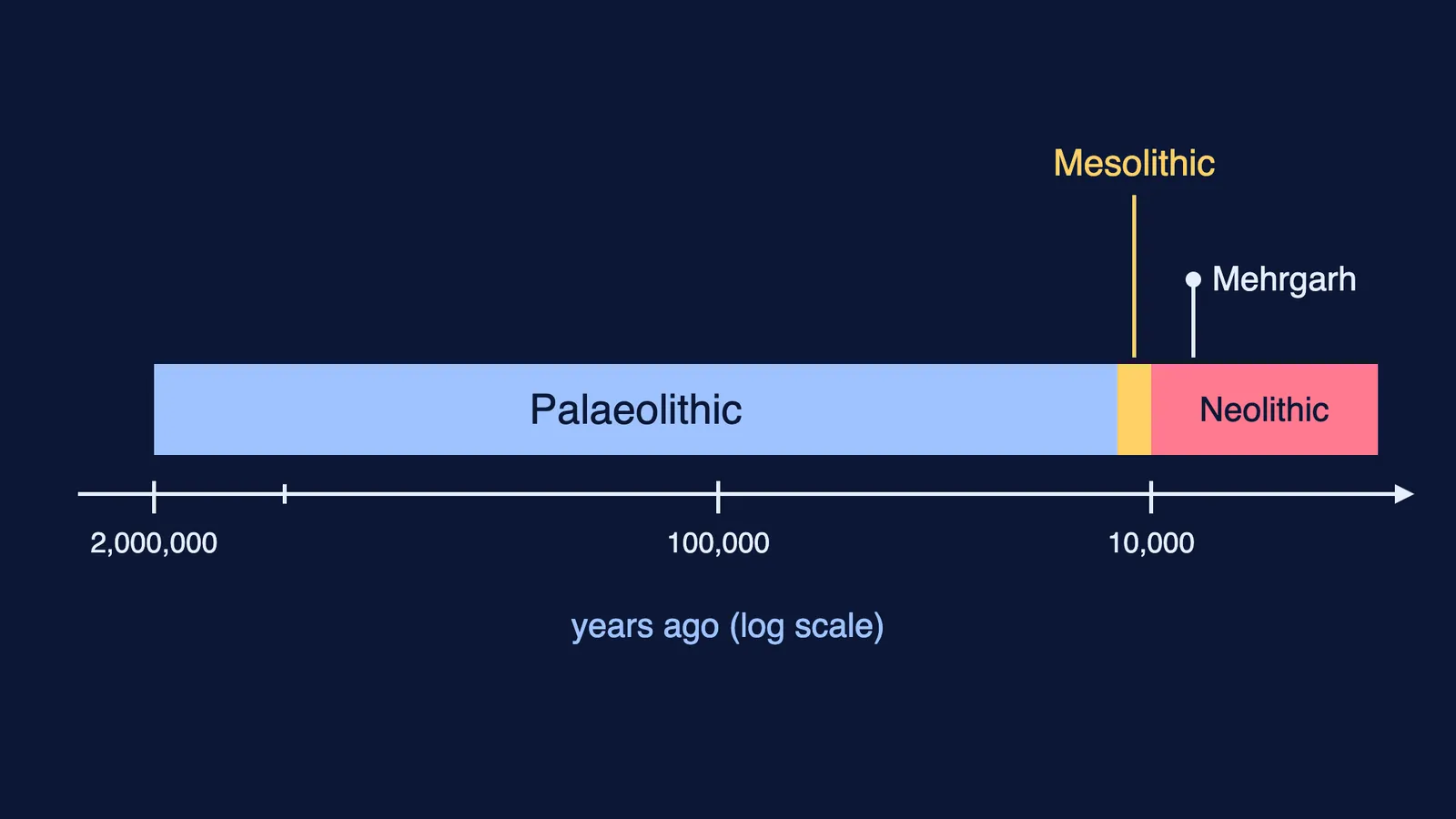
Palaeolithic: from about 2 million years ago to about 12,000 years ago, split into Lower, Middle and Upper. It covers 99% of human history.
Mesolithic: from about 12,000 to 10,000 years ago. Its tiny stone tools, called microliths, were stuck onto bone or wood handles to make saws and sickles.
Neolithic: from about 10,000 years ago. New tools were polished to a fine cutting edge, and mortars and pestles were used to grind grain.
How did people move from hunting to growing food?
Around 12,000 years ago the world's climate became warmer, grasslands spread, and deer, antelope, goat, sheep and cattle increased (NCERT Class 6, Chapter 2). Hunters following these herds learnt their breeding seasons, which probably helped them start rearing animals. People who gathered wild wheat, barley and rice learnt where and when they grew, which may have led them to grow plants. The first animal tamed was the wild ancestor of the dog.
Domestication is the process in which people grow plants and look after animals; NCERT dates its beginning to about 12,000 years ago.
Mehrgarh, near the Bolan Pass, is one of the earliest villages we know of; settlement there began about 8,000 years ago. People grew barley and wheat and reared sheep and goats. At Burzahom in Kashmir, people dug pit-houses into the ground. The change was slow: many kept hunting and gathering for thousands of years. Towns with planned drains appear later in the book, in the Harappan civilisation chapter.
How can you revise this chapter in 30 minutes?
Minutes 0-5: draw the three periods on a timeline, oldest on the left. The timeline method for the freedom struggle works here too.
Minutes 5-12: mark Bhimbetka, Hunsgi, Kurnool, Mehrgarh and Burzahom on a blank map from memory, then check Map 2.
Minutes 12-20: write the four reasons for moving without looking.
Minutes 20-27: answer how farmers' lives differed from hunter-gatherers', using the frame below.
Minutes 27-30: explain the Kurnool ash to a parent.
A three-point answer frame:
Home: hunter-gatherers moved often; farmers stayed to water, weed and guard crops till the grain ripened.
Food: hunter-gatherers found food; farmers grew it and kept animals as a store of milk and meat.
Things they made: farmers needed pots, baskets or pits to store grain, plus polished tools and grinding stones.
If revision across subjects feels scattered, Fermi's AI tutor works out what you already know and builds a plan for the session, so you start with a clear next step.
Start with the timeline tonight; the rest of the chapter hangs on it.


