On this page
Introduction to Three Dimensional Geometry is Chapter 11 of the NCERT Class 11 Mathematics textbook (reprint 2026-27). The CBSE Mathematics curriculum for 2026-27 lists three topics: coordinate axes and planes in three dimensions, coordinates of a point, and the distance between two points. The terms below follow that order. For preparation, read our Introduction to Three Dimensional Geometry Class 11 guide.
Not covered: the section formula (dividing a segment internally or externally, the midpoint and the centroid formula). The rationalised NCERT chapter, sections 11.1 to 11.4, has no section on it.
What are coordinate axes and coordinate planes in 3D?
Point in space: a position fixed by three numbers, not two. Example: a ceiling fan's tip needs its distances from two adjacent walls and its height above the floor.
Origin (O): the single point where the three axes meet; its coordinates are (0, 0, 0).
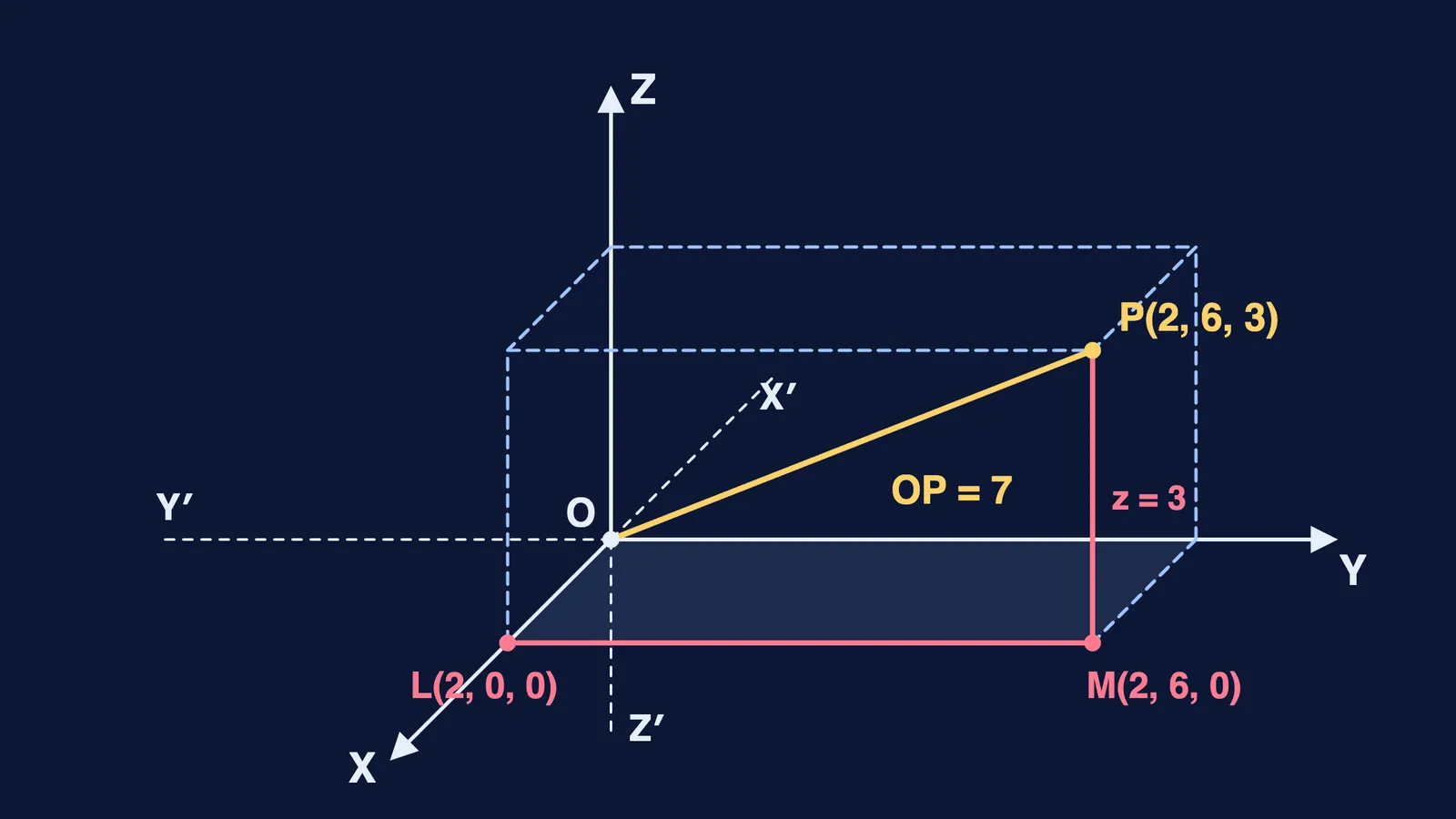
Coordinate axes: three mutually perpendicular lines through O: the x-axis (X′OX), y-axis (Y′OY) and z-axis (Z′OZ).
Rectangular coordinate system: the origin with these three perpendicular axes, the fixed frame for every point.
Coordinate planes: the three planes that each contain two of the axes: the XY, YZ and ZX-planes. Don't confuse with: the axes. The XY-plane is a flat surface; the x-axis is one line in it.
Sign convention: with the XY-plane flat and the z-axis vertical, distances above the XY-plane, in front of the YZ-plane (along OX) and to the right of the ZX-plane (along OY) are positive; the opposite sides are negative.
What is an octant?
Octant: each of the eight regions of space cut off by the three coordinate planes, named XOYZ, X′OYZ and so on, and numbered I to VIII.
Octant sign pattern: for (x, y, z) the signs are I (+, +, +), II (−, +, +), III (−, −, +), IV (+, −, +), and V to VIII repeat I to IV with z negative. Example: (−2, −1, 4) lies in III and (3, −1, −2) lies in VIII.
Point on a coordinate plane: a point with a zero coordinate lies on a coordinate plane, on the boundary between octants. Don't confuse with: a point inside an octant, where no coordinate is zero.
How are the coordinates of a point in space found?
Ordered triplet (x, y, z): a point's three coordinates in fixed order. Example: (2, 6, 3) and (6, 2, 3) are different points.
Foot of the perpendicular: the point M where the perpendicular from P meets the XY-plane. For P(2, 6, 3), M is (2, 6, 0).
x, y and z-coordinates: how far P is from the YZ, ZX and XY-planes respectively, measured perpendicularly, with sign. Example: P(2, −3, 5) is 2 units in front of the YZ-plane, 3 units on the negative side of the ZX-plane and 5 above the XY-plane. Don't confuse with: distance from an axis. P is √(9 + 25) = √34 from the x-axis, not 2.
One-to-one correspondence: each point in space gives exactly one ordered triplet of real numbers, and each triplet exactly one point.
Point on an axis: the other two coordinates are zero: (x, 0, 0) on the x-axis, (0, y, 0) on the y-axis, (0, 0, z) on the z-axis.
Point in a coordinate plane: one coordinate is zero: (x, y, 0) in the XY-plane, (0, y, z) in the YZ-plane, (x, 0, z) in the ZX-plane. Example: (0, −4, 7) lies in the YZ-plane.
Rectangular parallelopiped (box): the solid made by planes through P parallel to the coordinate planes; O and P are opposite corners and the edges are |x|, |y| and |z| long.
How do you find the distance between two points in 3D?
Distance formula: for P(x₁, y₁, z₁) and Q(x₂, y₂, z₂), PQ = √[(x₂ − x₁)² + (y₂ − y₁)² + (z₂ − z₁)²]. PQ is a box diagonal, so Pythagoras' theorem is used twice. Example: P(1, 2, −1) and Q(3, −1, 5) give √(4 + 9 + 36) = 7.
Distance from the origin: OQ = √(x² + y² + z²). Example: (1, −2, 2) is 3 units from O.
Collinear points: points that lie on one line. Test: the two shorter distances add up to the longest. Example: (1, 1, 1), (2, 3, 3) and (3, 5, 5) give 3 + 3 = 6. Don't confuse with: a triangle, where any two sides add up to more than the third.
Right-angled triangle test: two squared sides add up to the third squared side. Example: O(0, 0, 0), A(1, 2, 2) and B(3, 1, 2) give OA² = 9, AB² = 5 and OB² = 14 = 9 + 5, so the right angle is at A.
Isosceles and equilateral triangles: two sides equal, or all three. Example: (1, 0, 0), (0, 1, 0) and (0, 0, 1) are each √2 apart: equilateral.
Parallelogram check: both pairs of opposite sides are equal, the check NCERT uses. Rectangle test: a parallelogram whose diagonals are also equal. Example: A(0, 0, 0), B(2, 0, 0), C(3, 1, 1) and D(1, 1, 1) give AB = CD = 2 and BC = DA = √3, but diagonals AC = √11 and BD = √3: a parallelogram, not a rectangle.
Set of points (locus): all points P(x, y, z) meeting a distance condition, written as one equation in x, y and z. Example: PA = PB for A(1, 0, 0) and B(−1, 0, 0) gives (x − 1)² = (x + 1)², so x = 0: the YZ-plane.
For more worked examples, see our three-dimensional geometry Class 11 formulas, then try the Class 11 3D geometry case study questions.
How to learn these terms
Sketch the axes daily: XY-plane flat, z-axis up, x-axis towards you. Plot points along x, then parallel to y, then up or down.
Learn terms in pairs: axis and plane, octant and coordinate plane, distance from a plane and from an axis.
Write the signs for octants I to IV, then flip z for V to VIII.
In proofs, keep distances squared; take a square root only when a length is asked for.
If a term still feels abstract, the Fermi Concept Library gives each mathematics concept its own lesson and its place in the map.