On this page
What do 3D geometry case studies test in Class 11?
The CBSE 2026-27 Mathematics curriculum lists three things for this chapter: coordinate axes and coordinate planes in three dimensions, coordinates of a point, and the distance between two points. It lists the section formula for formative assessment only, so no case below uses it.
All values are original and stay inside NCERT Class 11 Mathematics Chapter 11 (Reprint 2026-27). Class 11 exams are set by schools, so treat these as practice in the case-based style. For the full chapter, see our Three Dimensional Geometry Class 11 guide.
Case 1: The fan in a Lucknow classroom
Ananya's classroom is 8 m long, 6 m wide and 3.5 m high, with the origin O at the floor corner where the front and left walls meet. The x-axis runs along the foot of the left wall, the y-axis along the front wall and the z-axis up the corner, in metres. The tip of the ceiling fan is at F(4, 3, 2.8), a corner of the teacher's desk is at D(2, 2, 0.8) and the top corner of the door is at Q(0, 5, 2).
(i) The point on the ceiling directly above F is (a) (4, 3, 0) (b) (4, 3, 3.5) (c) (0, 0, 3.5) (d) (4, 0, 3.5)
(ii) How far is F from the front wall, from the left wall and from the floor?
(iii) Find the distance from the fan tip to the desk corner.
(iv) A CCTV camera goes on the corner edge (the z-axis), equally far from F and Q. At what height?
Answers.
(i) (b) (4, 3, 3.5). Same x and y as F, with z at the ceiling.
(ii) x, y and z are the distances from the YZ, ZX and XY planes, so F is 4 m from the front wall, 3 m from the left wall and 2.8 m above the floor.
(iii) FD = √(2² + 1² + 2²) = √9 = 3 m.
(iv) Let C be (0, 0, h). CF² = 16 + 9 + (h − 2.8)² and CQ² = 0 + 25 + (h − 2)². Both have 25, so (h − 2.8)² = (h − 2)², giving h = 2.4 m.
Case 2: Surveying a metro tunnel in Bengaluru
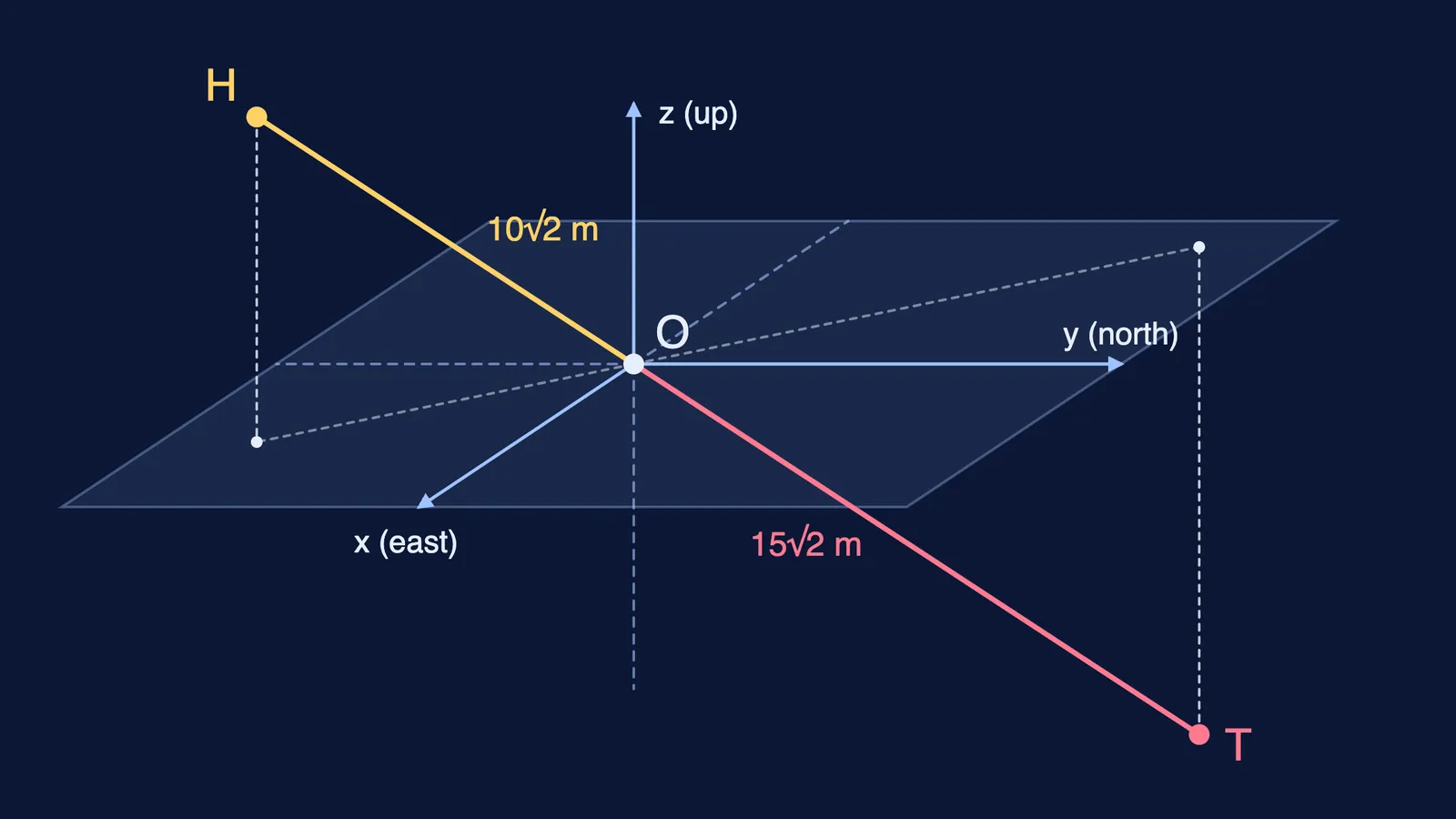
At a Bengaluru metro site, a surveyor's peg O at ground level is the origin. The x-axis points east, the y-axis north and the z-axis up, in metres. A crane's hook hangs at H(6, −8, 10); underground, the tunnel boring machine's cutter head is at T(−9, 12, −15). The engineer says a straight laser from hook to cutter head would pass through the peg.
(i) In which octant does T lie? (a) II (b) III (c) VI (d) VII
(ii) Write the point on the ground directly below the hook, and find its distance from the peg.
(iii) How deep is the cutter head, and how far from the peg horizontally and in a straight line?
(iv) Use distances to check the engineer's claim.
Answers.
(i) (c) VI. Signs (−, +, −) mean octant VI in NCERT's table. The hook, (+, −, +), is in octant IV.
(ii) Set z = 0: the point is (6, −8, 0). Its distance from O is √(36 + 64) = 10 m.
(iii) It is 15 m deep. Horizontally, √(81 + 144) = 15 m. In a straight line, OT = √450 = 15√2 ≈ 21.2 m.
(iv) OH = √(36 + 64 + 100) = 10√2, OT = 15√2 and HT = √(15² + 20² + 25²) = √1250 = 25√2. Since OH + OT = HT, the points H, O and T are collinear, with O between them.
Case 3: Balancing Wi-Fi in a Pune library
A Pune college library puts its origin at a floor corner, with x and y along the feet of two walls and z up, in metres. Two Wi-Fi routers hang from the 3 m ceiling at A(1, 1, 3) and B(7, 5, 3). A student's laptop sits on a table at L(4, 6, 1). The technician wants a booster equally far from both routers.
(i) The distance between the two routers is (a) 2√13 m (b) 6 m (c) 52 m (d) 4√3 m
(ii) Show that the triangle formed by A, B and L is right-angled, and name the right angle.
(iii) Find the point on the x-axis that is equally far from A and B.
(iv) Find the equation satisfied by every point P(x, y, z) equally far from A and B. Why does z not appear?
Answers.
(i) (a) AB = √(6² + 4² + 0²) = √52 = 2√13 ≈ 7.21 m.
(ii) AL² = 9 + 25 + 4 = 38 and BL² = 9 + 1 + 4 = 14. As 38 + 14 = 52 = AB², the angle at L is 90°.
(iii) Take (x, 0, 0). Then (x − 1)² + 1 + 9 = (x − 7)² + 25 + 9, so 12x = 72 and x = 6. The point is (6, 0, 0).
(iv) (x − 1)² + (y − 1)² + (z − 3)² = (x − 7)² + (y − 5)² + (z − 3)² simplifies to 12x + 8y = 72, that is 3x + 2y = 18. The (z − 3)² terms cancel because both routers are at the same height.
How do you solve 3D geometry case study questions?
Fix the axes from the story. Note which wall or floor is which coordinate plane.
Name forms on sight. Points on the floor have z = 0, points on the z-axis are (0, 0, z), and so on.
Prove collinearity with distances. If the two shorter distances add up to the longest, the points are on a line.
For "equally far", square and cancel. Write PA² = PB², expand, and let matching terms cancel, as in Cases 1 and 3.
Check the answer fits the scene. A camera above the ceiling means a slip.
If the octants are hard to picture, Fermi's Concept Library has a lesson on every mathematics concept, each with its place in the map. For more practice, read distance between two points in 3D and the eight octants, and for general technique, our guide to case-based questions in board exams.