On this page
This sheet covers every formula in NCERT Class 11 Mathematics Chapter 11, Introduction to Three Dimensional Geometry (Reprint 2026-27). For what the chapter covers and how to study it, read our Class 11 three-dimensional geometry chapter guide.
Not included: the section formula, which is no longer in the rationalised chapter. The CBSE Mathematics curriculum for 2026-27 lists the chapter's content as coordinate axes and planes, coordinates of a point and the distance between two points.
What do the coordinates (x, y, z) of a point mean?
Three mutually perpendicular axes meet at the origin O; each pair fixes a coordinate plane: XY, YZ and ZX. The three planes divide space into eight octants.
Origin: O = (0, 0, 0).
Point P(x, y, z): x, y and z are the signed perpendicular distances of P from the YZ, ZX and XY-planes, in that order.
Distance of P from the YZ-plane = |x|; from the ZX-plane = |y|; from the XY-plane = |z|.
On the x-axis: (x, 0, 0). On the y-axis: (0, y, 0). On the z-axis: (0, 0, z).
In the XY-plane: (x, y, 0). In the YZ-plane: (0, y, z). In the ZX-plane: (x, 0, z).
Foot of the perpendicular from P(x, y, z) to a coordinate plane: set the missing coordinate to 0, e.g. (x, 0, z) on the ZX-plane.
Worked example. Where is P(−5, 2, −7)? It is 5 units from the YZ-plane, 2 from the ZX-plane and 7 from the XY-plane. The foot of the perpendicular from P to the ZX-plane is (−5, 0, −7).
Watch for: the coordinate that is 0 names the plane it is missing from. A point in the ZX-plane has y = 0, not x = 0.
How do you find the octant of a point?
The signs of (x, y, z) fix the octant. Table 11.1 of the NCERT chapter numbers them:
I: (+, +, +)
II: (−, +, +)
III: (−, −, +)
IV: (+, −, +)
V: (+, +, −)
VI: (−, +, −)
VII: (−, −, −)
VIII: (+, −, −)
Octants I to IV (z > 0) follow the quadrant order of the plane; V to VIII repeat it with z < 0. A point with a zero coordinate lies on a plane, so it is in no octant.
Worked example. P(−5, 2, −7) has signs (−, +, −), so it lies in octant VI.
Watch for: octant V is (+, +, −), the mirror of octant I below the XY-plane. It is not the next quadrant round.
What is the distance formula in 3D?
For P(x₁, y₁, z₁) and Q(x₂, y₂, z₂):
PQ = √[(x₂ − x₁)² + (y₂ − y₁)² + (z₂ − z₁)²]
Distance of Q(x, y, z) from the origin: OQ = √(x² + y² + z²)
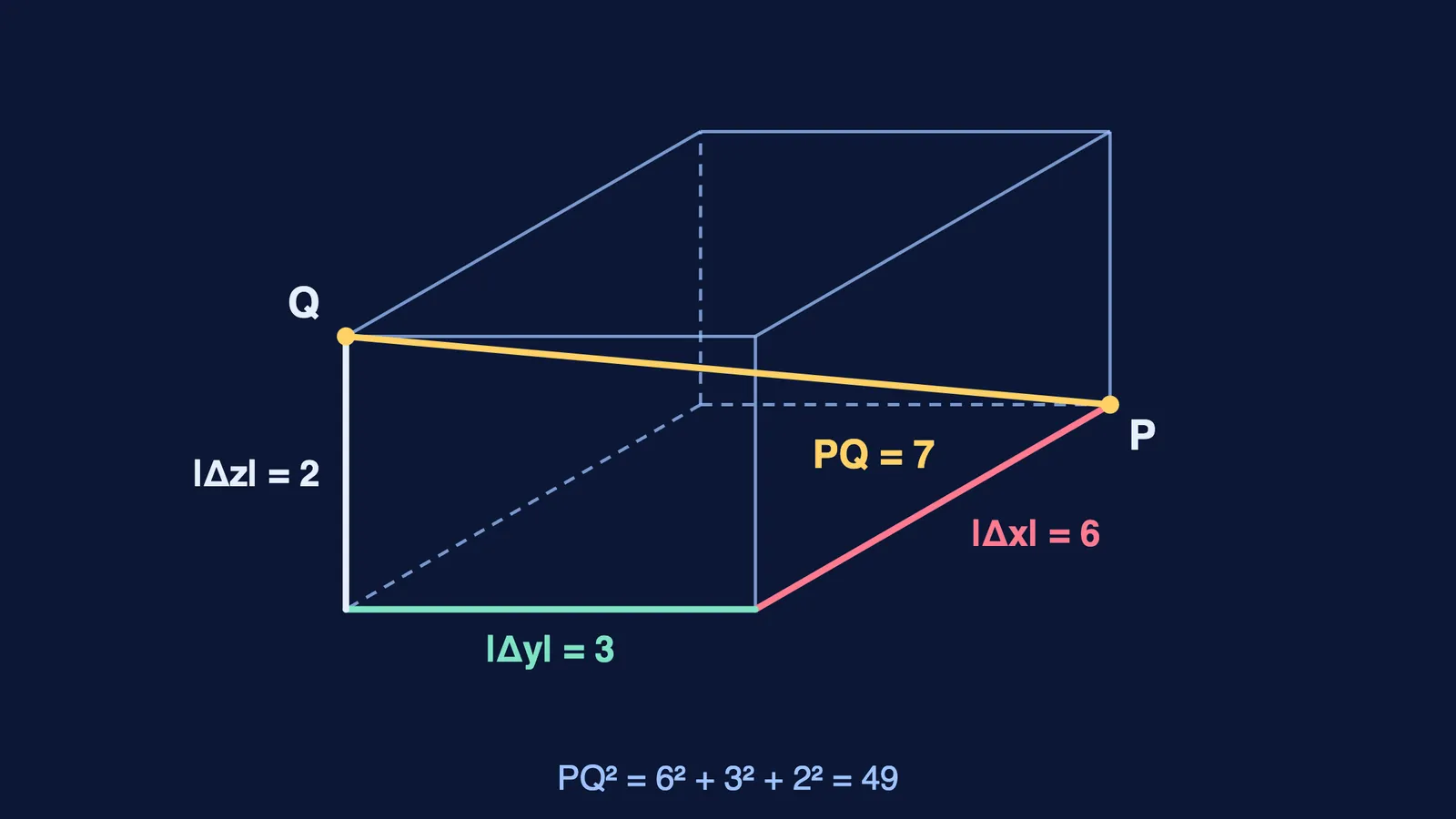
The chapter derives it with Pythagoras twice in a box with diagonal PQ: PQ² = PA² + AN² + NQ², the edges being the differences in y, x and z.
Worked example. A(3, −1, 4) and B(−3, 2, 6). The differences are −6, 3 and 2. AB² = 36 + 9 + 4 = 49, so AB = 7 units.
Watch for: subtracting a negative. For y, the difference is 2 − (−1) = 3, not 1.
How do you prove points are collinear or form a triangle?
Collinear A, B, C: the longest of AB, BC, CA equals the sum of the other two.
Right-angled triangle: the square of the longest side equals the sum of the squares of the other two.
Isosceles triangle: two sides are equal.
Parallelogram ABCD: diagonals AC and BD bisect each other. Equal opposite sides (Example 7) can fail in space, where such points need not be coplanar. It is a rectangle only if AC = BD too.
Centroid of a triangle with vertices (x₁, y₁, z₁), (x₂, y₂, z₂), (x₃, y₃, z₃): G = ((x₁ + x₂ + x₃)/3, (y₁ + y₂ + y₃)/3, (z₁ + z₂ + z₃)/3). The chapter uses it in Miscellaneous Example 9 to find a missing vertex.
Worked example. A(2, 0, −1), B(4, 1, 1), C(8, 3, 5). AB = √(4 + 1 + 4) = 3, BC = √(16 + 4 + 16) = 6, AC = √(36 + 9 + 36) = 9. Since 3 + 6 = 9, the points are collinear.
Watch for: the longest distance must be the sum; testing the wrong pair proves nothing.
What is a locus question in 3D geometry?
A locus is the set of all points P(x, y, z) meeting a distance condition. Write each distance, square, expand and simplify.
Equidistant from A and B: PA² = PB². The x², y² and z² terms cancel, leaving a linear equation.
PA² + PB² = k² (k a constant): the squared terms add instead of cancelling, so 2x², 2y² and 2z² stay in the answer.
PA + PB = constant: isolate one root, square, simplify, then square again.
Worked example. Points equidistant from A(2, −1, 3) and B(0, 3, −1). PA² = PB² gives (x − 2)² + (y + 1)² + (z − 3)² = x² + (y − 3)² + (z + 1)². Expanding and cancelling: −4x + 8y − 8z + 4 = 0, that is, x − 2y + 2z − 1 = 0.
Watch for: (y + 1)² is y² + 2y + 1. Dropping the middle term gives the wrong equation.
How to revise this formula sheet
Learn the planes by their missing coordinate: YZ-plane means x = 0, ZX means y = 0, XY means z = 0.
Write the eight octant sign patterns from memory once a day for a week, starting from the four quadrants with z > 0.
Redo NCERT Examples 3 to 8 without looking, then check every subtraction of a negative.
For proofs, practise with our Class 11 three-dimensional geometry case study questions and test your reasoning with the 3D geometry assertion-reason questions for Class 11.
If octants are hard to picture, turning a model helps; the Fermi Simulation Lab has interactive simulations for the ideas that are easier to see than to read.