On this page
Two common slips in this chapter are confusing distance to a plane with distance to an axis, and carrying a 2D fact into space. These 10 original questions target them.
What do these questions cover?
The CBSE 2026-27 Mathematics curriculum covers coordinate axes and planes, coordinates of a point and the distance between two points. The section formula is for formative assessment only, so no item uses it.
Every statement was checked against NCERT Class 11 Mathematics Chapter 11 (Reprint 2026-27). This is a practice set, not a model of any exam paper. For the full chapter, see our Three Dimensional Geometry Class 11 guide.
How do you answer assertion-reason questions?
Judge each statement alone. If both are true, ask whether "A, because R" holds. More in our assertion-reason strategy guide.
Keys for Q1 to Q6:
(A) Both A and R are true and R is the correct explanation of A.
(B) Both A and R are true but R is NOT the correct explanation of A.
(C) A is true but R is false.
(D) A is false but R is true.
Keys for Q7 to Q10:
(A) Both statements are correct.
(B) Both statements are incorrect.
(C) Statement I is correct, Statement II is incorrect.
(D) Statement I is incorrect, Statement II is correct.
Assertion-reason questions with answers
Q1 (easy). Assertion (A): The point (0, −3, 5) lies in the YZ-plane. Reason (R): A point lies in the YZ-plane exactly when its x-coordinate is 0.
Answer: (A). x is the distance from the YZ-plane, so x = 0 puts the point on it. R directly explains A.
Trap: naming the plane after the zero coordinate.
Q2 (easy). Assertion (A): The point (2, −5, −1) lies in octant VIII. Reason (R): In octant VIII, all three coordinates are negative.
Answer: (C). NCERT's Table 11.1 gives octant VIII the signs (+, −, −). All negative is octant VII.
Trap: assuming the last octant is the "all negative" one.
Q3 (medium). Assertion (A): The distance of P(6, −2, 3) from the origin is 7. Reason (R): P lies in octant IV.
Answer: (B). OP = √(36 + 4 + 9) = √49 = 7, and the signs (+, −, +) give octant IV. But the distance squares each coordinate, so the octant plays no part.
Trap: picking (A) because both are about the same point.
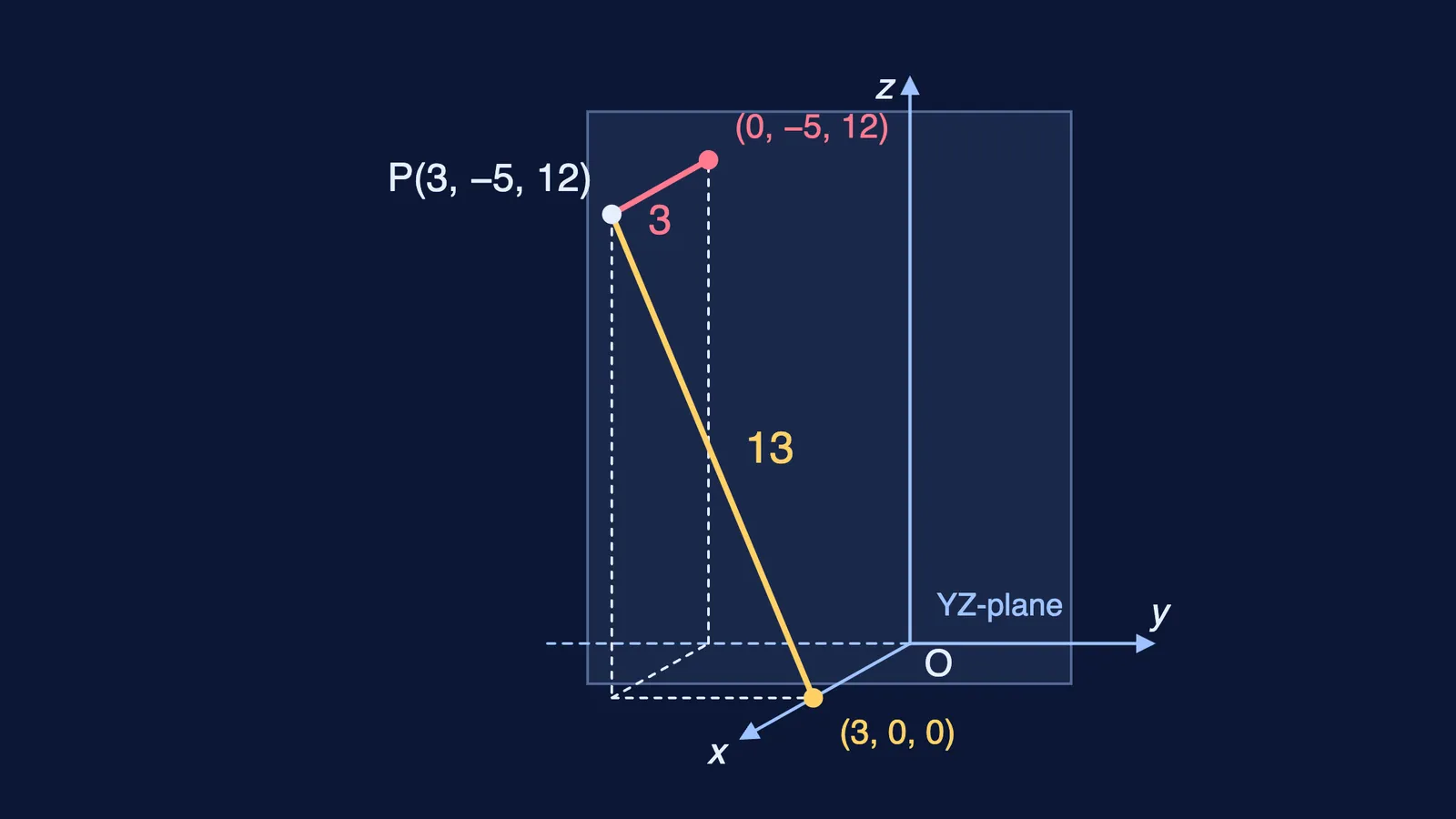
Q4 (medium). Assertion (A): The distance of P(3, −5, 12) from the x-axis is 3. Reason (R): The perpendicular distance of a point (x, y, z) from the YZ-plane is |x|.
Answer: (D). R is NCERT's meaning of the x-coordinate. A is false: the foot of the perpendicular on the x-axis is (3, 0, 0), so the distance is √(25 + 144) = 13. The 3 is P's distance from the YZ-plane (see the diagram).
Trap: reading "distance from the x-axis" as the x-coordinate.
Q5 (medium). Assertion (A): The points A(2, −1, 0), B(3, 1, 2) and C(5, 5, 6) are collinear. Reason (R): AB : BC = 1 : 2.
Answer: (B). AB = 3, BC = 6 and AC = 9, so AB + BC = AC and A is true. R is true too, but a ratio of two lengths says nothing about a straight line; the sum test does.
Trap: treating a neat ratio as proof.
Q6 (hard). Assertion (A): The set of points equidistant from A(4, 2, −1) and B(−4, 2, −1) is the YZ-plane. Reason (R): In space, the set of points equidistant from two fixed points is a line through their midpoint.
Answer: (C). PA² = PB² gives (x − 4)² = (x + 4)², so x = 0: the YZ-plane. R is false: in a plane the set is a line, but in space it is a plane through the midpoint.
Trap: carrying the 2D perpendicular bisector into three dimensions.
Statement I and II questions with answers
Q7 (easy). Statement I: The point (0, 0, −6) lies on the z-axis. Statement II: The XY-plane and the ZX-plane meet along the x-axis.
Answer: (A). Points on the z-axis are (0, 0, z), and z may be negative. Points on both planes have z = 0 and y = 0: the x-axis.
Trap: rejecting the point because z is negative.
Q8 (medium). Statement I: The point (−4, 0, 5) lies in octant II. Statement II: The distance between (1, −2, 3) and (−1, 2, −1) is 6.
Answer: (D). With y = 0 the point lies in the ZX-plane, in no octant. For II, the differences are 2, 4 and 4, giving √36 = 6.
Trap: reading the signs of x and z and skipping the zero.
Q9 (hard). Statement I: The points (1, 2, 0), (3, 4, 1) and (5, 6, 3) are collinear. Statement II: The triangle with vertices (2, 0, 0), (0, 2, 0) and (0, 0, 2) is right-angled.
Answer: (B). In I the distances are 3, √12 ≈ 3.46 and √41 ≈ 6.40, and 3 + 3.46 ≠ 6.40. In II every side is √8: equilateral, not right-angled.
Trap: trusting even steps in x and y, and the right angle between the axes.
Q10 (hard). Statement I: If A = (3, 0, 0) and B = (−3, 0, 0), the set of points P with PA² + PB² = 50 is x² + y² + z² = 16. Statement II: The set of points at distance 4 from the z-axis is x² + y² + z² = 16.
Answer: (C). In I, PA² + PB² = 2(x² + y² + z²) + 18 = 50 gives x² + y² + z² = 16. In II, the foot on the z-axis is (0, 0, z), so the condition is x² + y² = 16.
Trap: writing "distance 4" as x² + y² + z² = 16 without asking "from what?".
How should you use this set?
Attempt all ten in 15 minutes.
Mark each miss: wrong fact or wrong link.
For distance items, name the point you measure to first.
Redo the misses two days later.
For more octant and collinearity practice, see our post on the 3D distance formula and the eight octant signs. If one method mistake keeps returning, the Fermi Problem Library has worked problems with a step-by-step solver that explains the reasoning rather than printing an answer.