On this page
Thermodynamics is Unit 5 of the NCERT Class 11 Chemistry textbook, Part I (reprint 2026-27). The CBSE Class XI Chemistry syllabus for 2026-27 lists its topics from thermodynamic terms and calorimetry to Gibbs energy and equilibrium. The terms below follow the chapter. For sign conventions and worked numbers, read our Thermodynamics Class 11 chemistry guide.
What are system, surroundings and state functions?
System: the part of the universe you are studying. Example: a reaction in a beaker. Don't confuse with: the surroundings, the nearby part of the universe that can exchange energy or matter with it.
Open system: exchanges both energy and matter. Example: reactants in an open beaker.
Closed system: exchanges energy but not matter. Example: reactants in a sealed steel vessel.
Isolated system: exchanges neither. Example: reactants in a thermos flask. Don't confuse with: a closed system, which still lets heat through.
State function: a property that depends only on the present state, not the route taken. Examples: p, V, T, U, H. Don't confuse with: heat q and work w, which depend on the path.
Internal energy (U): the total energy stored in a system. Only its change, ∆U, can be measured.
Heat (q) and work (w): energy transferred because of a temperature difference, and energy transferred in other ways. Under the IUPAC convention the chapter uses, both are positive when energy enters the system.
First law of thermodynamics: the energy of an isolated system stays constant; for any change, ∆U = q + w.
Which terms describe processes and properties?
Adiabatic process: no heat crosses the boundary (q = 0), so ∆U equals the work. Don't confuse with: an isothermal process, where temperature stays fixed but heat can flow.
Reversible process: a change made in infinitesimal steps, always near equilibrium, so a tiny change could reverse it. Don't confuse with: an irreversible process, which covers every real change.
Free expansion: a gas expanding into a vacuum; nothing opposes it, so no work is done.
Extensive property: depends on the amount of matter. Examples: mass, volume, enthalpy. Don't confuse with: an intensive property, which does not, such as temperature or density.
Heat capacity (C): heat needed per degree of temperature rise, so q = C∆T; per mole it is molar heat capacity, per unit mass specific heat. For an ideal gas, Cp − CV = R.
Calorimetry: finding heat changes from temperature changes. A sealed bomb calorimeter works at constant volume and gives ∆U.
What do the enthalpy terms mean?
Values in this section come from the NCERT chapter.
Enthalpy (H): H = U + pV, a state function; at constant pressure ∆H equals the heat absorbed. Don't confuse with: ∆U, the heat at constant volume; they differ by ∆ngRT, which matters only for gases.
Exothermic and endothermic: reactions that release heat (∆H negative) or absorb it (∆H positive).
Standard state: the pure substance at 1 bar and the stated temperature, usually 298 K.
Enthalpy of fusion, vaporisation, sublimation: enthalpy change per mole for melting, boiling, and going straight from solid to vapour; always positive.
Standard enthalpy of formation (∆fH): the standard enthalpy change for making one mole of a compound from its elements, each in its most stable (reference) form; zero for an element in that state, such as graphite. Don't confuse with: any reaction enthalpy; CaO + CO2 → CaCO3 is not formation, because it starts from compounds.
Thermochemical equation: a balanced equation with physical states and its ∆rH. Reverse it and the sign of ∆rH flips.
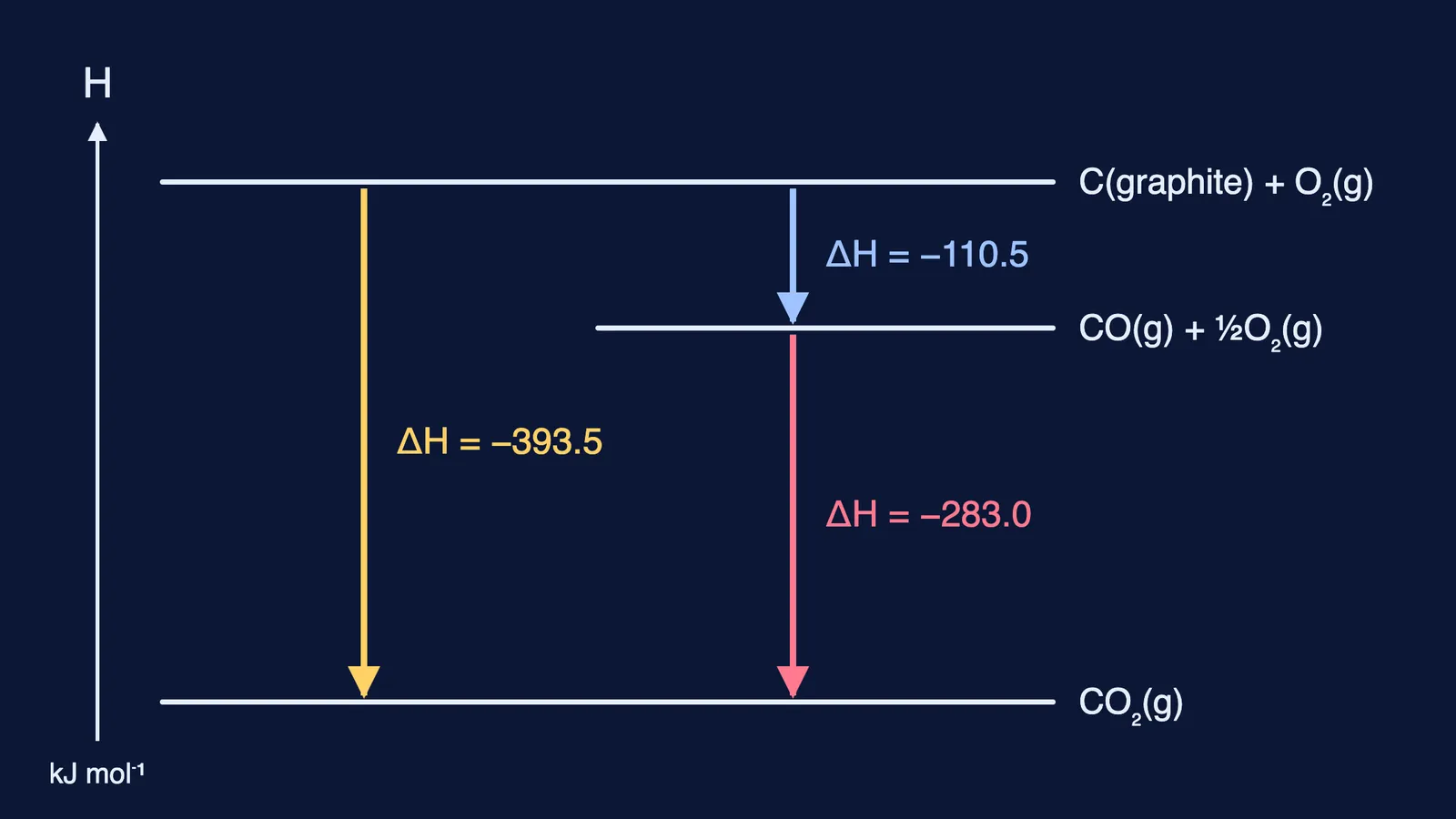
Hess's law: since enthalpy is a state function, a reaction's enthalpy change is the same in one step or several. Example: for C + ½O2 → CO, ∆H = −393.5 − (−283.0) = −110.5 kJ mol⁻¹.
Enthalpy of combustion (∆cH): enthalpy change when one mole of a substance burns completely. Example: butane, −2658 kJ mol⁻¹.
Enthalpy of atomization (∆aH): enthalpy change for breaking one mole of a substance fully into gaseous atoms. Example: CH4, 1665 kJ mol⁻¹.
Bond dissociation enthalpy: enthalpy change for breaking one mole of a particular bond in gaseous molecules. Don't confuse with: mean bond enthalpy, the average over identical bonds; methane's four C-H bonds break at different enthalpies but average 416 kJ mol⁻¹.
Lattice enthalpy: enthalpy needed to pull one mole of an ionic solid fully apart into free gaseous ions; NaCl's is +788 kJ mol⁻¹. It is found indirectly with a Born-Haber cycle.
Enthalpy of solution: heat change per mole of substance dissolved in a stated quantity of solvent. Don't confuse with: enthalpy of dilution, the change when more solvent is added to a solution.
What decides whether a reaction is spontaneous?
Spontaneous process: one that can proceed on its own without outside help, possibly very slowly. Don't confuse with: a fast reaction; spontaneity says nothing about rate.
Entropy (S): a state function that measures disorder or randomness; for a given substance, the crystalline solid has the lowest and the gas the highest. For a reversible change, ∆S = qrev/T.
Second law of thermodynamics: in a spontaneous change the total entropy of system plus surroundings increases. Don't confuse with: the first law, which conserves energy but gives no direction.
Third law of thermodynamics: a pure, perfectly ordered crystal has zero entropy at absolute zero.
Gibbs energy (G): G = H − TS, so at constant temperature ∆G = ∆H − T∆S. At constant temperature and pressure, negative ∆G means spontaneous and positive means non-spontaneous.
Gibbs energy and equilibrium: at equilibrium ∆rG = 0, while the standard value is fixed by the equilibrium constant, ∆rG⦵ = −RT ln K.
How to learn these terms
Draw open, closed and isolated boxes with arrows for heat and matter.
Sort every symbol into state functions (U, H, S, G) and path functions (q, w).
For each named enthalpy, write its one-mole defining equation, like the CO example.
Make a four-row table of ∆H and ∆S signs and say when ∆G is negative, then practise with our Thermodynamics Class 11 chemistry formulas and case study questions.
If a term still feels abstract, the Fermi Concept Library covers every concept in chemistry, each with its own lesson and its place in the map.