On this page
Three original thermodynamics cases for CBSE Class 11 Chemistry, easiest first, each with four parts of rising difficulty and worked answers.
What are thermodynamics case-study questions in Class 11?
Class 11 exams are set by your school, not the board, so treat these as practice in the case-based style: a short real-world passage, then linked questions. Every idea comes from Unit 5 of NCERT Class 11 Chemistry (Reprint 2026-27), which is Unit 5, Chemical Thermodynamics, in the CBSE 2026-27 Chemistry curriculum. Scenarios and numbers are ours. Use R = 8.314 J K⁻¹ mol⁻¹, C = 12, H = 1, N = 14 and O = 16.
Case 1: Why does the cold pack feel cold?
For her Jaipur school's sports day, Kavya wants a pack that turns cold the moment it is squeezed, so she tests ammonium nitrate. In a coffee-cup calorimeter open to the air, she dissolves 8.00 g of NH₄NO₃ in 100 g of water. Within a minute the thermometer falls from 25.0 °C to 19.2 °C and the crystals vanish without heating. Her teacher tells her to treat the solution as 108 g with a specific heat of 4.2 J g⁻¹ K⁻¹ and to ignore the cup.
(i) The heat change measured in this open cup is equal to: (a) ∆U (b) ∆H (c) ∆G (d) T∆S
(ii) Is dissolving NH₄NO₃ endothermic or exothermic? Using ∆solH = ∆latticeH + ∆hydH, what does this tell you about the two terms?
(iii) The salt dissolves on its own even though it absorbs heat. What must be the sign of ∆S, and why?
(iv) Calculate the enthalpy of solution of NH₄NO₃ in kJ mol⁻¹.
Answers.
(i) (b). The cup is at constant pressure, and heat absorbed at constant pressure, qp, equals ∆H.
(ii) Endothermic: the solution cooled, giving heat to the salt. A positive ∆solH means the lattice enthalpy (positive) outweighs the hydration enthalpy (negative).
(iii) Positive. The ions leave their ordered lattice and move more freely in solution, so T∆S is larger than ∆H and ∆G = ∆H − T∆S is negative.
(iv) q(solution) = 108 × 4.2 × (19.2 − 25.0) = −2,631 J, so the dissolving salt absorbed +2,631 J. Moles = 8.00 ÷ 80 = 0.100 mol. ∆solH = +2.631 kJ ÷ 0.100 mol = +26.3 kJ mol⁻¹.
Case 2: How much energy is in the fuel sample?
A refinery quality lab must confirm the energy content of every fuel batch before dispatch. A technician burns 0.570 g of a sample, treated as pure octane, C₈H₁₈(l), in excess oxygen inside a sealed steel bomb calorimeter. The water around the bomb warms from 298.00 K to 300.77 K, and the calorimeter's heat capacity is 9.85 kJ K⁻¹. The combustion is C₈H₁₈(l) + 25/2 O₂(g) → 8CO₂(g) + 9H₂O(l). The lab manager also wants the value at constant pressure, as on the batch sheet.
(i) A bomb calorimeter measures: (a) ∆H (b) ∆U (c) ∆G (d) ∆S
(ii) Why is no work done in the bomb, even though gases are consumed and formed?
(iii) Calculate ∆cU of octane in kJ mol⁻¹.
(iv) Find ∆cH at 298 K, and say why it is more negative than ∆cU.
Answers.
(i) (b). The reaction runs at constant volume, so ∆U = qV.
(ii) The sealed bomb keeps ∆V = 0, so w = −pex∆V = 0.
(iii) Calorimeter gains 9.85 × 2.77 = 27.28 kJ, which the reaction lost. Moles of octane = 0.570 ÷ 114 = 5.00 × 10⁻³ mol. ∆cU = −27.28 ÷ 0.00500 = −5,457 kJ mol⁻¹.
(iv) ∆ng = 8 − 12.5 = −4.5 (water is liquid). ∆H = ∆U + ∆ngRT = −5,457 + (−4.5 × 8.314 × 298 ÷ 1000) = −5,457 − 11.1 = −5,468 kJ mol⁻¹. Gas moles fall, so ∆ngRT is negative.
Case 3: When does magnesium carbonate break down?
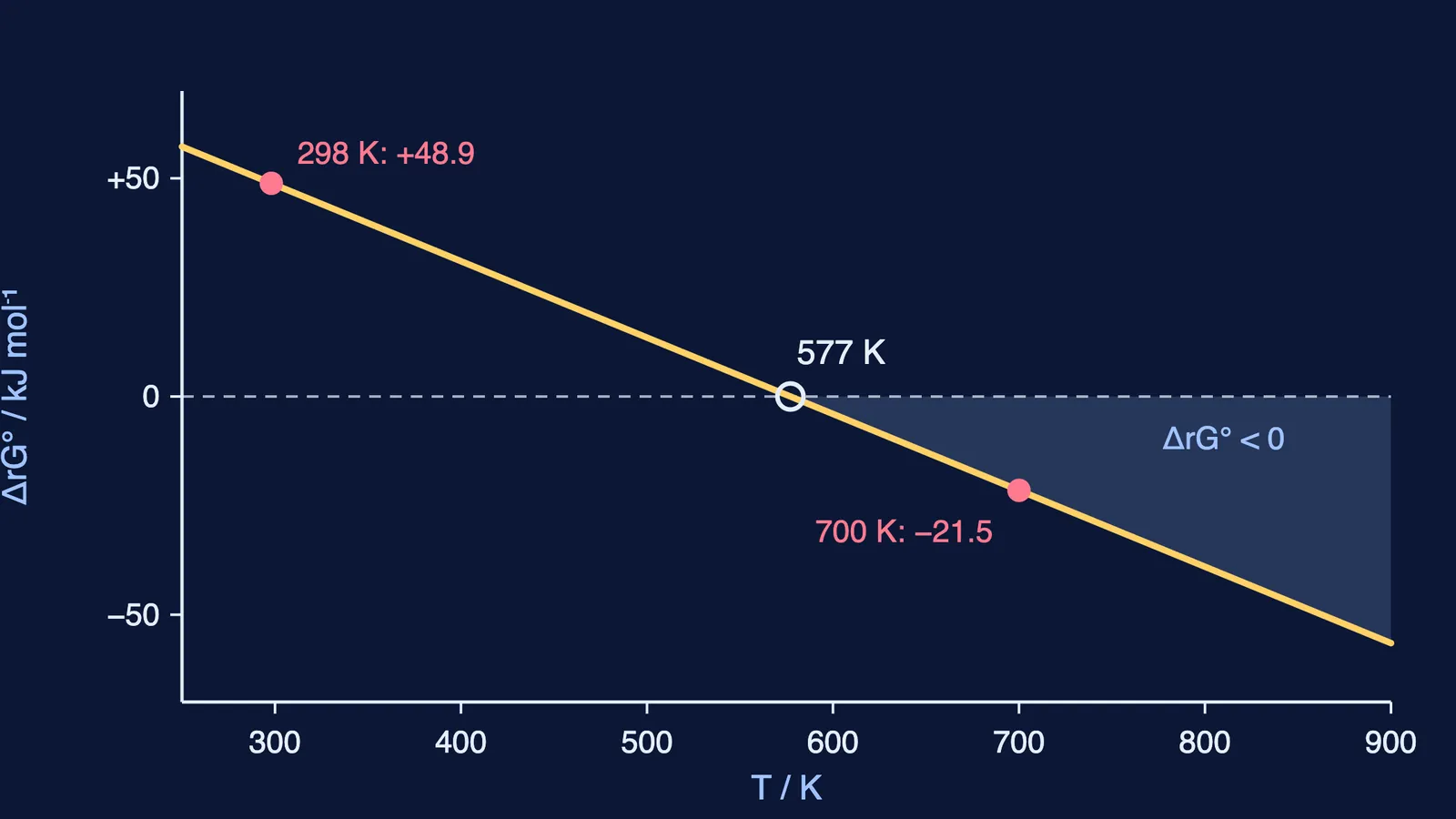
A refractory-brick unit calcines magnesium carbonate to magnesium oxide: MgCO₃(s) → MgO(s) + CO₂(g). For this case, the plant engineer uses ∆rH° = +101 kJ mol⁻¹ and ∆rS° = +175 J K⁻¹ mol⁻¹, and assumes both stay the same at all temperatures. Bags of carbonate sit unchanged in the 298 K store for months, yet the kiln is held at 700 K and burns a lot of costly fuel. A trainee asks whether the kiln could safely run much cooler.
(i) With ∆H positive and ∆S positive, the reaction is spontaneous: (a) at all temperatures (b) only at high temperature (c) only at low temperature (d) at no temperature
(ii) Why is ∆rS° positive for this reaction?
(iii) Calculate ∆rG° at 298 K and the temperature above which the reaction becomes spontaneous.
(iv) Calculate ∆rG° and K at 700 K, and say what K tells you.
Answers.
(i) (b). As in NCERT's Table 5.4, T∆S outweighs ∆H only at high temperature.
(ii) A solid gives another solid plus a gas, and the gaseous state has the highest entropy.
(iii) ∆rG° = 101 − 298 × 0.175 = +48.9 kJ mol⁻¹, so stored carbonate is stable. ∆rG° = 0 at T = 101 ÷ 0.175 = 577 K; above this the reaction is spontaneous.
(iv) ∆rG° = 101 − 700 × 0.175 = −21.5 kJ mol⁻¹. From ∆rG° = −RT ln K, ln K = 21,500 ÷ (8.314 × 700) = 3.69, so K ≈ 40. K is well above 1, so products are favoured at equilibrium.
How to attack case-study questions
Name the condition first. Open cup: constant pressure, ∆H. Sealed bomb: constant volume, ∆U.
Write the sign of q from the system's view. If the water warms, the reaction lost heat and q is negative.
Count only gas moles for ∆ng. Liquid water does not count.
Match units before any formula. Keep ∆S in kJ K⁻¹ mol⁻¹ with ∆H in kJ mol⁻¹, but R in J for ln K.
End with meaning. Say whether the reaction is spontaneous or K favours products.
If a numerical goes wrong, the Fermi Problem Library has worked problems with a step-by-step solver that explains the reasoning rather than printing an answer. For the full chapter, read our Thermodynamics Class 11 chemistry guide, then see how to answer case-based questions and try the chemical thermodynamics assertion-reason questions.