On this page
Here are six assertion-reason items and four Statement I / Statement II pairs, from easy to hard. Every statement was checked against Unit 5 of NCERT Class 11 Chemistry (reprint 2026-27). The NMC NEET (UG)-2026 syllabus lists it as Unit 4 of Physical Chemistry.
How do you answer assertion-reason questions on chemical thermodynamics?
Assertion-reason:
(A) Both A and R are true and R is the correct explanation of A.
(B) Both A and R are true but R is NOT the correct explanation of A.
(C) A is true but R is false.
(D) A is false but R is true.
Statement pairs:
(A) Both statements are correct.
(B) Both statements are incorrect.
(C) Statement I is correct, Statement II is incorrect.
(D) Statement I is incorrect, Statement II is correct.
Judge A alone, then R alone; only if both are true, ask whether R is the reason NCERT gives for A. Most false lines here swap close symbols: q for ΔH, ΔG for ΔG°, or drop the sign of Δng.
Assertion-reason questions on chemical thermodynamics
Every statement below follows NCERT Unit 5.
Q1 (easy). Assertion (A): For an isolated system, ΔU = 0. Reason (R): An isolated system exchanges neither energy nor matter with its surroundings.
Answer: (A). Both are true. With no exchange, q = 0 and w = 0, so ΔU = q + w = 0. Trap: confusing isolated with closed.
Q2 (easy). Assertion (A): The standard enthalpy of formation of O3(g) is zero. Reason (R): The standard enthalpy of formation of an element in its reference state is taken as zero.
Answer: (D). R is the convention. A is false because NCERT names O2(g) as the reference state of oxygen, so ozone is not in its reference state and its ΔfH° is not zero. Trap: "it is an element, so it is zero".
Q3 (easy). Assertion (A): ΔH for C(graphite) + O2(g) → CO2(g) is the same whether carbon burns straight to CO2 or first to CO and then to CO2. Reason (R): The heat q absorbed by a system is a state function.
Answer: (C). A is Hess's law, since enthalpy is a state function. R is false: NCERT calls q path dependent; only at constant pressure does qp equal ΔH and become path independent. Trap: equating q with ΔH.
Q4 (medium). Assertion (A): No work is done when an ideal gas expands isothermally into a vacuum. Reason (R): Joule found experimentally that no heat is absorbed in this expansion.
Answer: (B). Both are true. Work is zero because w = –pex ΔV and pex = 0; q = 0 is a separate experimental finding. Trap: chaining "no heat, so no work".
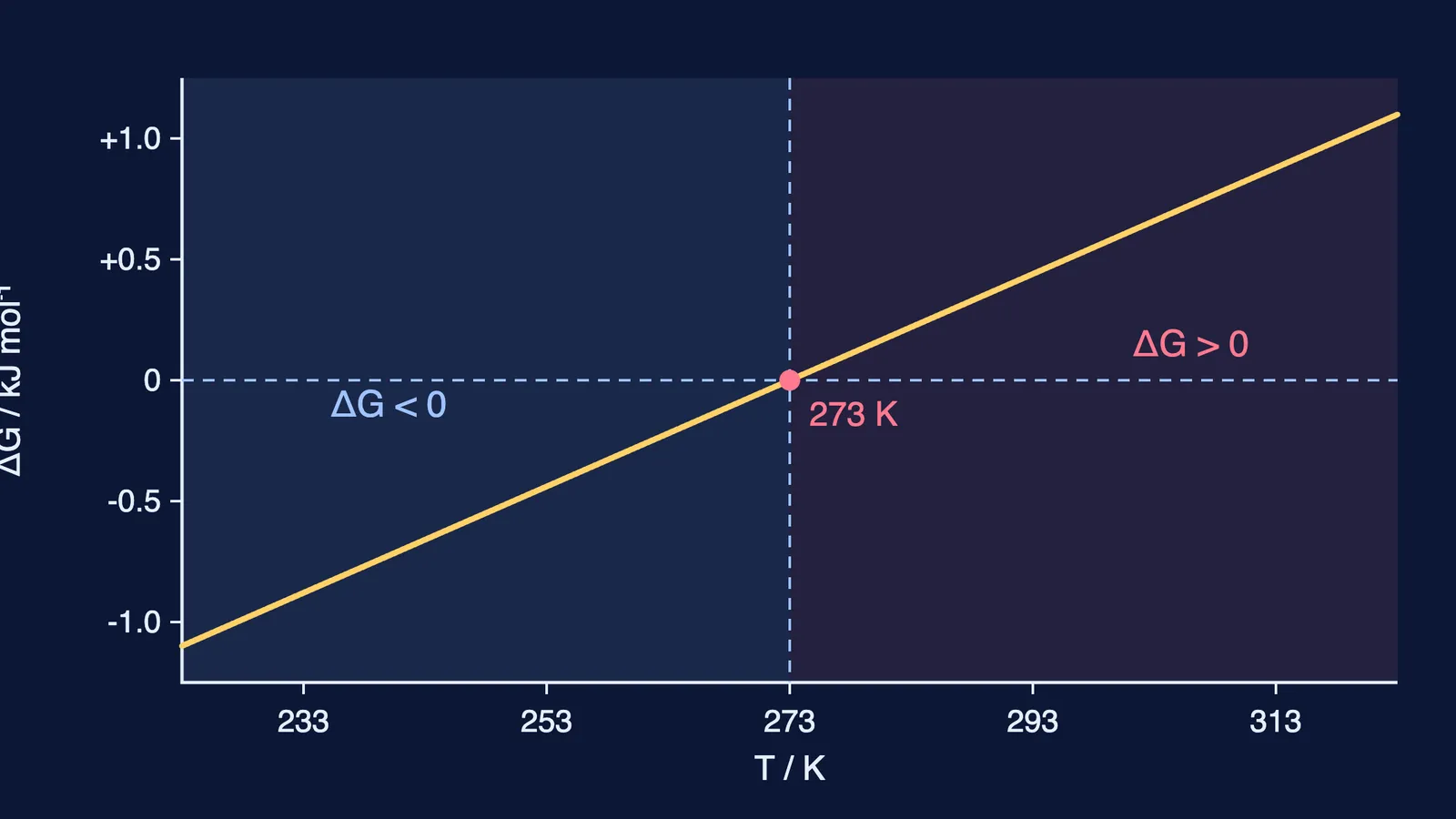
Q5 (medium). Assertion (A): At 1 bar, freezing of liquid water is spontaneous at every temperature. Reason (R): For H2O(l) → H2O(s), both ΔH and ΔS are negative.
Answer: (D). R is true: freezing releases 6.00 kJ mol⁻¹ (the reverse of NCERT's ΔfusH), so ΔS ≈ –6000/273 ≈ –22.0 J K⁻¹ mol⁻¹. With both negative, ΔG = ΔH – TΔS is negative only at low temperature, and it turns positive above 273 K. Trap: "exothermic means spontaneous".
Q6 (hard). Assertion (A): For a reaction mixture at equilibrium at constant T and p, ΔrG = 0. Reason (R): ΔrG° is the Gibbs energy change when all reactants and products are in their standard states.
Answer: (B). Both are true. A holds because Gibbs energy is at its minimum at equilibrium. R only defines ΔrG°, which is usually not zero at equilibrium (ΔrG° = –RT ln K), so it does not explain A. Trap: treating ΔrG and ΔrG° as one quantity.
Statement I and Statement II questions on chemical thermodynamics
These also rest on NCERT Unit 5, with R = 8.314 J K⁻¹ mol⁻¹.
Q7 (medium). Statement I: q and w depend on the path, but q + w for a given change of state does not. Statement II: For one mole of an ideal gas, Cp – Cv = R.
Answer: (A). Both are correct: q + w = ΔU, a state function, and NCERT derives Cp – Cv = R from ΔH = ΔU + RΔT. Trap: assuming a sum of path functions must depend on the path.
Q8 (medium). Statement I: For a reaction in which Δng = 0, ΔH = ΔU. Statement II: For N2(g) + 3H2(g) → 2NH3(g) at 298 K, ΔH is greater than ΔU.
Answer: (C). From ΔH = ΔU + ΔngRT, I is correct. Here Δng = 2 – 4 = –2, so ΔH – ΔU = –2RT ≈ –4.96 kJ mol⁻¹: ΔH is smaller than ΔU, and II is wrong. Trap: dropping the sign of Δng.
Q9 (hard). Statement I: An exothermic reaction has a negative ΔG at every temperature. Statement II: A reaction with K < 1 has a negative ΔrG°.
Answer: (B). I is wrong: if ΔS is also negative, NCERT's Table 5.4 makes it non-spontaneous at high temperature (as in Q5). II is wrong: ln K < 0 when K < 1, so ΔrG° = –RT ln K is positive. Trap: "some product forms, so ΔrG° is negative".
Q10 (hard). Statement I: In an adiabatic process, ΔU = 0. Statement II: When 1 mol of an ideal gas expands isothermally and reversibly from 10 L to 20 L at 300 K, it absorbs about 1.73 kJ of heat.
Answer: (D). I is wrong: adiabatic means q = 0, so ΔU = wad, not zero. II is right: q = –w = nRT ln(Vf/Vi) = 1 × 8.314 × 300 × ln 2 ≈ 1,729 J. Trap: swapping "q = 0" (adiabatic) with "ΔU = 0" (isothermal ideal gas).
How should you use this set?
Cover the answers; mark each statement T or F first.
For every both-true item, say why A happens, then check whether R is that cause or just a nearby fact.
Redo Q5 and Q8 a week later with a new temperature or a different Δng.
For the chapter plan, read our Chemical Thermodynamics for NEET guide and the numerical chemical thermodynamics NEET practice questions, plus our general assertion-reason strategy. If the link between ΔH, ΔS and temperature still feels abstract, the Fermi Concept Library gives every chemistry concept its own lesson and its place in the map.