On this page
This sheet follows Unit 5, Thermodynamics, of the NCERT Class 11 Chemistry Part I textbook (Reprint 2026-27). Signs follow the IUPAC convention used by NCERT: q is positive for heat absorbed by the system, w is positive for work done on it. R = 8.314 J K⁻¹ mol⁻¹.
The CBSE Chemistry curriculum for 2026-27 lists thermodynamic terms, calorimetry, reaction enthalpy, spontaneity, and Gibbs energy and equilibrium. Adiabatic pV^γ relations are not in this chapter; they sit in our Class 11 physics thermodynamics formulas, which also use the opposite sign for work. For Hess cycles and practice, see our Thermodynamics Class 11 chemistry guide.
What are the first-law and work formulas?
Symbols: U internal energy, q heat, w work (J); pex external pressure (Pa); V volume (m³); n moles; T temperature (K).
First law: ∆U = q + w (J).
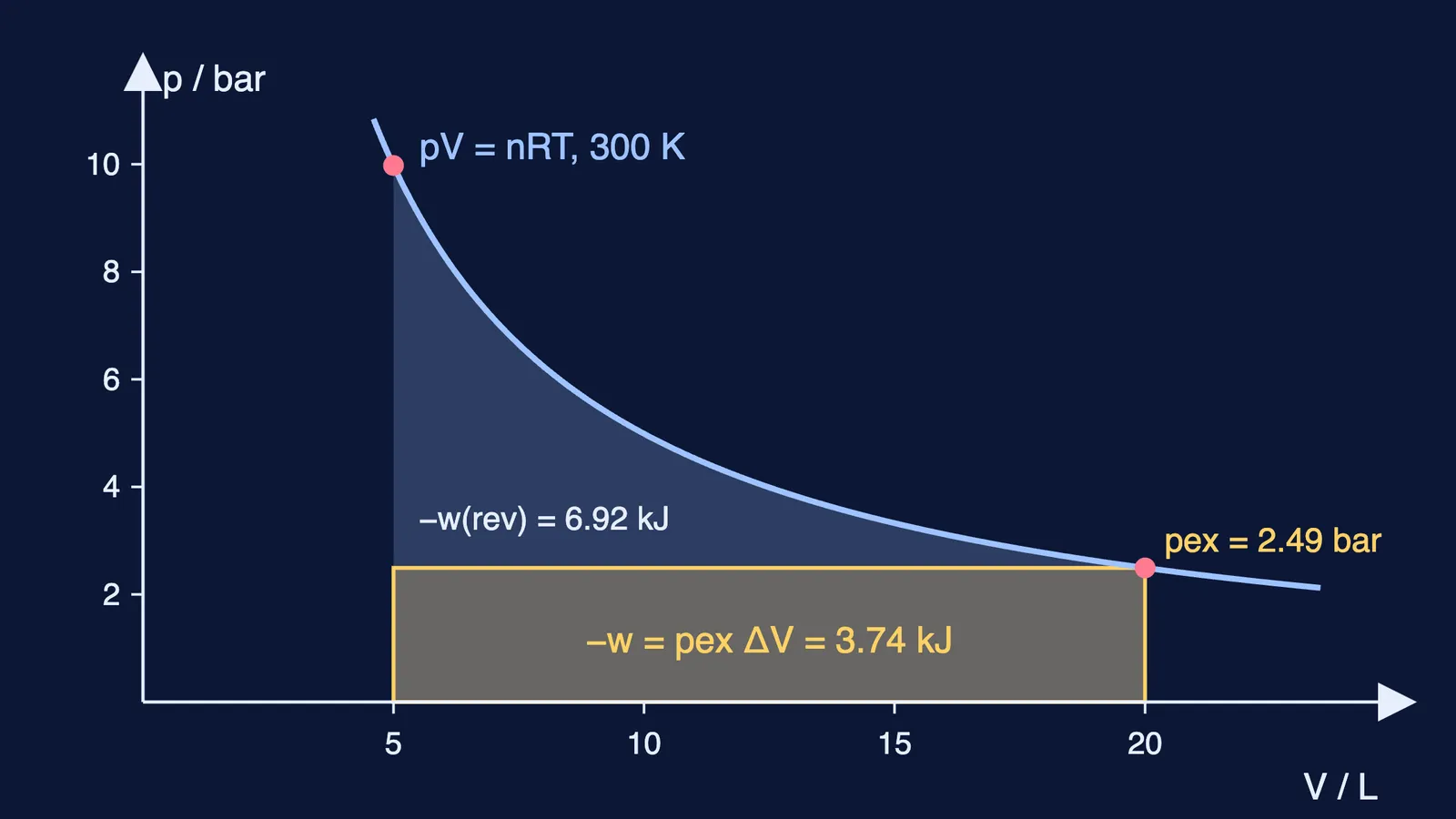
Against constant pex: w = −pex∆V = −pex(Vf − Vi) (J). Free expansion (pex = 0): w = 0.
Reversible isothermal, ideal gas: w = −nRT ln(Vf/Vi) = −2.303 nRT log(Vf/Vi) (J).
Isothermal, ideal gas: ∆U = 0, so q = −w (J). Constant volume: ∆U = qV (J). Adiabatic: ∆U = wad (J).
Worked example: 2.0 mol of ideal gas at 300 K expands from 5.0 L to 20.0 L. Reversibly, w = −2.303 × 2.0 × 8.314 × 300 × log 4 = −6.92 kJ and q = +6.92 kJ. In one step against pex = 2.49 bar, w = −(2.49 × 10⁵ Pa)(0.0150 m³) = −3.74 kJ.
Watch for: convert L to m³ and bar to Pa (1 L bar = 100 J). Expansion makes w negative.
Enthalpy, heat capacity and calorimetry formulas
Symbols: H enthalpy (J); ∆ng gaseous product moles minus gaseous reactant moles; c specific heat (J g⁻¹ K⁻¹); m mass (g); C heat capacity (J K⁻¹); Cp, CV heat capacities at constant pressure and constant volume (J K⁻¹; molar values in J K⁻¹ mol⁻¹).
H = U + pV; at constant pressure ∆H = ∆U + p∆V = qp (J).
Reactions involving gases (ideal gases): ∆H = ∆U + ∆ngRT (J mol⁻¹, per mole of reaction as written).
Temperature change: q = c × m × ∆T = C∆T (J).
qV = CV∆T = ∆U and qp = Cp∆T = ∆H (J).
One mole of ideal gas, molar heat capacities: Cp − CV = R (J K⁻¹ mol⁻¹).
Bomb calorimeter (constant volume): q(reaction) = −Ccal∆T = ∆U (J).
Worked example: 0.921 g of ethanol (M = 46.07 g mol⁻¹) burns in a bomb calorimeter (Ccal = 9.50 kJ K⁻¹), raising its temperature 2.88 K. The calorimeter absorbs 9.50 × 2.88 = 27.36 kJ from 0.01999 mol: ∆cU = −1368.6 kJ mol⁻¹. For C2H5OH(l) + 3O2(g) → 2CO2(g) + 3H2O(l), ∆ng = 2 − 3 = −1, so at 298 K ∆cH = −1368.6 + (−1)(2.48) = −1371.1 kJ mol⁻¹.
Watch for: count gases only in ∆ng, and convert RT to kJ (8.314 × 298 J = 2.48 kJ).
How do you calculate reaction enthalpy from data?
Symbols: ai, bi coefficients of products and reactants; ∆fH° standard enthalpy of formation (kJ mol⁻¹); ° means standard state, 1 bar.
∆rH° = Σ ai ∆fH°(products) − Σ bi ∆fH°(reactants) (kJ mol⁻¹). ∆fH° of an element in its reference state is zero.
Hess's law: ∆rH = ∆rH1 + ∆rH2 + ∆rH3 + … (kJ mol⁻¹) for steps that add up to the reaction. Reversing a step flips its sign.
Gas-phase reactions only, approximate: ∆rH° = Σ bond enthalpies(reactants) − Σ bond enthalpies(products) (kJ mol⁻¹).
Mean C–H bond enthalpy: ∆C–HH = ¼ ∆aH(CH4) (kJ mol⁻¹).
Ionic solid dissolving: ∆solH° = ∆latticeH° + ∆hydH° (kJ mol⁻¹), with ∆latticeH° from a Born-Haber cycle.
Worked example: C2H4(g) + H2(g) → C2H6(g) with NCERT's Table 5.3 mean bond enthalpies (C=C 611, H–H 435.8, C–C 347, C–H 414 kJ mol⁻¹). Bonds broken: 611 + 435.8 + 4(414). Bonds formed: 347 + 6(414). ∆rH° = 1046.8 − 1175 = −128.2 kJ mol⁻¹.
Watch for: with a liquid product, use formation data, not bond enthalpies.
When is a reaction spontaneous: entropy and Gibbs energy?
Symbols: S entropy (J K⁻¹ mol⁻¹); G Gibbs energy (J mol⁻¹); qrev heat absorbed reversibly (J mol⁻¹).
∆S = qrev/T (J K⁻¹ mol⁻¹).
Spontaneous process: ∆Stotal = ∆Ssys + ∆Ssurr > 0, with ∆Ssurr = −∆Hsys/T (J K⁻¹ mol⁻¹).
G = H − TS; at constant T and p, ∆G = ∆H − T∆S (J mol⁻¹).
∆G < 0 spontaneous; ∆G > 0 non-spontaneous; ∆G = 0 at equilibrium (constant T and p).
If ∆H and ∆S share a sign, ∆G changes sign at T = ∆H/∆S (K), taking ∆H and ∆S as constant with temperature.
Third law: S → 0 for a pure crystalline solid as T → 0 K.
Worked example: ice melts at 273.15 K with ∆fusH = 6.00 kJ mol⁻¹ (NCERT's value), so ∆fusS = 6000/273.15 = 21.97 J K⁻¹ mol⁻¹. At 263.15 K, with ∆H and ∆S constant, ∆G = 6000 − 263.15 × (6000/273.15) = +220 J mol⁻¹ (no melting); at 283.15 K, ∆G = −220 J mol⁻¹ (melts).
Watch for: convert ∆H (kJ) and ∆S (J K⁻¹) to the same energy unit first.
How is Gibbs energy linked to the equilibrium constant?
Symbols: ∆rG° standard Gibbs energy of reaction (J mol⁻¹); K equilibrium constant.
∆rG° = −RT ln K = −2.303 RT log K (J mol⁻¹).
∆rG° = ∆rH° − T∆rS° = −RT ln K (J mol⁻¹).
∆rG° < 0 gives K > 1; ∆rG° > 0 gives K < 1.
Worked example: a reaction at 298 K has ∆rH° = −50.0 kJ mol⁻¹ and ∆rS° = −80.0 J K⁻¹ mol⁻¹. ∆rG° = −50 000 − 298(−80.0) = −26 160 J mol⁻¹. log K = 26 160/(2.303 × 8.314 × 298) = 4.585, so K ≈ 3.8 × 10⁴.
Watch for: with R = 8.314, ∆rG° must be in J mol⁻¹; use 2.303 only with log.
The Fermi Problem Library has worked problems with a step-by-step solver that explains the reasoning rather than printing an answer.
How to revise this formula sheet
Write ∆U = q + w beside the sign rule: heat in +, work on the system +.
Redo the ethanol example for propane gas, where ∆ng changes, and compare ∆H with ∆U.
Test the ∆H and ∆S sign cases in NCERT Table 5.4, then try our Class 11 thermodynamics case study questions.