On this page
This sheet covers two chapters of NCERT Class 11 Physics, both marked Reprint 2026-27: Thermal Properties of Matter and Thermodynamics, matched against the CBSE 2026-27 Physics syllabus. Section 11.11, the Carnot engine, is not in the CBSE 2026-27 syllabus, so it is left out. For the ideas behind each line, read our Thermodynamics Class 11 physics guide and the Thermal Properties of Matter Class 11 guide.
Temperature scales and thermal expansion formulas
Scales: t_F = (9/5) t_C + 32 (°F, °C); T = t_C + 273.15 (K).
Linear expansion: ΔL = α_l L ΔT, so L₂ = L₁[1 + α_l(T₂ − T₁)]. L in m, ΔT in K, α_l in K⁻¹.
Area expansion: ΔA = 2α_l A ΔT (m²), since α_l ΔT is tiny next to 2.
Volume expansion: ΔV = α_v V ΔT (m³), with α_v = 3α_l (K⁻¹).
Ideal gas at constant pressure: α_v = 1/T (K⁻¹).
Thermal stress in a rod between rigid supports: Y α_l ΔT (N m⁻²), Y being Young's modulus.
Worked example. An aluminium rod (α_l = 2.5 × 10⁻⁵ K⁻¹, NCERT Table 10.1) is 1.20 m long at 25 °C. At 85 °C, ΔL = 1.20 × 2.5 × 10⁻⁵ × 60 = 1.8 × 10⁻³ m, or 1.8 mm; 85 °C is 185 °F or 358.15 K.
Watch for: water contracts on heating between 0 °C and 4 °C.
How do you calculate heat with specific heat and latent heat?
Heat capacity: S = ΔQ/ΔT (J K⁻¹).
Specific heat capacity: s = ΔQ/(m ΔT) (J kg⁻¹ K⁻¹), so Q = m s ΔT (J).
Molar specific heat capacity: C = ΔQ/(μ ΔT) (J mol⁻¹ K⁻¹), μ in mol. For a solid, C = 3R ≈ 24.9 J mol⁻¹ K⁻¹.
Latent heat: Q = mL (J), L in J kg⁻¹; temperature stays constant during the change.
Calorimetry, insulated system: heat lost by the hot body = heat gained by the cold body (J).
1 cal = 4.186 J; water has s = 4186 J kg⁻¹ K⁻¹.
Worked example. Drop 0.20 kg of ice at 0 °C into 0.50 kg of water at 40 °C. Melting all the ice needs 0.20 × 3.33 × 10⁵ = 66,600 J; cooling the water to 0 °C releases at most 83,720 J, so all of it melts. Then 0.50 × 4186 × (40 − T) = 66,600 + 0.20 × 4186 × T gives T ≈ 5.8 °C.
Watch for: assuming all the ice melts. Compare the two heats first.
What are the heat transfer formulas in Class 11?
Conduction, steady state: H = K A (T_C − T_D)/L. H in W, K in W m⁻¹ K⁻¹, A in m², L in m.
Wien's displacement law: λ_m T = 2.9 × 10⁻³ m K.
Stefan-Boltzmann law: H = e σ A T⁴ (W), σ = 5.67 × 10⁻⁸ W m⁻² K⁻⁴, emissivity e from 0 to 1 (e = 1 for a perfect radiator).
Net loss to surroundings at T_s: H = e σ A (T⁴ − T_s⁴) (W).
Newton's law of cooling, small temperature differences: −dQ/dt = k(T₂ − T₁) (W), body at T₂, surroundings at T₁, k in W K⁻¹.
Cooling curve: T₂ = T₁ + C′e^(−Kt), K = k/(m s) in s⁻¹.
Worked example. A glass pane (K = 0.8 W m⁻¹ K⁻¹, NCERT Table 10.6) of area 1.5 m² and thickness 5.0 mm sits between 22 °C and 12 °C. H = 0.8 × 1.5 × 10 / 0.005 = 2400 W.
Watch for: putting °C into T⁴. Radiation needs kelvin; conduction uses a difference, so either works.
First law of thermodynamics and specific heats of a gas
First law: ΔQ = ΔU + ΔW (J). ΔQ > 0 when heat enters the system; ΔW > 0 when the system does work.
Work for a small volume change: ΔW = P ΔV (J), P in Pa, ΔV in m³.
Ideal gas: PV = μRT, R = 8.31 J mol⁻¹ K⁻¹.
Molar heat capacities of an ideal gas: C_v = ΔU/ΔT per mole; C_p − C_v = R (J mol⁻¹ K⁻¹).
Ratio of specific heats: γ = C_p/C_v (no unit).
Worked example. A gas absorbs 800 J of heat and does 300 J of work on a piston, so ΔU = 800 − 300 = 500 J.
Watch for: a question that gives work done on the gas. Flip its sign before using ΔQ = ΔU + ΔW.
Which formulas apply to each thermodynamic process?
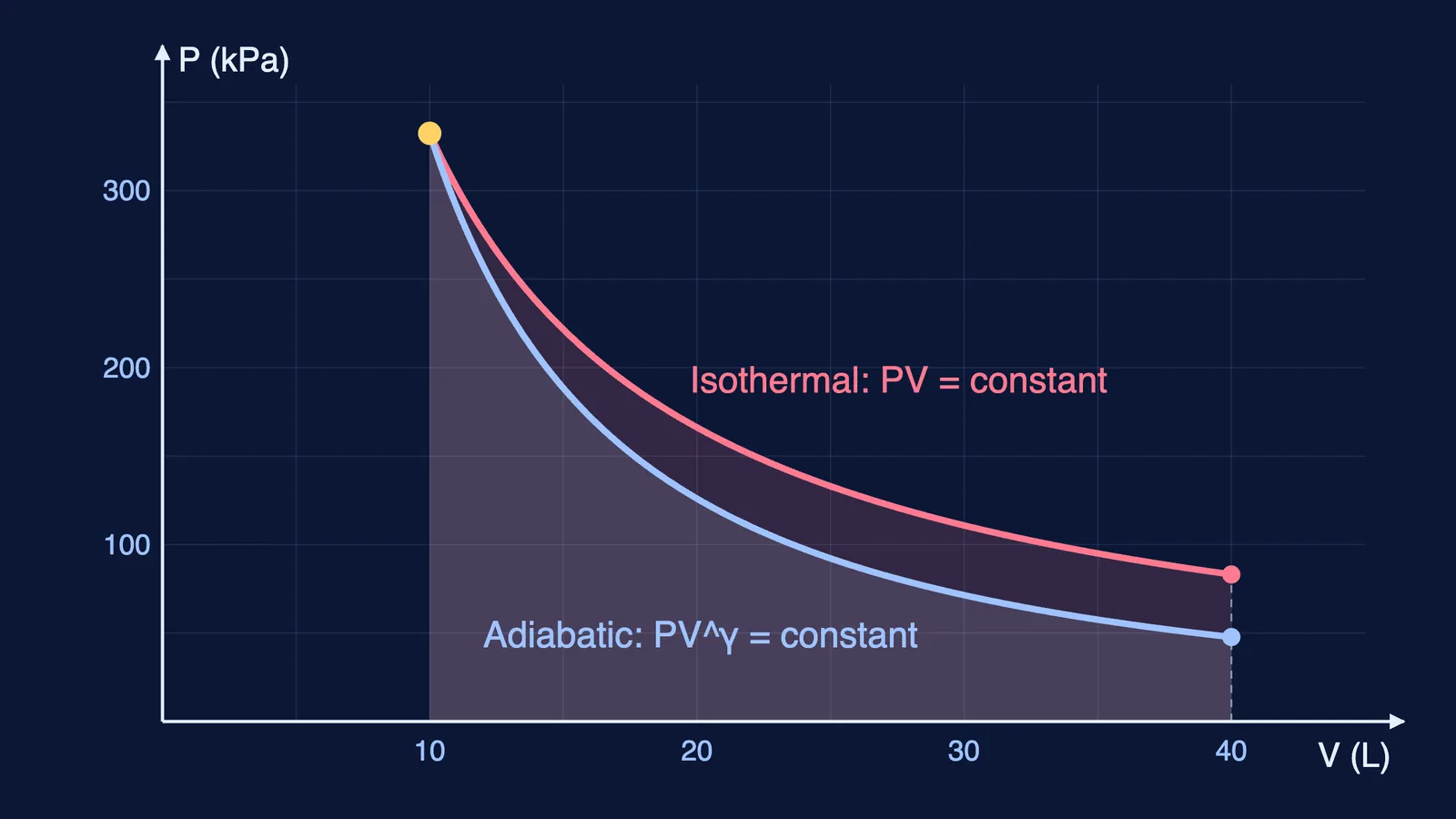
Isothermal, ideal gas: PV = constant; ΔU = 0; Q = W = μRT ln(V₂/V₁) (J).
Adiabatic (Q = 0), ideal gas: PV^γ = constant, TV^(γ−1) = constant; W = μR(T₁ − T₂)/(γ − 1) = (P₁V₁ − P₂V₂)/(γ − 1) (J).
Isochoric: W = 0, so ΔQ = ΔU (J).
Isobaric: W = P(V₂ − V₁) = μR(T₂ − T₁) (J).
Cyclic: ΔU = 0, so net heat absorbed = net work done (J).
Reversible process: quasi-static and non-dissipative.
Second law, Kelvin-Planck: no process can only absorb heat from a reservoir and turn all of it into work.
Second law, Clausius: no process can only move heat from a colder object to a hotter one.
Worked example. One mole of ideal gas at 300 K doubles its volume isothermally: W = 8.31 × 300 × ln 2 ≈ 1728 J, all absorbed as heat. Doubled adiabatically instead (γ = 1.4): T₂ = 300 × (1/2)^0.4 ≈ 227 K and W = 8.31 × (300 − 227.4)/0.4 ≈ 1509 J, drawn from internal energy.
Watch for: calling a slow process in a conducting cylinder adiabatic. That is isothermal.
How to revise this formula sheet
Sort formulas into those using a temperature difference (expansion, conduction, calorimetry) and those needing absolute T (gas law, adiabatic TV^(γ−1), Stefan, Wien).
For each process, write Q, W and ΔU for one mole of gas and check the first law balances.
Sketch an isotherm and an adiabat through one point on a P-V graph; the adiabat is steeper.
Trace the isothermal and adiabatic work back through our Thermodynamics Class 11 derivations.
If P-V diagrams are hard to picture, the Fermi Simulation Lab has interactive simulations for the ideas that are easier to see than to read.