On this page
Chapter 11 of the NCERT Class 11 Physics Part II textbook, 2026-27 reprint builds five results from the first law of thermodynamics: the first law for a gas at constant pressure, the relation Cp − Cv = R, and the work done by an ideal gas in isothermal, adiabatic and isobaric processes. Each comes with setup, steps, result and the usual slip. For first-law sign conventions, PV cycles and the rest of the chapter, read our Thermodynamics Class 11 physics guide.
The CBSE Class XI Physics syllabus for 2026-27 lists heat, work and internal energy, the first and second laws, state variables and the equation of state, and isothermal, adiabatic, reversible, irreversible and cyclic processes for this chapter.
First law at constant pressure: ΔQ = ΔU + PΔV
Setup: a gas in a cylinder closed by a frictionless piston of area A, pushing against a constant pressure P.
The gas pushes the piston with force F = PA.
If the piston moves out by a small distance Δx, the work done by the gas is ΔW = PA Δx.
A Δx is the change in volume ΔV, so ΔW = PΔV.
The first law says the heat supplied, ΔQ, goes into the change in internal energy ΔU plus the work done by the system: ΔQ = ΔU + ΔW.
Result: ΔQ = ΔU + PΔV.
NCERT's worked case: 1 g of water boiling at atmospheric pressure (1.013 × 10⁵ Pa) takes in 2256 J of latent heat, and its volume grows from 1 cm³ to 1671 cm³. The work is 1.013 × 10⁵ × 1670 × 10⁻⁶ ≈ 169.2 J, so ΔU = 2256 − 169.2 = 2086.8 J. About 7.5% of the heat becomes work; the rest becomes internal energy.
Where students slip: mixing sign conventions. In NCERT, ΔW is work done by the system, so it is positive when the gas expands.
How do you prove Cp − Cv = R for an ideal gas?
Setup: one mole of an ideal gas; Cv and Cp are the molar specific heats at constant volume and constant pressure.
Start from the first law for one mole: ΔQ = ΔU + PΔV.
At constant volume, ΔV = 0, so Cv = ΔQ/ΔT = ΔU/ΔT.
At constant pressure, Cp = ΔQ/ΔT = ΔU/ΔT + P(ΔV/ΔT).
The internal energy of an ideal gas depends only on T, so ΔU/ΔT is the same in steps 2 and 3. That term equals Cv.
From PV = RT at fixed P, a change ΔT gives PΔV = RΔT, so P(ΔV/ΔT) = R.
Substitute into step 3: Cp = Cv + R.
Result: Cp − Cv = R for an ideal gas.
Where students slip: skipping step 4. The proof only works because U of an ideal gas depends on temperature alone; say so in your answer.
Isothermal work: why is W = µRT ln(V2/V1)?
Setup: µ moles of an ideal gas expand slowly (quasi-statically) at fixed temperature T from (P1, V1) to (P2, V2).
For a small volume change dV, the work is dW = P dV.
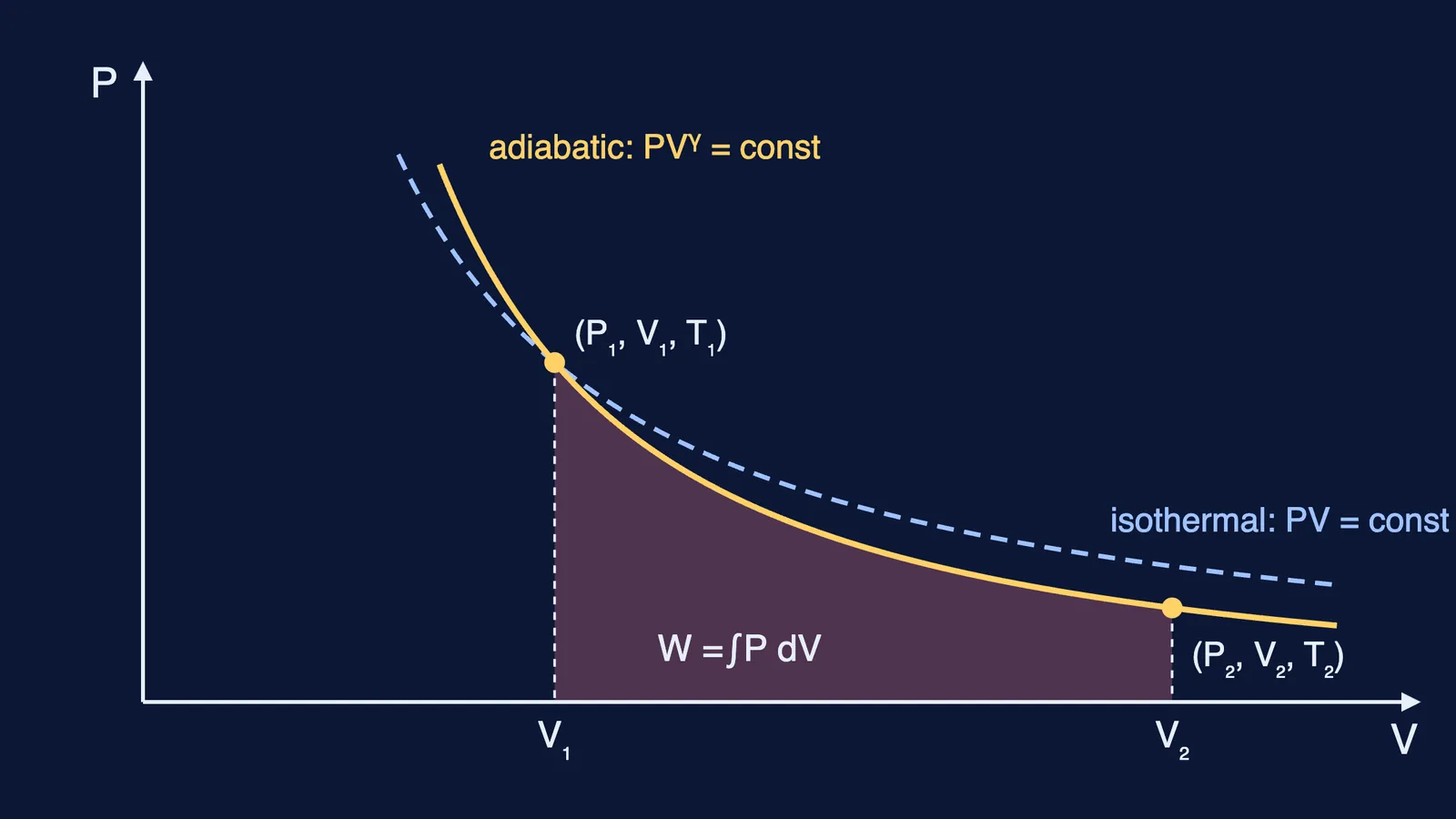
Add up all the small pieces: W = ∫ P dV from V1 to V2.
From PV = µRT, P = µRT/V at every stage.
µ, R and T are constant, so W = µRT ∫ dV/V from V1 to V2.
The integral of dV/V is ln V, giving µRT (ln V2 − ln V1).
Result: W = µRT ln(V2/V1). With T fixed, ΔU = 0, so heat absorbed Q = W.
Where students slip: writing log base 10 without the factor 2.303, or forgetting that W is negative when the gas is compressed (V2 < V1).
Adiabatic work: how do you get W = µR(T1 − T2)/(γ − 1)?
Setup: an ideal gas, insulated so no heat flows, goes from (P1, V1, T1) to (P2, V2, T2). NCERT states, and does not prove, that PVᵞ = K, a constant, where γ = Cp/Cv.
Write the pressure at any stage: P = K/Vᵞ.
W = ∫ P dV from V1 to V2 = K ∫ V⁻ᵞ dV.
Integrating: W = [K/(1 − γ)] (V2^(1−γ) − V1^(1−γ)).
Replace K by P2V2ᵞ in the first term and P1V1ᵞ in the second: K × V2^(1−γ) = P2V2 and K × V1^(1−γ) = P1V1.
So W = (P2V2 − P1V1)/(1 − γ).
Use PV = µRT at both ends and flip the sign of the denominator.
Result: W = µR(T1 − T2)/(γ − 1).
Expanding adiabatically (W > 0), the gas pays for the work from internal energy, so T2 < T1; compressed, it warms.
Where students slip: trying to prove PVᵞ = constant in an answer. NCERT states it without proof, so quote it and use it.
Isobaric work: W = µR(T2 − T1)
Setup: µ moles of an ideal gas at fixed pressure P go from (V1, T1) to (V2, T2).
P is constant, so W = ∫ P dV = P(V2 − V1).
From PV = µRT, PV2 = µRT2 and PV1 = µRT1.
Subtract: P(V2 − V1) = µR(T2 − T1).
Result: W = P(V2 − V1) = µR(T2 − T1).
NCERT adds two quick cases: isochoric, where W = 0, and cyclic, where ΔU = 0 so net heat equals net work.
Where students slip: assuming ΔU = 0 here. Here T changes, so U changes and only part of the heat appears as W.
How to practise derivations
Draw the P-V graph for every process before you write a line, and shade the area that W stands for.
Write the rule for P (µRT/V, K/Vᵞ or constant) as step one; it decides the whole integral.
Check your answer against the sign: expansion gives W > 0, compression gives W < 0, in each formula.
Derive Cp − Cv = R from memory twice a week, saying why ΔU/ΔT is the same at constant P and V.
Test yourself on the thermodynamics case study questions for Class 11. If isothermal and adiabatic curves are hard to picture, the Fermi Simulation Lab has interactive simulations for ideas that are easier to see than to read.