On this page
Here are eight slips to guard against in thermal properties. Each comes below with the wrong working, the physics, a fresh example and a habit.
Both the JEE (Main) syllabus from NTA and the NMC syllabus for NEET (UG)-2026 list thermal expansion, specific heat capacity, calorimetry, latent heat and conduction in Unit 7. All data below comes from NCERT Class 11 Physics, Chapter 10, Thermal Properties of Matter (Reprint 2026-27).
Why do thermal expansion answers come out wrong?
Using the linear coefficient for a volume change.
Wrong: a 500 cm³ copper block heated by 80 K expands by αl V ΔT = 1.7 × 10⁻⁵ × 500 × 80 = 0.68 cm³.
Why it fails: NCERT shows that αV = 3αl, and area expansion uses 2αl (NCERT section 10.5). Copper's αl is 1.7 × 10⁻⁵ K⁻¹ (NCERT Table 10.1).
Fix: ΔV = 3 × 1.7 × 10⁻⁵ × 500 × 80 = 2.04 cm³.
Habit: write l, A or V next to α, with its factor 1, 2 or 3.
Thinking a hole shrinks when the plate is heated.
Wrong: a 4.000 cm hole in a brass plate warmed by 150 K gets smaller.
Why it fails: every length in the plate scales by (1 + αl ΔT), including the hole's edge. The hole grows as if it were brass.
Fix: with brass αl = 1.8 × 10⁻⁵ K⁻¹ (Table 10.1), the diameter becomes 4.000 × (1 + 1.8 × 10⁻⁵ × 150) = 4.0108 cm.
Habit: picture an enlarged photo of the plate; nothing in it shrinks.
Making thermal stress depend on length.
Wrong: a clamped 20 m steel rail feels ten times the stress of a 2 m one.
Why it fails: a clamped rod's strain is αl ΔT, so its stress is Y αl ΔT (NCERT section 10.5). Length cancels.
Fix: using NCERT's steel values, Y = 2 × 10¹¹ N m⁻² and αl = 1.2 × 10⁻⁵ K⁻¹, a 25 K rise gives 6.0 × 10⁷ N m⁻² in both rails.
Habit: ask first whether the rod is free (ΔL needs L) or clamped (stress does not).
Which unit slips cost marks in thermal numericals?
Adding 273 to a temperature difference.
Wrong: a 1.5 m aluminium rod warms from 20 °C to 80 °C, so "ΔT = 333 K" and ΔL = 2.5 × 10⁻⁵ × 1.5 × 333 = 12.5 mm.
Why it fails: T = tC + 273.15 (NCERT section 10.4), so the 273.15 cancels in a difference. A change of 1 °C is a change of 1 K.
Fix: ΔT = 60 K, so ΔL = 2.5 × 10⁻⁵ × 1.5 × 60 = 2.25 mm.
Habit: mark each temperature as "Δ" or "T" before converting.
Mixing grams with per-kilogram data.
Wrong: melting 40 g of ice at 0 °C takes 40 × 3.33 × 10⁵ = 1.33 × 10⁷ J.
Why it fails: NCERT gives Lf = 3.33 × 10⁵ J kg⁻¹ and water's specific heat as 4186 J kg⁻¹ K⁻¹ (NCERT sections 10.6 and 10.8). Grams make the answer a thousand times too large.
Fix: to melt the ice and warm it to 25 °C, 0.040 × 3.33 × 10⁵ + 0.040 × 4186 × 25 = 13,320 + 4186 = 17,506 J.
Habit: convert every mass to kg on the first line.
Why does a calorimetry answer come out negative?
Assuming all the ice melts.
Wrong: 120 g of ice at 0 °C goes into 150 g of water at 30 °C. Solving 0.150 × 4186 × (30 − T) = 0.120 × 3.33 × 10⁵ + 0.120 × 4186 × T gives T ≈ −18.7 °C.
Why it fails: heat lost = heat gained applies to the process that actually happens (NCERT section 10.7), and this equation assumed liquid water below 0 °C.
Fix: cooling the water to 0 °C frees 0.150 × 4186 × 30 = 18,837 J, but melting all the ice needs 39,960 J. The mix stays at 0 °C; 18,837 / (3.33 × 10⁵) ≈ 0.057 kg melts, leaving about 63 g of ice.
Habit: check the 0 °C heat budget before writing any equation for T.
Ignoring the calorimeter.
Wrong: 80 g of metal at 90 °C goes into 200 g of water at 25 °C in a 250 g copper calorimeter, settling at 29 °C. Counting only water, s = 0.200 × 4186 × 4 / (0.080 × 61) ≈ 686 J kg⁻¹ K⁻¹.
Why it fails: the cup also warms by 4 K. Copper's specific heat is 386.4 J kg⁻¹ K⁻¹ (NCERT Table 10.3); our explainer on specific heat versus heat capacity shows why the cup's mass matters.
Fix: heat gained = (0.250 × 386.4 + 0.200 × 4186) × 4 = 3735 J, so s = 3735 / 4.88 ≈ 765 J kg⁻¹ K⁻¹.
Habit: one term for every object whose temperature changes.
How do you combine two slabs in conduction?
Averaging conductivities for layers in series.
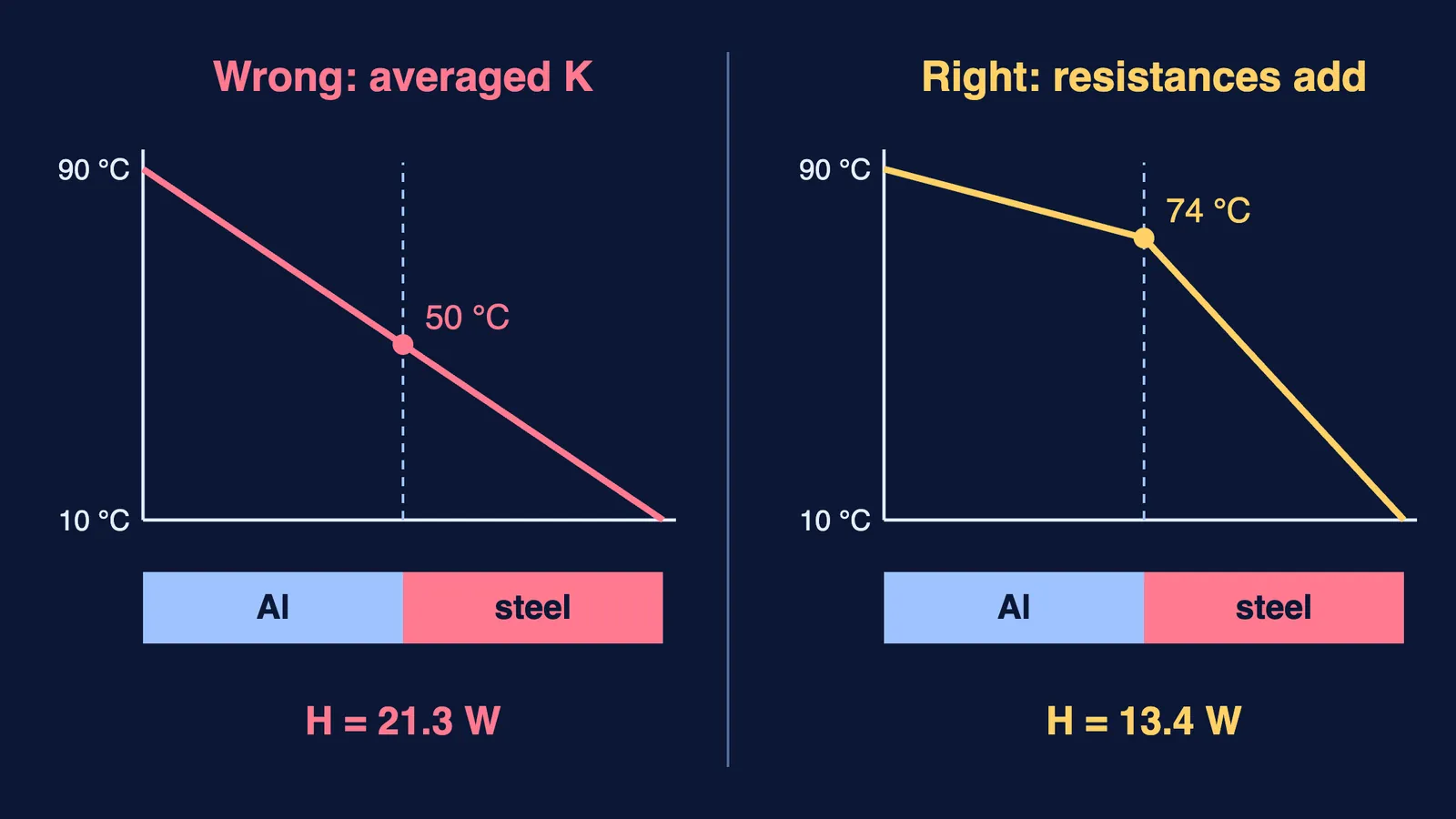
Wrong: aluminium and steel bars, each 12 cm long with 5 cm² cross-section, are joined end to end between 90 °C and 10 °C. Averaging K to about 128 W m⁻¹ K⁻¹ gives H ≈ 21.3 W.
Why it fails: in the steady state the same heat current crosses both bars, so their resistances L/(KA) add. For equal lengths NCERT gives K′ = 2K1K2/(K1 + K2) (NCERT section 10.9, Example 10.7); Table 10.6 gives 205 W m⁻¹ K⁻¹ for aluminium and 50.2 for steel.
Fix: K′ = 2 × 205 × 50.2 / 255.2 ≈ 80.7 W m⁻¹ K⁻¹, so H = 80.7 × 5 × 10⁻⁴ × 80 / 0.24 ≈ 13.4 W. The junction sits near 74 °C: the poor conductor takes most of the drop.
Habit: draw the bars as resistors; series adds L/(KA).
Stuck on why your answer is off by a factor you cannot find? The Fermi Problem Library has worked problems with a step-by-step solver that explains the reasoning rather than printing an answer.
A 60-second self-check before you mark
For the rest of the unit, see our Properties of Solids and Liquids guide for NEET or the Properties of Solids and Liquids guide for JEE Main.