On this page
The World of Numbers is Chapter 3 of Ganita Manjari Part I, the new NCERT Class 9 maths book first published in April 2026 (NCERT, Ganita Manjari prelims). It runs from counting to the real number line (NCERT, Chapter 3 PDF). Below, its key terms are grouped by topic, each with a plain definition, an example and, where students slip, a pair not to mix up. For the full chapter walkthrough, read our World of Numbers Class 9 chapter guide.
This chapter does not cover rationalising denominators or laws of exponents.
Counting, zero and integers
One-to-one correspondence: matching each object in one group with exactly one object in another. Example: one pebble in a pot for each cow that leaves to graze.
Natural numbers (N): the counting numbers 1, 2, 3, 4 and so on. Example: 7, but not 0 or −2.
Closure: a set is closed under an operation if combining any two members always gives a member. Example: natural numbers are closed under addition, but not under subtraction, since 3 − 5 = −2.
Śhūnya (zero): the result of subtracting a number from itself, a − a = 0, as Brahmagupta defined it in 628 CE, with rules such as a + 0 = a and a × 0 = 0 (NCERT, Chapter 3). Don't confuse with: a placeholder, which only marks an empty column.
Integers (Z): the natural numbers, zero and their negatives. Example: −3, 0, 12.
Dhana and ṛiṇa: Brahmagupta's names for fortunes (positive numbers) and debts (negative numbers). Example: the product of two debts is a fortune, so (−3) × (−4) = 12.
Additive inverse: the number that adds to a given number to make 0. Example: the additive inverse of 19 is −19.
What is a rational number in Class 9?
Rational number (Q): any number that can be written as p/q, where p and q are integers and q ≠ 0. Example: 5 = 5/1, −0.25 = −1/4. Counter-example: 3/0 is not allowed.
Negative fraction: the additive inverse of a positive fraction. Example: −1/5 = (−1)/5 = 1/(−5).
Equivalent rational numbers: different p/q forms of the same number; a/b equals c/d exactly when ad = bc. Example: 2/3 = 4/6 because 2 × 6 = 3 × 4.
Lowest terms (co-prime form): p/q where p and q share no common factor except 1. Example: 12/30 in lowest terms is 2/5.
Origin and unit interval: the point 0, and the gap between neighbouring integers. Example: to mark 3/4, split the unit interval from 0 to 1 into 4 equal parts and move 3 parts right.
Absolute value |x|: the distance of x from 0, so it is never negative. Example: |−5/3| = 5/3 and |0| = 0.
Distance between two numbers: |a − b|. Example: −4 and 3 are 7 apart.
Density of rational numbers: between any two rational numbers there is always another one. Example: the average of 1 and 3/2 is 5/4, which lies between them. Don't confuse with: "no gaps". Rationals are dense yet still miss points like √2.
Irrational and real numbers
Irrational number: a number on the number line that cannot be written as p/q. Example: √2, π.
Proof by contradiction: assume the opposite, then show it leads to something impossible. Example: assuming √2 = p/q in lowest terms forces p and q both to be even, which breaks "lowest terms".
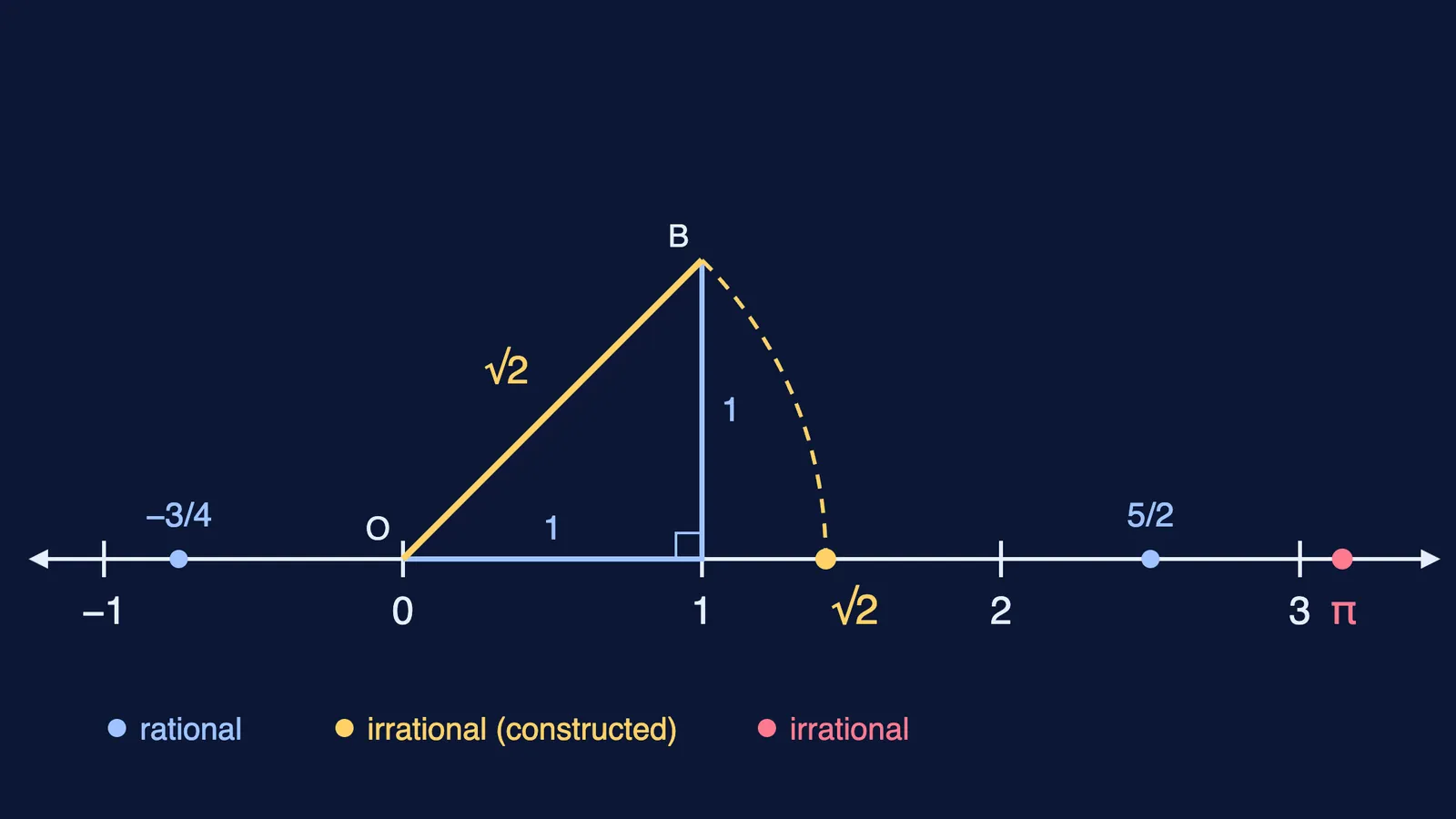
Constructing √2: draw a 1-unit perpendicular at 1 on the number line, join its top to 0 (that side is √2), then swing an arc centred at 0 down to the line, as in the image above.
Square root spiral: a chain of right triangles, each adding a 1-unit side, with hypotenuses √2, √3, √4 and so on; it is listed in CBSE's 2026-27 key concepts for the unit (CBSE Class IX Mathematics curriculum 2026-27).
π (pi): the ratio of a circle's circumference to its diameter; Johann Lambert proved it irrational in 1761 (NCERT, Chapter 3). Don't confuse with: 22/7 or Āryabhaṭa's 3927/1250 = 3.1416, which are only approximations (āsanna).
Infinite series: a never-ending sum whose value is what the running total approaches. Example: Mādhava's series π = 4 × (1 − 1/3 + 1/5 − 1/7 + …).
Real numbers (R): all rational and irrational numbers together, filling the number line.
How do you tell a rational decimal from an irrational one?
Terminating decimal: a decimal that stops. In lowest terms, p/q terminates exactly when q has no prime factor other than 2 or 5 (NCERT, Chapter 3). Example: 3/20 = 0.15, but 4/15 repeats because 15 has a 3. Practice: checking a terminating decimal without dividing.
Repeating (recurring) decimal: a never-ending decimal with a looping block. Example: 5/11 = 0.454545…
Pure repeating decimal: the loop starts right after the decimal point. Example: 0.666… = 2/3 (let x = 0.666…, then 10x − x = 6).
General repeating decimal: some digits come first, then the loop. Example: 0.1666… = 1/6 (100x − 10x = 15, so x = 15/90).
Non-terminating, non-repeating decimal: the decimal of an irrational number. Example: π = 3.14159265… Don't confuse with: 0.123451234512345…, which repeats 12345, so it is rational.
Cyclic number: a repeating block whose multiples keep the same digits in rotated order. Example: 142857 from 1/7, multiplied by any of 1 to 6; 142857 × 3 = 428571.
Two decimal forms: every non-zero terminating decimal also has a form ending in repeating 9s. Example: 0.999… = 1 and 2.47 = 2.46999…; see three short proofs that 0.999… equals 1.
How to learn these terms
Place a natural number, a negative integer, a fraction, √2 and π on one number line.
Learn the pairs together: terminating vs repeating, rational vs irrational, dense vs gap-free, π vs 22/7.
Write an example and a counter-example for each definition, such as 3/0 for "q ≠ 0".
Write the √2 proof as numbered steps, then try √3.
Convert three repeating decimals to p/q daily until "multiply, subtract" feels automatic.
If one definition still feels slippery, the Fermi Concept Library has a lesson for each concept in mathematics, with its place in the map.