On this page
You can tell whether 17/8 or 64/455 ends or repeats without any long division. The test looks only at the denominator. Here is the check, why it works, five worked fractions and a three-line way to write the reason.
How do you check if a decimal terminates without dividing?
Write the fraction in lowest terms by cancelling the HCF of the numerator and denominator.
Write the denominator as a product of primes.
If the only primes are 2 and 5, the decimal terminates. If any other prime appears, the decimal is non-terminating repeating.
The rule rests on the Fundamental Theorem of Arithmetic, which NCERT states as: "Every composite number can be expressed (factorised) as a product of primes, and this factorisation is unique, apart from the order in which the prime factors occur" (NCERT Class 10 Mathematics, Chapter 1). The introduction to that same chapter says the prime factorisation of q "will completely reveal the nature of the decimal expansion" of p/q. The Delhi Directorate of Education's Class 10 support material puts it in one line: a terminating decimal has denominator 2ⁿ × 5ᵐ. For a refresher on the theorem, see our guide to where the Fundamental Theorem of Arithmetic gets used.
Why do only 2s and 5s give a terminating decimal?
A terminating decimal is just a fraction over a power of 10: 2.125 is 2125/1000. Since 10 = 2 × 5, every power of 10 is made of equal numbers of 2s and 5s.
So if the denominator contains only 2s and 5s, you can multiply top and bottom by the missing 2s or 5s and land on a power of 10. Take 17/8: 8 = 2³, so multiply by 5³ = 125 to get 2125/1000 = 2.125.
It works the other way too. A decimal that stops equals a whole number over 10ᵏ, so by unique factorisation its reduced denominator can only contain 2s and 5s. A 3, 7 or 13 can never be turned into a power of 10, so the division never comes out even and the remainders cycle.
A bonus: in lowest terms, the number of decimal places is the larger of the two powers. The Delhi material's answers say 327/(2³ × 5) terminates after three decimal places and 13497/1250 after four, because 1250 = 2 × 5⁴.
Five NCERT fractions, tested
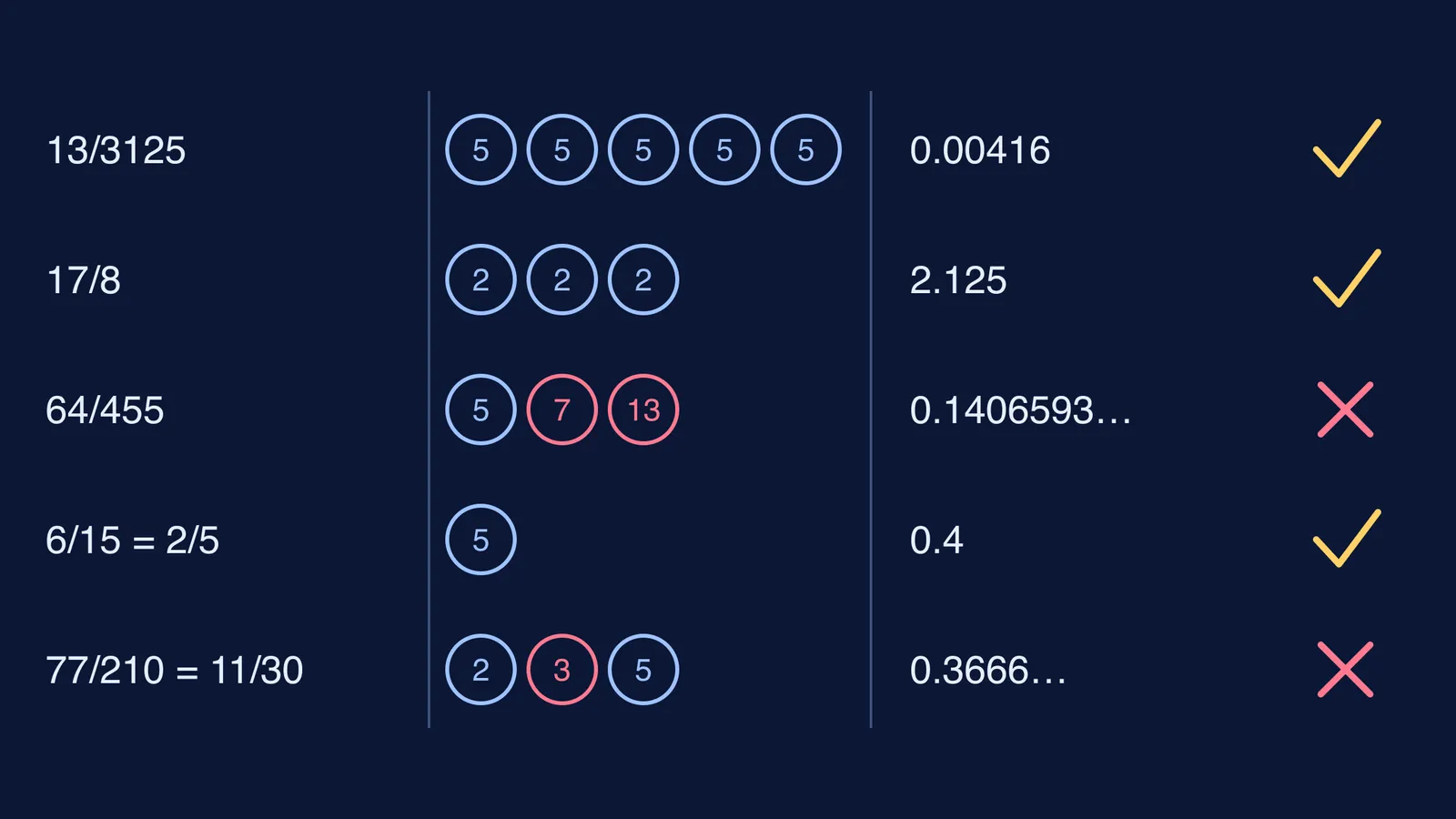
These five come from Exercise 1.4 of the earlier edition of NCERT's Real Numbers chapter (full question list as reproduced in Cuemath's NCERT solutions).
13/3125: 3125 = 5⁵, only 5s, so it terminates. Multiply by 2⁵: 416/100000 = 0.00416.
17/8: 8 = 2³, only 2s, so it terminates: 2.125.
64/455: 64 = 2⁶ shares no factor with 455, and 455 = 5 × 7 × 13. The 7 and 13 make it non-terminating repeating (0.140659340659…).
6/15: the trap. 15 = 3 × 5 looks like a fail, but HCF(6, 15) = 3, so 6/15 = 2/5. It terminates: 0.4.
77/210: the reverse trap. 210 = 2 × 3 × 5 × 7. Cancel the 7 to get 11/30, and 30 = 2 × 3 × 5. The 3 survives, so it is non-terminating repeating: 0.3666…
To turn 0.3666… back into 11/30, see our walkthrough on converting a recurring decimal to a fraction.
How should you write the reason in your answer?
A one-word answer such as "terminating" hides your reasoning. Write three short lines, in this order:
Lowest terms: "HCF(77, 210) = 7, so 77/210 = 11/30."
Factorisation: "30 = 2 × 3 × 5."
Conclusion, naming the rule: "The denominator has the prime factor 3, which is neither 2 nor 5, so 11/30 has a non-terminating repeating decimal expansion."
For a terminating fraction, end line 3 with the conversion: "8 = 2³, so 17/8 = (17 × 5³)/10³ = 2.125." Line 2 is the reason; without it, the answer reads as a guess.
If you reach the right label by the wrong route, say judging 6/15 before cancelling, the Fermi Problem Library has worked problems with a step-by-step solver that explains the reasoning rather than printing an answer.
Is this still in the CBSE Class 10 syllabus?
Check before you spend revision time on it. The CBSE Class X Mathematics curriculum for 2026-27 lists two items under Real Numbers: statements of the Fundamental Theorem of Arithmetic, and proofs that √2, √3 and √5 are irrational, with Unit I (Number Systems) carrying 6 marks. Decimal expansions are not listed as a separate topic, and the current NCERT reprint of the chapter has no decimal-expansion exercise.
The curriculum does expect you to apply the Fundamental Theorem of Arithmetic, and this test is one of its neatest applications, so ask your teacher whether your school's tests include it. For the rest of the chapter, start with our Class 10 Real Numbers guide. If prime factorisation itself still feels shaky, the Fermi Concept Library gives every mathematics concept its own lesson and shows where it sits in the map.
For practice, try three more fractions from that old exercise: 15/1600, 29/343 and 35/50. Reduce, factorise, decide, then write your three lines.