

On this page
When you type 1 ÷ 3 into a calculator, the screen fills with 0.33333333. A repeating decimal (also known as a recurring decimal) is a number whose digits eventually form a periodic sequence that repeats forever, according to Wikipedia.
Because you cannot write out an infinite number of digits, a fraction is the only way to write these numbers exactly. If you are preparing for exams like the JEE or simply solving school mathematics, you need a reliable way to turn any repeating decimal back into a fraction.
The most robust technique is the subtract-the-shifted-number method.
How do you convert 0.3 recurring to a fraction?
The goal of this method is to use algebra to line up the infinite repeating tails of two numbers and subtract them. This makes the infinite part vanish completely.
Here is how you do it for a single repeating digit, such as 0.3 recurring (often written as 0.3 with a bar over it, or 0.333...).
Assign a variable to the decimal. Let x = 0.333...
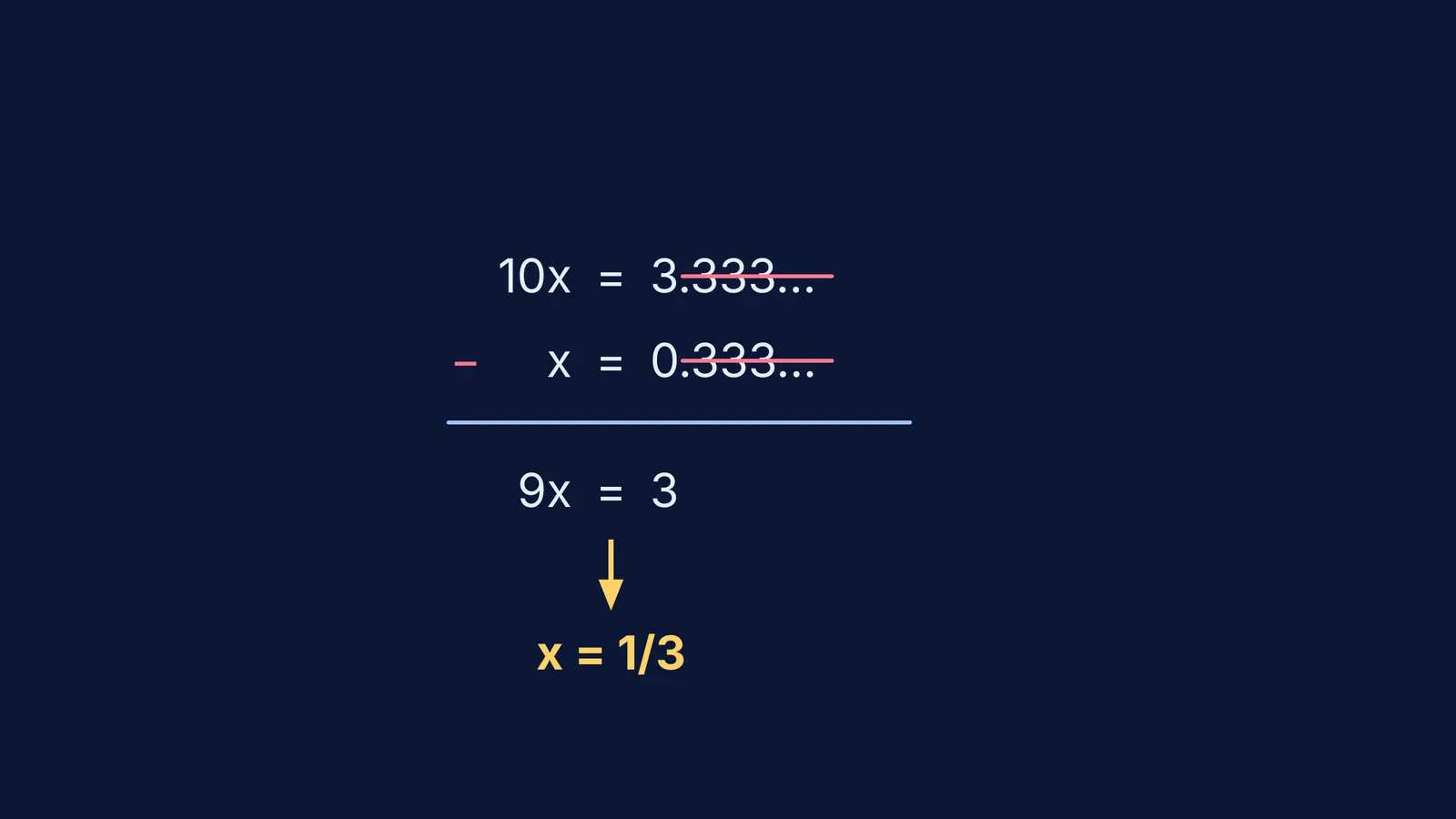
Multiply the equation by 10. Because exactly one digit repeats, shifting the decimal point one place to the right lines up the repeating pattern again. You get 10x = 3.333...
Subtract the original equation from the new one.
10x − x = 3.333... − 0.333...
9x = 3
Solve for x. The result is x = 3/9, which simplifies to 1/3.
What if multiple digits repeat?
The same logic applies to longer sequences. For instance, consider 0.474747... (or 0.47 with a bar over the 47).
Because there are two repeating digits in the periodic sequence (the repetend), multiplying by 10 would offset the pattern. Instead, you must shift the decimal point two places by multiplying by 100.
Let x = 0.474747...
Multiply by 100 to shift the decimal two places: 100x = 47.474747...
Subtract the original x equation: 100x − x = 47.474747... − 0.474747...
99x = 47
Solve for x to get x = 47/99.
This confirms that every rational number is either a terminating decimal or a repeating one. If you can write it as an integer over an integer, long division will eventually loop.
How do you convert a mixed recurring decimal?
A mixed recurring decimal is one where the repeating pattern does not start immediately after the decimal point, such as 1.2333... (where only the 3 repeats). According to Wolfram MathWorld, this happens when the original fraction's denominator contains a mix of terminating prime factors (2 and 5) and non-terminating ones.
To convert these, you perform the shift twice: once to place the decimal point just before the repeating block, and once to place it just after one full cycle of the block.
Consider the number 1.2333...
Let x = 1.2333...
Multiply by 10 to shift the decimal just before the repeating 3s: 10x = 12.333...
Multiply the original x by 100 to shift the decimal past the first repeating 3: 100x = 123.333...
Subtract the smaller shifted equation from the larger one: 100x − 10x = 123.333... − 12.333...
90x = 111
Solve for x to get x = 111/90. Both divide by 3, which simplifies the fraction to 37/30.
If you find yourself stuck simplifying fractions or dealing with negative signs along the way, the Fermi Problem Library has worked problems with a step-by-step solver that explains the reasoning rather than printing an answer.
Why does subtracting infinity work?
It can feel strange to subtract two infinite sequences. You might wonder if subtracting an infinite string of 3s from another infinite string of 3s leaves some tiny remainder infinitely far away.
The reason it works perfectly is built into the definition of a limit. When we write 0.333..., we are describing a number that approaches exactly 1/3 as you add more decimal places. Because the repeating pattern is identical in both x and 10x, and they extend forever, aligning the decimal points ensures every single digit in the infinite tail matches perfectly. When you subtract them, every position from the tenths place downwards becomes exactly zero. This leaves a neat, finite integer on the right side of your equation, turning an infinite problem into simple algebra.
You can also solve these conversions by treating the decimal tail as an infinite geometric progression. The two approaches are mathematically identical; the shift-and-subtract method is simply the algebra that derives the geometric progression sum formula in disguise. To see how that works, read our guide on treating recurring decimals as fractions using an infinite GP, or explore how the same pattern applies to sums like 9 + 99 + 999 + ….


