On this page
If you are in a CBSE Class 9 in 2026-27, your maths textbook is the new NCERT book Ganita Manjari (Part I), first published in April 2026, and Chapter 3 is The World of Numbers (NCERT, Ganita Manjari contents). It runs from counting numbers to real numbers, on pages 41 to 67 (NCERT, Chapter 3 PDF). The chapter does not teach rationalising denominators or laws of exponents, and CBSE's 2026-27 key concepts for the unit do not list them, so skip those pages if your guide was written for the older book.
What is in The World of Numbers class 9?
The chapter follows numbers in the order people needed them (NCERT, Chapter 3):
Counting: natural numbers and Vedic names for powers of 10.
Zero (śhūnya): the chapter credits Brahmagupta's Brāhmasphuṭasiddhānta (628 CE) with rules that made zero a number you can calculate with.
Integers: Brahmagupta's fortunes (dhana) and debts (ṛiṇa).
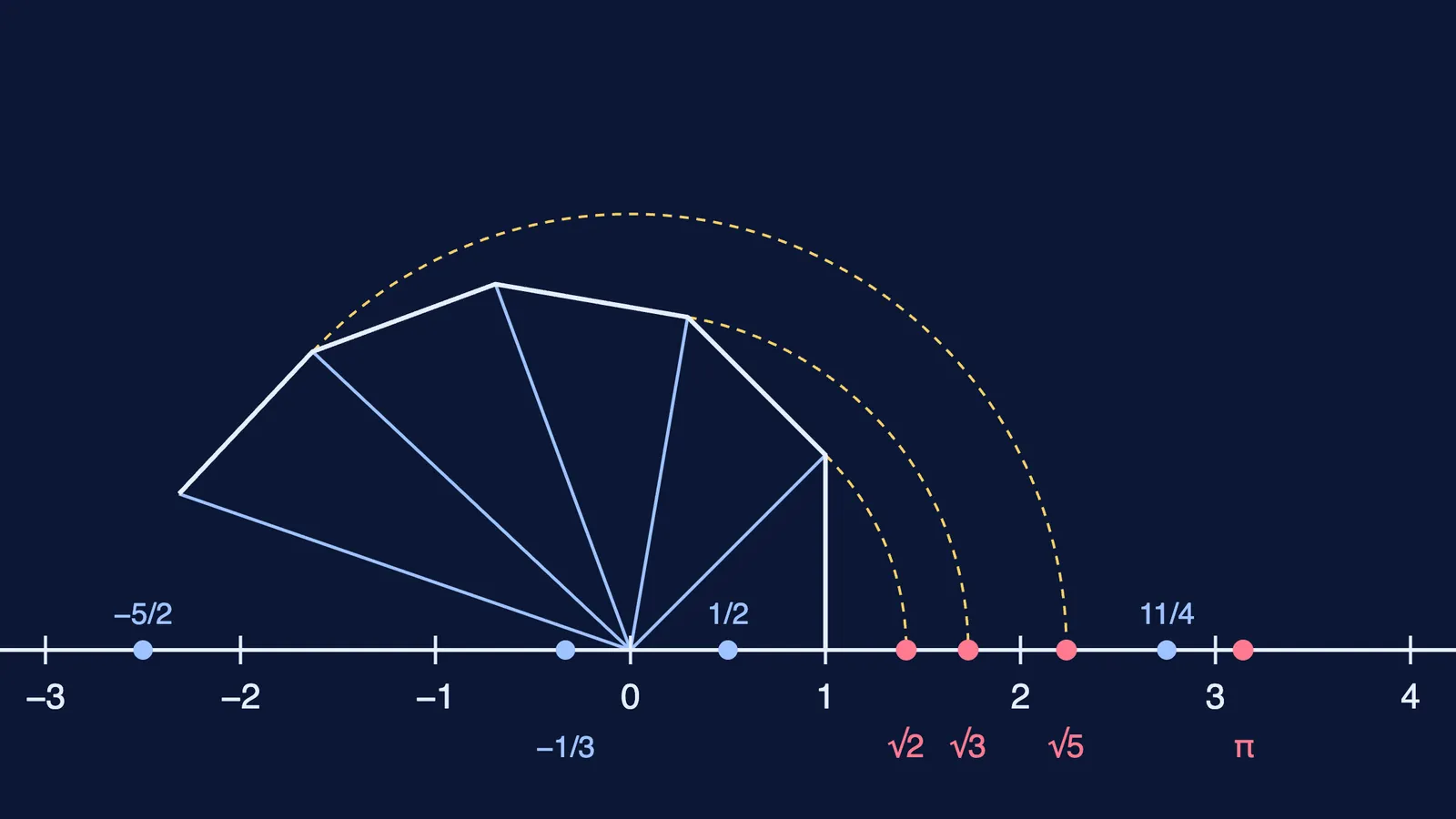
Rational numbers: the form p/q with q ≠ 0, the number line, absolute value and density.
Irrational numbers: the proof that √2 is irrational, constructing √2 on the number line, and π, including Mādhava's 14th-century infinite series for it.
Real numbers: terminating and repeating decimals, converting them to p/q, and the cyclic number 142857.
For the longer story of zero, read our piece on who invented zero, from the Bakhshali dots to Gwalior.
How many marks does Number System carry in CBSE 2026-27?
Number System carries 7 of the 80 theory marks in CBSE's 2026-27 Class IX maths curriculum, with 12 teaching periods (CBSE curriculum 2026-27). Its key concepts include density of rationals, decimal representation, proofs that √2 and √3 are irrational, and the square root spiral. Internal assessment adds a separate 20 marks.
How do you find rational numbers between two rationals?
Take 2/7 and 3/7. Their average is (2/7 + 3/7) ÷ 2 = 5/14, and since 4/14 < 5/14 < 6/14, it sits between them. Repeat forever: that is density.
For several at once, multiply top and bottom by 10: 2/7 = 20/70 and 3/7 = 30/70, so 21/70, 22/70 and so on up to 29/70 give nine numbers in one step.
How do you tell a terminating decimal from a repeating one?
A rational number p/q in lowest terms terminates exactly when q has no prime factors other than 2 and 5 (NCERT, Chapter 3). Worked examples:
7/40: 40 = 2³ × 5, so it terminates. Multiply by 25/25: 175/1000 = 0.175.
5/12: 12 = 2² × 3, so it repeats: 0.41666…
33/150: 150 has a 3, but 33/150 = 11/50 = 22/100 = 0.22. Reduce first.
More practice: checking a terminating decimal without dividing.
To convert 0.2363636… to p/q, let x = 0.2363636… Then 10x = 2.363636… and 1000x = 236.363636… Subtract: 990x = 234, so x = 234/990 = 13/55. Check by dividing: 13 ÷ 55 = 0.23636… A pure repeat is quicker: 0.272727… = 27/99 = 3/11.
How do you prove a square root is irrational?
The chapter's proof for √2 works by contradiction: assume √2 = p/q in lowest terms, square to get 2q² = p², deduce that p is even, then that q is even, which breaks "lowest terms" (NCERT, Chapter 3).
The step students skip is "if p² is even, then p is even". Justify it: an odd number is 2k + 1, and (2k + 1)² = 4k² + 4k + 1 is odd, so an even square must come from an even number.
For √3, which CBSE also lists, you need "if p² is a multiple of 3, so is p". A number that is not a multiple of 3 is 3k + 1 or 3k + 2. Squaring gives 9k² + 6k + 1 and 9k² + 12k + 4 = 3(3k² + 4k + 1) + 1, both leaving remainder 1. To find the weak line in your own write-up, see checking your √2 proof for gaps.
For the square root spiral, build on the chapter's √2 construction: each new right triangle has the last hypotenuse and 1 unit as its legs. Work out each length with Pythagoras.
What mistakes cost marks in this chapter?
Testing the denominator before reducing the fraction (33/150 above).
Treating 22/7 or 3.14 as π. They are rational approximations; π is irrational, and the chapter cites Lambert's 1761 proof (NCERT, Chapter 3).
Assuming every square root is irrational: √49 = 7.
Assuming two irrationals always add to an irrational: (1 + √2) + (1 − √2) = 2.
Calling a patterned decimal repeating: 0.12112111211112… has a pattern but no fixed block, so it is irrational.
Leaving out "q ≠ 0" or "lowest terms" in the first line of a proof.
If a conversion keeps going wrong at the same step, the Fermi Problem Library has worked problems with a step-by-step solver that explains the reasoning rather than printing an answer. To revisit density or decimals, the Fermi Concept Library gives each mathematics concept its own lesson.
Next step: write the √3 proof once from memory.