On this page
You can memorise the proof that √2 is irrational and still leave out the two quiet lines that make it work. A better test: write the proof from memory, then ask an AI to point at the single weakest line without fixing it. Below is the prompt, plus two student proofs with real gaps to practise on first.
What does the NCERT proof that root 2 is irrational need?
The current NCERT Class 10 textbook proves that √2 is irrational by contradiction in Chapter 1, Real Numbers, and Example 5 does the same for √3 (NCERT Class 10 Mathematics, Chapter 1, Reprint 2026-27). The proof rests on Theorem 1.2 of that chapter: if a prime p divides a², then p divides a.
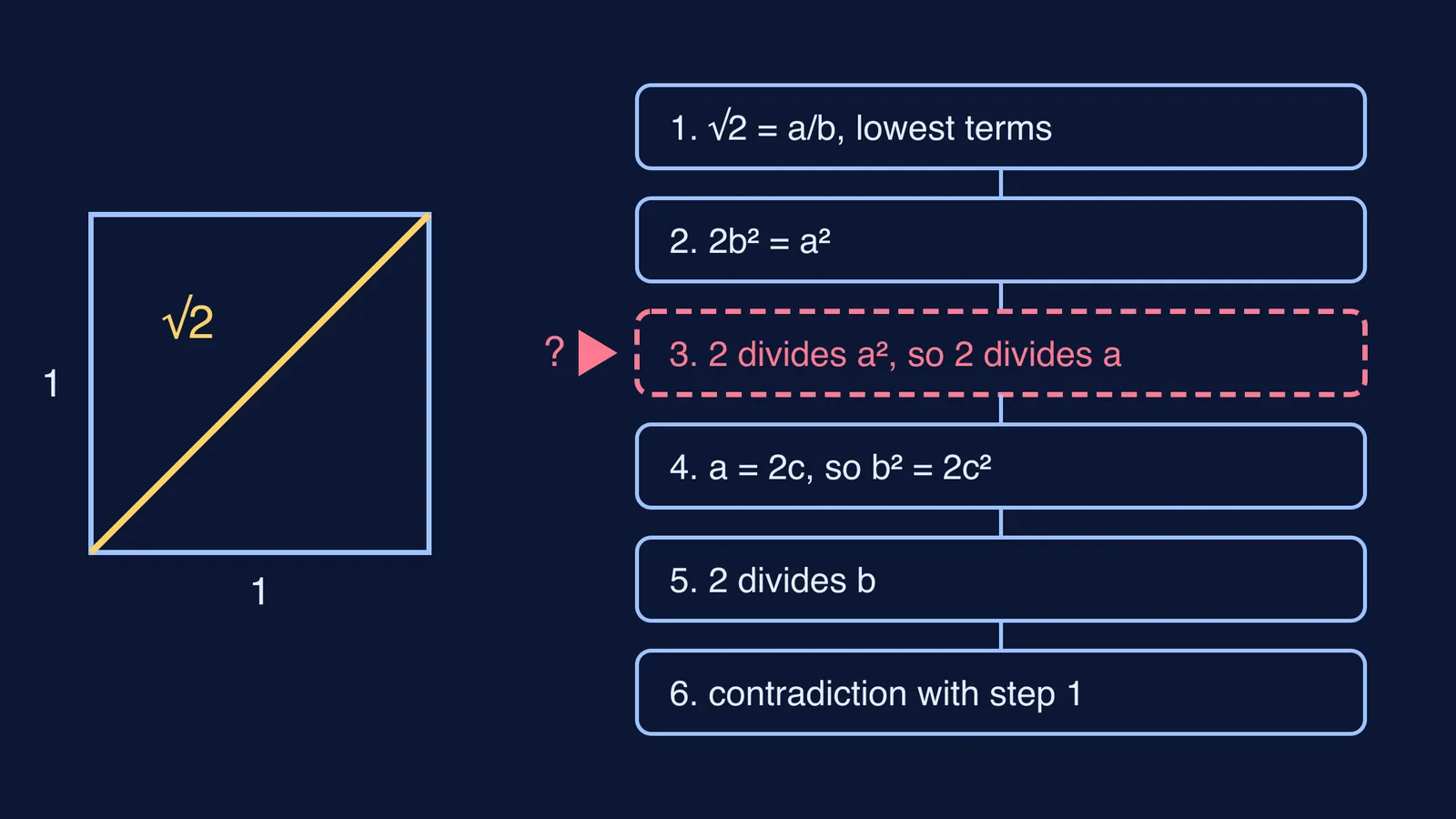
The chain has six links:
Assume √2 is rational, so √2 = a/b with a and b coprime (no common factor other than 1).
Square and rearrange: 2b² = a².
2 divides a², and 2 is prime, so 2 divides a.
Write a = 2c, which gives b² = 2c².
So 2 divides b², and by the same theorem, 2 divides b.
Now 2 divides both a and b, which contradicts line 1.
Lines 1 and 3 carry the logic: without “coprime”, line 6 contradicts nothing; without “2 is prime”, line 3 has no stated reason. For the full walk-through, see our Class 10 guide to proving root 2 is irrational.
Why ask AI for the weakest line instead of a rewrite?
A rewritten proof feels like help, but it swaps your reasoning for a clean copy you will forget. John Hattie and Helen Timperley's review of feedback research calls feedback one of the most powerful influences on learning, but its impact can be positive or negative, and its type and delivery matter (Review of Educational Research, 2007). One flagged line and one question keep the repair work with you.
There is a second reason: AI gets proofs wrong too. In a 2025 study, expert human graders marked AI models' full solutions to the six USAMO 2025 olympiad problems; the top model, Gemini-2.5-Pro, scored 25% and every other model tested scored under 5% (Petrov and colleagues, arXiv, 2025). Those problems are far harder than √2, and newer models may do better, but a confident AI proof is not automatically a correct one.
What prompt should you use to check your proof?
Write the proof on paper from memory, with numbered lines. Then paste it in with this:
“Here is my proof that √3 is irrational. Do not rewrite it and do not show me a corrected proof. 1. Name the single weakest line by its number. 2. In one sentence, say why a strict Class 10 examiner might not accept it. 3. Ask me one question that would help me fix it myself. If every line is justified, say so and name the line that depends on an outside theorem.”
When it answers, send back only your repaired line and ask: “Is this line now justified? Yes or no, and why?”
Two student proofs with gaps: can you find them first?
Cover the answers and try each one.
Proof A (√2)
“Suppose √2 = a/b where a and b are integers and b ≠ 0. Then 2b² = a², so a² is even, so a is even. Let a = 2c. Then b² = 2c², so b is even. This is a contradiction, so √2 is irrational.”
Weakest line: the first. It never says a and b share no common factor, so “both are even” contradicts nothing. Fix: add “with a and b coprime”, as NCERT does.
Proof B (√3)
“Suppose √3 = a/b with a and b coprime. Then 3b² = a². So 3 divides a², and a number that divides a square always divides the number itself, so 3 divides a. Let a = 3c. Then b² = 3c², so 3 divides b. Contradiction.”
Weakest line: the rule in the middle. It is false in general: 4 divides 36, which is 6², but 4 does not divide 6. Run the √4 test and this proof “shows” √4 is irrational. Fix: “3 is prime, so by Theorem 1.2, 3 divides a.”
If you found both gaps, try Exercise 1.2's 3 + 2√5 yourself, then work through similar problems in the Fermi Problem Library, whose step-by-step solver explains the reasoning rather than printing an answer.
How do you know the AI's verdict is right?
Check it against the textbook, not against how sure it sounds.
If it flags a line, find the textbook sentence that line should match.
If it says your proof is perfect, run the √4 test yourself.
If it rewrites anyway, paste the prompt again and add “one line only”.
If you are unsure why primes matter here, revisit prime factorisation in the Fermi Concept Library first.
The same habit works beyond proofs: see how to ask AI for the first bad line in your answer and how to check an AI's trigonometric identity proof. Tonight, write the √3 proof from memory and run the prompt once.