On this page
Your working ends in a dead end, and the answer key says 5 s. The usual move is to paste the question into a chatbot and read its solution. You see the right answer, but not which of your own lines went wrong.
A better request is simple. Paste your full working, number every line, and ask the AI to find the first line where it goes wrong, and to stop there.
Why ask for the first wrong line instead of a fresh solution?
A fresh solution shows how someone else solved the problem. Your mistake lives in your own working.
Research on learning from mistakes points the same way. In a review in the Annual Review of Psychology, Columbia University psychologist Janet Metcalfe concluded that making errors and then getting corrective feedback helps learning, and that corrective feedback "including analysis of the reasoning leading up to the mistake, is crucial" (Metcalfe, 2017). The same review reports that errors made with high confidence are corrected more readily than low-confidence ones, which is good news for the sign you were sure about.
After one wrong line, every line below it can be good algebra built on a bad number. Fix the first one and the rest usually follows.
What should I type when I ask AI why my answer is wrong?
Copy this, then paste your working under it:
"Here is my working for this question, with numbered lines. Do not solve the problem again and do not show me the final answer. Tell me the number of the first line that is wrong and explain in two sentences what is wrong with it. Do not correct the lines after it. If every line is correct, say so."
Three things help:
Write out every line, including your sign convention, units and the formula you chose.
Number the lines yourself, so "line 4" means the same to you and the AI.
Give the question exactly as printed, with the answer key if you have it.
Worked example: where did this projectile go wrong?
Question: a ball is thrown straight up at 20 m/s from the top of a building 25 m tall. Taking g = 10 m/s², when does it hit the ground?
A student's working:
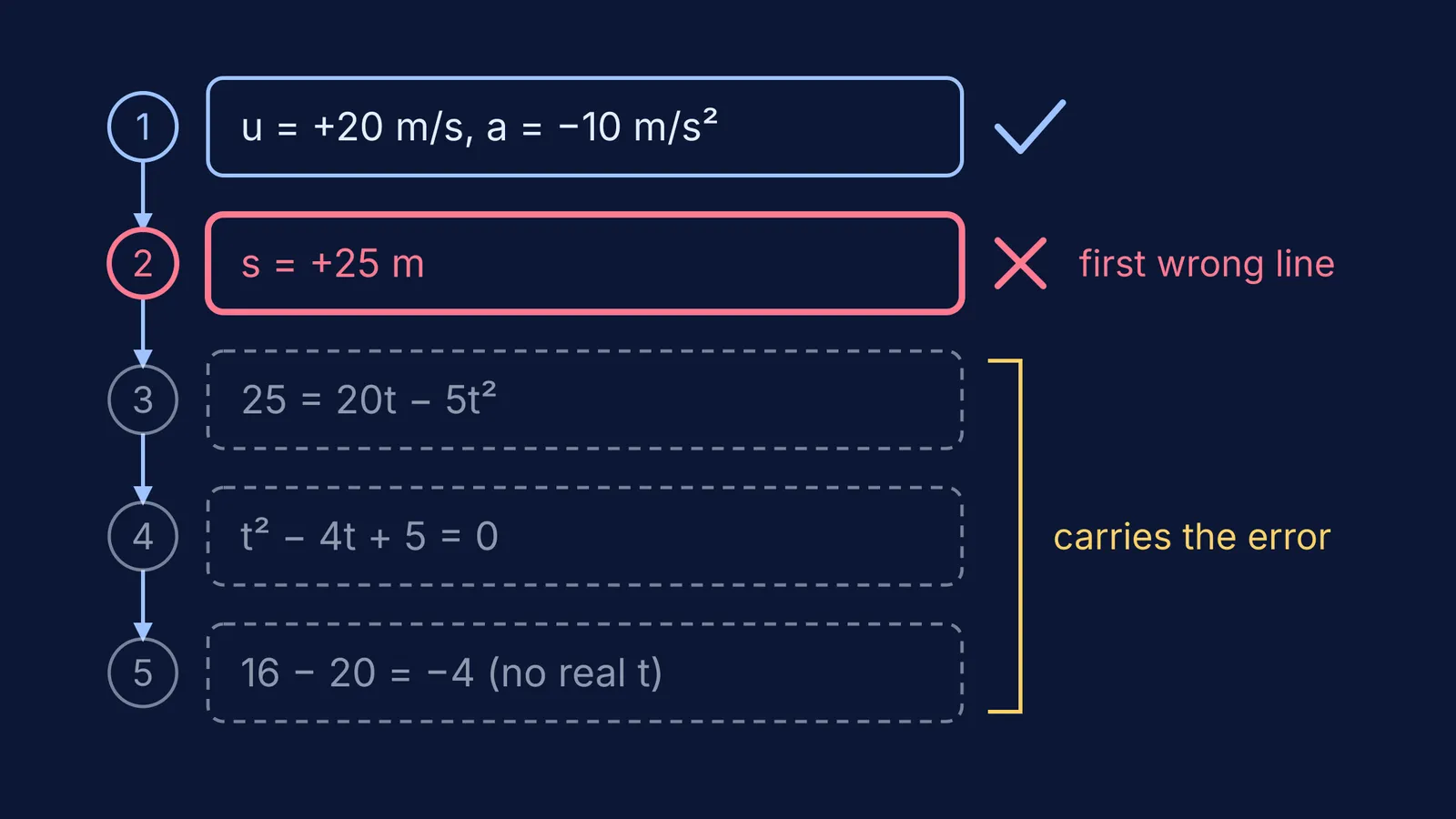
Take upward as positive: u = +20 m/s, a = −10 m/s².
Displacement to the ground: s = +25 m.
Using s = ut + ½at²: 25 = 20t − 5t².
Rearranging: t² − 4t + 5 = 0.
Discriminant = 16 − 20 = −4, so there is no real time. Stuck.
A re-solve would print t = 5 s and move on. Asking for the first wrong line gets you line 2. The ground is below the starting point, so with upward taken as positive, s = −25 m. Lines 3 to 5 are correct algebra applied to a wrong sign. Fix line 2 and the equation becomes t² − 4t − 5 = 0, which factorises to (t − 5)(t + 1) = 0, so t = 5 s; the root t = −1 s is before the throw.
The lesson is not "the answer is 5 s" but "with up positive, a displacement below the start is negative", a rule you carry into the next problem.
Can the AI get the first wrong line wrong?
Yes, so treat its verdict as a claim to check, not a ruling. In a study that asked AI models to name the step where the first logical mistake occurs in step-by-step reasoning on five tasks such as word sorting and multi-step arithmetic, the best model tested, GPT-4, reached an overall accuracy of 52.87% (Tyen et al., ACL Findings 2024). Newer models may do better, but the same study found that giving models the mistake's location improved their corrections, so the location is the part worth checking.
Another study found that when models rechecked their reasoning without outside feedback, their performance sometimes got worse (Huang et al., ICLR 2024). So pushing back with "are you sure?" is not much of a test.
A five-step check:
Read the flagged line. Can you say in your own words why it is wrong?
Check the lines above it. If line 2 is flagged, line 1 should hold up.
Fix only that line and redo the rest yourself, without looking at a solution.
If you still disagree, ask "What would make line 2 correct?" and test the reply against the physics.
Write the mistake down in one line.
Where does Fermi fit in?
If you keep picking the wrong method rather than slipping on a sign, the Fermi Problem Library has worked problems with a step-by-step solver that explains the reasoning rather than printing an answer. Fermi's AI tutor is built to notice where a student is stuck and decide whether to explain, ask or show, so the conversation stays on your working.
Next time the answer key disagrees with you, don't ask for the answer. Ask for the line.