

On this page
In 2024, 2,251,812 students appeared for the CBSE Class 10 board examinations. In these exams, the irrationality of numbers like √2, √3 and √5 is a staple of the mathematics paper.
Unlike most problems you solve in high school, you cannot arrive at the answer by simply running a calculation. Instead, you have to use a logical technique called proof by contradiction. You start by assuming the exact opposite of what you want to prove, and then show that this assumption breaks the rules of arithmetic.
If you are brushing up on Real numbers in Class 10: HCF, LCM and irrationality proofs, here is how the proof works, why it is set up the way it is, and how to adapt it for other irrational numbers.
Why do we assume a and b are co-prime?
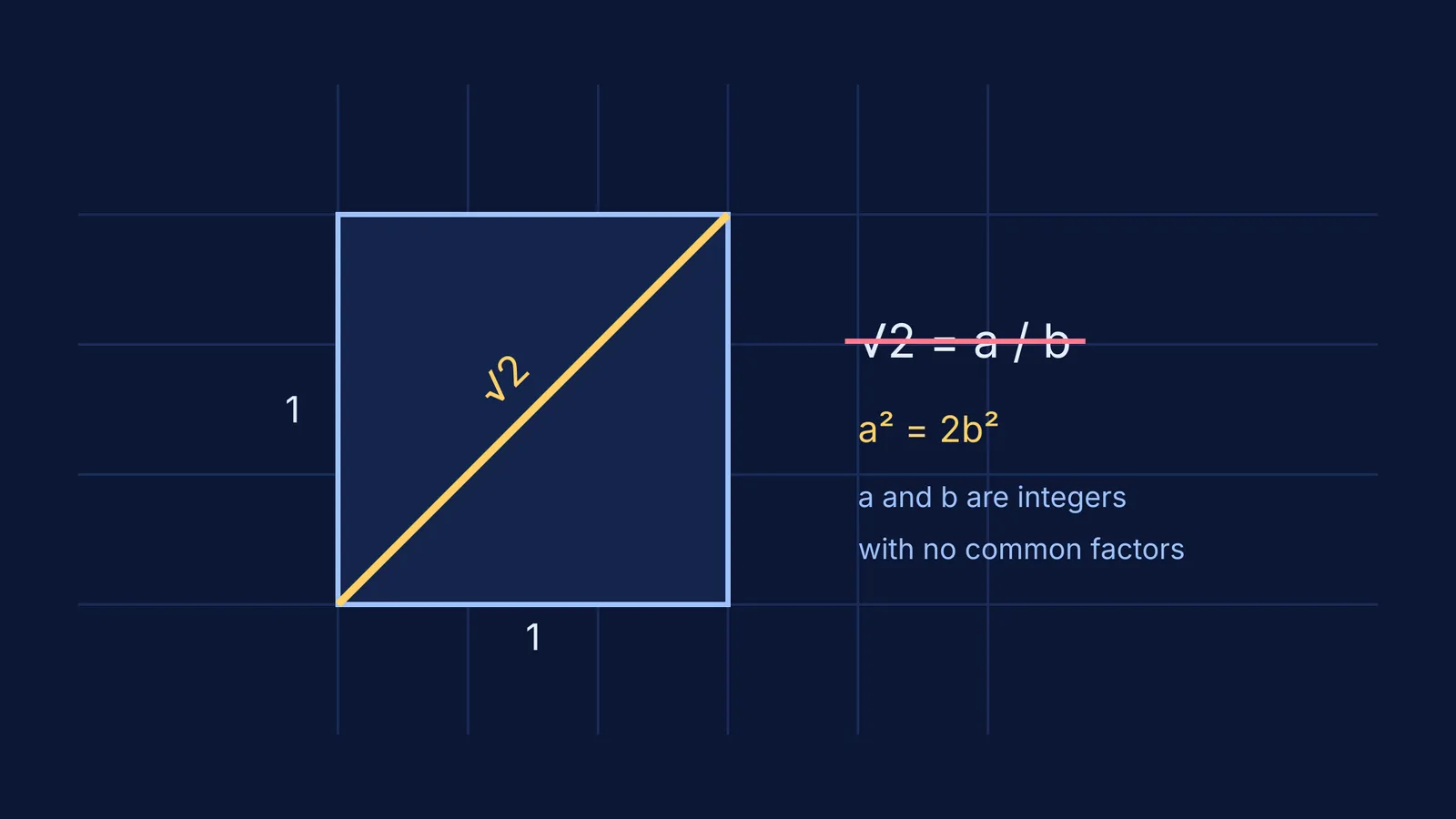
The proof begins with a deliberate mistake: "Let us assume that √2 is a rational number."
By definition, any rational number can be written as a fraction a/b, where a and b are integers and b is not zero. But there are infinitely many ways to write the same fraction (for example, 1/2 = 2/4 = 50/100). To make the proof work, we insist on the simplest form: we state that a and b are co-prime.
Two numbers are co-prime if they share no common factors other than 1. (This is a concept first introduced in Prime time in Class 6: primes, co-primes and divisibility tests). By defining a and b as co-prime, we set a trap. If we can later prove that a and b actually do share a common factor, our original assumption collapses.
How to prove √2 is irrational?
Here are the standard steps. According to NCERT Theorem 1.3, if a prime number divides the square of a number, it must also divide the number itself. We will use this rule twice.
Make the assumption. Assume √2 is rational. Therefore, we can write √2 = a/b, where a and b are co-prime integers and b ≠ 0.
Square both sides. Squaring removes the square root, giving 2 = a²/b². Rearranging this, we get a² = 2b².
Deduce for a. Because a² is equal to 2 multiplied by an integer (b²), a² must be an even number (divisible by 2). By Theorem 1.3, if a² is divisible by 2, then a is also divisible by 2.
Substitute. Since a is divisible by 2, we can write it as a = 2c for some integer c. Substitute this back into our earlier equation: (2c)² = 2b², which simplifies to 4c² = 2b², and then b² = 2c².
Deduce for b. The equation b² = 2c² means b² is also divisible by 2. Therefore, b is divisible by 2.
State the contradiction. We have just proved that both a and b are divisible by 2. This means they share 2 as a common factor, which directly contradicts our very first statement that a and b are co-prime. The contradiction arose from assuming √2 is rational. Hence, √2 is irrational.
How does the proof change for √3 and √5?
Once you understand the structure, you can prove the irrationality of any square root of a prime number. The logic remains identical; only the prime number changes.
If you are asked to prove that √3 is irrational, you assume √3 = a/b. Squaring gives a² = 3b². This tells you a² is divisible by 3, so a is divisible by 3 (a = 3c). Substituting this back yields 9c² = 3b², or b² = 3c², meaning b is also divisible by 3. The contradiction is that a and b share a factor of 3.
How to prove 3 + 2√5 is irrational?
Examiners often test your understanding of Number systems in Class 9: rational, irrational and real numbers by asking you to prove that a mixed expression like 3 + 2√5 is irrational.
This is actually a much shorter proof, because you are allowed to take as a given fact that √5 is irrational.
Assume the contrary. Let 3 + 2√5 be a rational number, equal to a/b (where a and b are integers, b ≠ 0).
Rearrange for the root. Isolate the irrational part on one side:
2√5 = (a/b) − 3 √5 = (a − 3b) / 2b
State the contradiction. Because a and b are integers, the right-hand side is entirely rational. However, we already know the left-hand side (√5) is irrational. An irrational number cannot equal a rational number. Therefore, our assumption was wrong, and 3 + 2√5 must be irrational.
Writing out these proofs requires clear reasoning. If you are practising for your board exams and getting stuck on similar logic problems, the Fermi Problem Library has a step-by-step solver that explains the mathematical reasoning behind each algebraic move, helping you catch where a proof might be going off track. If you need a refresher on the underlying theory, you can search for real numbers in the Fermi Concept Library.


