On this page
Someone in your class group chat says 0.999... is the same as 1, and half the class refuses to believe it. They are equal. In the standard real numbers, the decimal with a 9 in every place forever is exactly 1, as the overview of 0.999... on Wikipedia sets out with several proofs.
What does 0.999... actually mean?
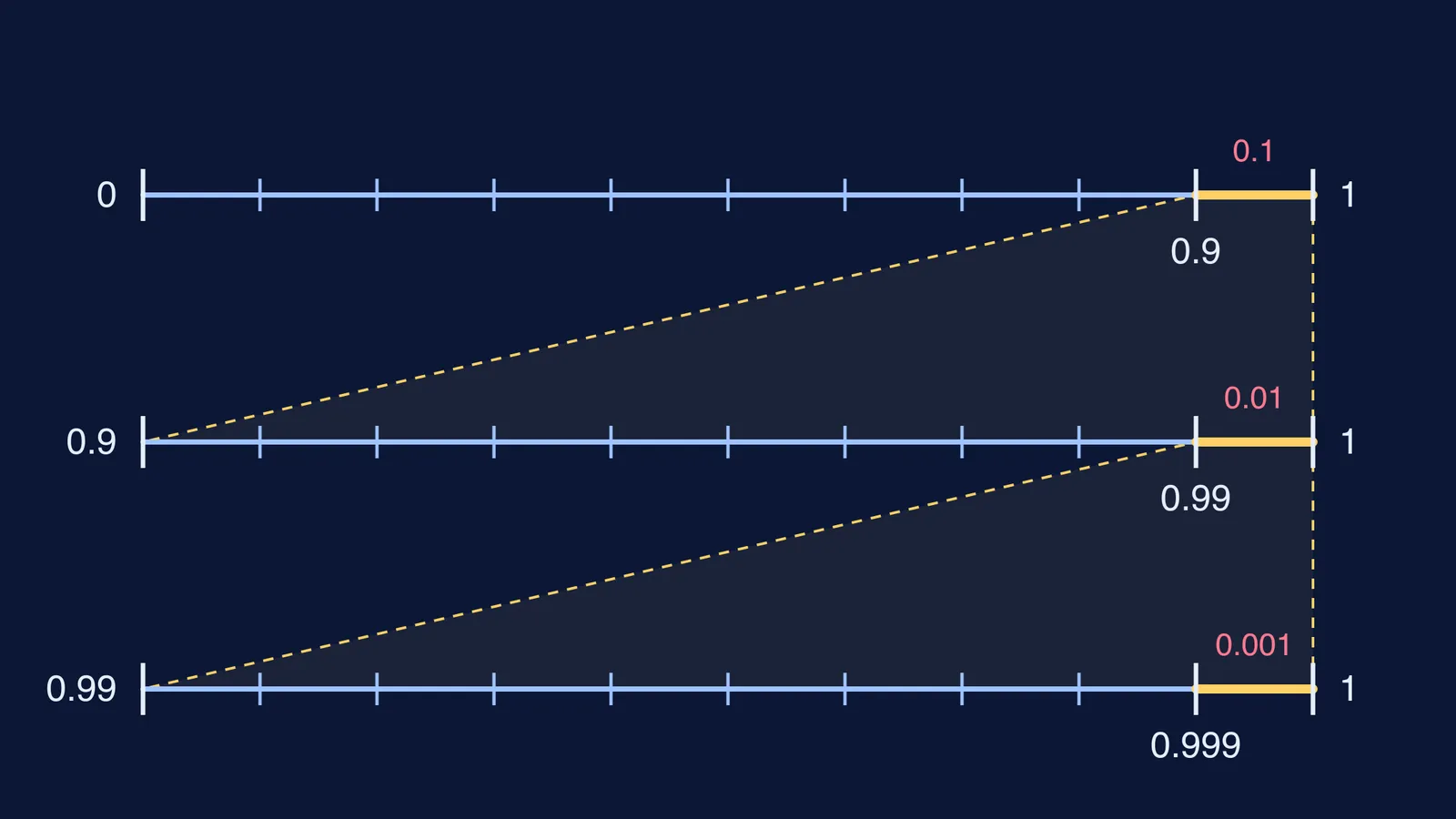
An infinite decimal is defined as the limit of its finite cut-offs: 0.9, 0.99, 0.999 and so on (0.999..., Wikipedia). Each cut-off falls short of 1 by exactly 1/10ⁿ, where n is the number of nines: 0.1, then 0.01, then 0.001.
0.999... is not any one cut-off. It is the single number they close in on.
Argument 1: why does 1/3 = 0.333... prove it?
Divide 1 by 3 and you get 0.333..., with threes forever. Now multiply both sides by 3:
3 × 1/3 = 1
3 × 0.333... = 0.999...
So 0.999... = 1.
Critics point out that this only moves the question: it relies on accepting 1/3 = 0.333... without thinking, and a sceptic may start to doubt that step instead (Wikipedia). The next two arguments close that gap.
Argument 2: how does the 10x trick work?
Let x = 0.999...
Multiply by 10: 10x = 9.999...
Subtract the first line from the second: 10x − x = 9.999... − 0.999... = 9
So 9x = 9, which gives x = 1.
The nines after the decimal point cancel exactly, because both numbers have a 9 in every decimal place. This is the same subtraction method you use for converting any recurring decimal to a fraction. Try it on 0.444...: 10x − x = 4, so x = 4/9, and 4 ÷ 9 does give 0.444...
One caveat: multiplying by 10 by shifting the decimal point assumes you already know what 0.999... means (Wikipedia). The limit definition above supplies that meaning.
Argument 3: is there a number between 0.999... and 1?
Two different real numbers always have another between them, such as their average. That is how you find rational numbers between two numbers. So try to find one between 0.999... and 1.
Any decimal below 1 must have a digit smaller than 9 somewhere. But 0.999... has a 9 in every place, so it is bigger than that decimal. Nothing fits in between.
Or look at the gap: 1 − 0.999... is smaller than 0.1, 0.01, 0.001, and indeed 1/10ⁿ for every n. The Archimedean property of the real numbers says that for every positive real number there is some n with 1/10ⁿ smaller than it (Wikipedia). So the gap cannot be positive. It is 0.
The same idea appears as a geometric series: 0.9 + 0.09 + 0.009 + ... = 0.9 ÷ (1 − 0.1) = 1, a calculation found in Euler's 1770 Elements of Algebra (Wikipedia). For a picture of why such sums land exactly on a whole number, see why 1/2 + 1/4 + 1/8 + ... = 1, visualised.
Why does it still feel wrong?
Anderson Norton and Michael Baldwin's article Does 0.999... Really Equal 1? in The Mathematics Educator looks at why secondary and university students resist the equality even after they have seen and understood logical arguments for it.
The authors argue that, in some sense, the equality holds by definition, but that definition depends on properties of the real numbers, especially the Archimedean property and limits. A student who chooses the hyperreal numbers instead may reject it, but must then accept the consequences. In the real numbers of school maths, JEE and calculus, the answer is 1.
Two common mix-ups:
"It never reaches 1." The cut-offs never reach 1. The number 0.999... is not a process that is still going; it is the limit, and the limit is 1.
"It is infinitely close to 1." The real numbers have no positive gap smaller than every 1/10ⁿ. Infinitely close, in the real numbers, means equal.
How do you explain it to a friend who disagrees?
Ask questions instead of arguing louder. Try this script:
"If they are different numbers, name one that lies between them." Let them try.
"How far apart are they? More than 0.1? More than 0.001? More than 0.000001?"
"So the distance is smaller than every positive number you can write. What number is that?"
If they are still unsure, show the 1/3 version, then the 10x version.
Name the real sticking point: 0.999... is one fixed number, not a list of nines still being written.
If the gap is what a limit or real number is, the Fermi Concept Library has a lesson for every concept in mathematics, with its place in the map, so you can go back to the idea underneath.
To practise the subtraction method on harder recurring decimals such as 0.1666... or 0.142857142857..., the Fermi Problem Library has worked problems with a step-by-step solver that explains the reasoning rather than printing an answer.
Next time the group chat argues, start with question 1.