On this page
The Value of Work is Chapter 13 of Exploring Society: India and Beyond, the NCERT Social Science textbook for Class 6 (book code fees1). The book's prelims list it as the First Edition of June 2024, reprinted in February 2025 and February 2026, and place this chapter at the start of Theme E, "Economic Life Around Us" (NCERT prelims PDF). CBSE publishes no separate 2026-27 curriculum for Classes 6 to 8; these classes follow the NCERT book, and the chapter is assessed by the school.
The chapter asks two big questions: what kinds of activities people take part in, and what each kind adds to everyday life (NCERT Chapter 13 PDF).
What are economic and non-economic activities in Class 6?
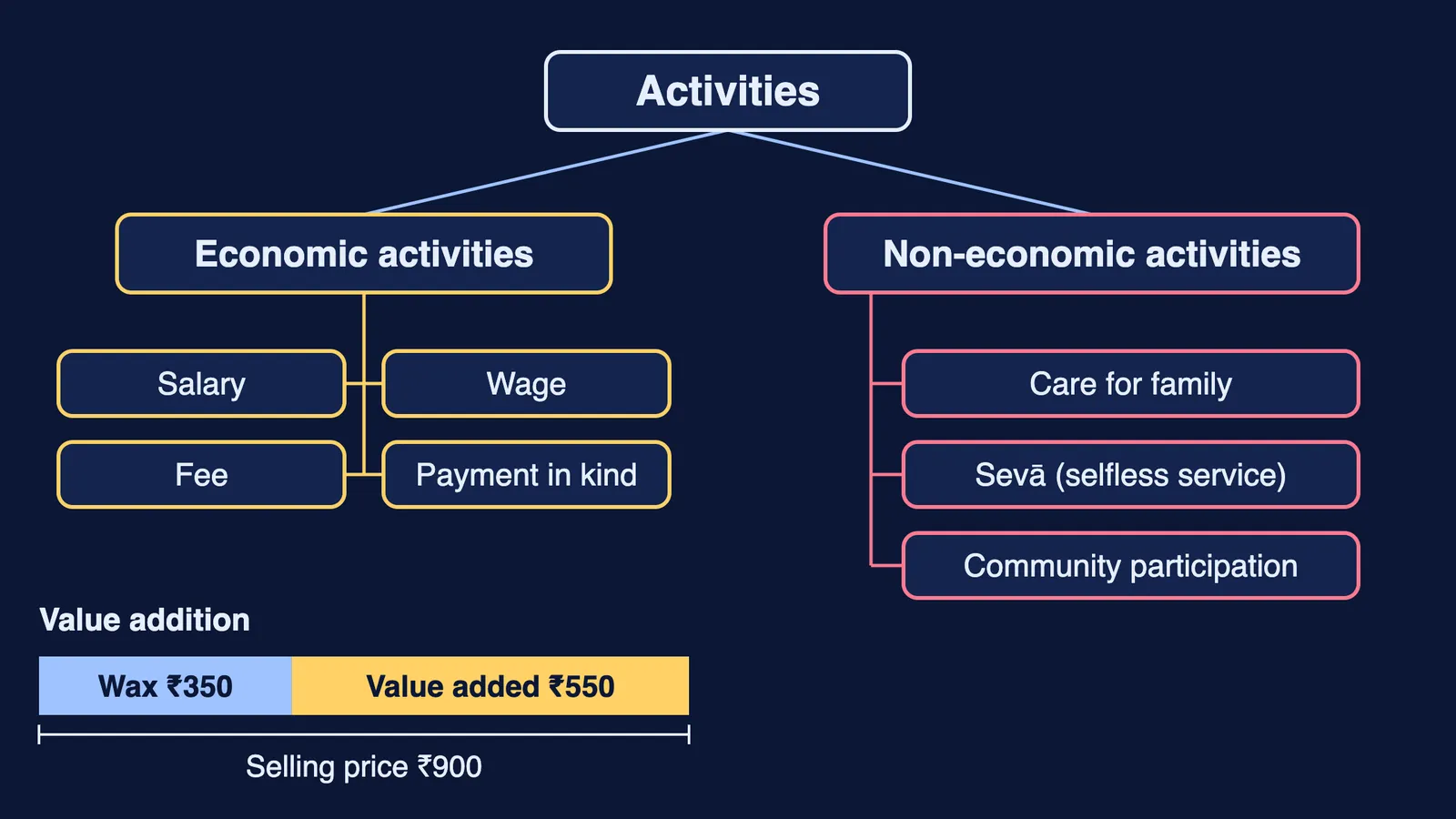
Economic activities involve money: people do them to earn money, or money's worth. The book's examples include a business person selling school bags, a lawyer earning a fee and workers in a car factory (NCERT Chapter 13). Money's worth, in the book's margin note, is the money value a person places on something because of the benefit they get from it.
Non-economic activities produce no income or wealth. People do them out of love, care, respect or gratitude: parents cooking for the family, young people looking after grandparents, relatives helping to repair the house.
The useful test is the reason for the work, not the skill. In the book, Rohan is paid a salary as a software engineer, which is economic. On weekends he teaches computer skills as a volunteer, which is non-economic.
How are people paid for economic activities?
The chapter names four kinds of payment (NCERT Chapter 13):
Salary: a fixed, regular payment, generally monthly, from an employer to an employee. Kavya's aunt earns one at the village post office.
Wage: a payment from an employer to a worker for a specific period of time. Sahil, a farm labourer, earns a daily wage.
Fee: a payment for professional advice or services, such as a doctor's or lawyer's fee. Kavya's aunt also charges a weekly fee for her online classes.
Payment in kind: a non-cash payment for work done. Part of Sahil's pay comes as mangoes.
What is value addition? A worked example
The chapter says economic activities add value at each stage of turning something into another form, and calls this value addition (NCERT Chapter 13). Here is our own example with made-up numbers.
Meena, a candle maker, buys wax for ₹350 and makes a batch of candles that she sells for ₹900.
Selling price minus cost of material: ₹900 − ₹350 = ₹550.
That ₹550 is the money value of Meena's skill, time and effort. It is the value she added.
If wax costs ₹420 and the price stays ₹900, the value added falls to ₹480.
Like the book's carpenter example, we count only the main material.
Payment in kind works the same way. Suppose a helper at a flour mill is paid ₹300 in cash and flour worth ₹100 for a day's work. The total payment is ₹400, of which ₹100 is in kind.
Why do non-economic activities matter?
The book stresses that these activities create real value without money (NCERT Chapter 13). It gives three kinds of example:
Sevā, or selfless service, seen at temples, gurudwaras, mosques and churches. Langars, the community kitchens at gurudwaras, serve free food to every visitor.
Community participation, such as people cleaning streets and parks together under the Swachh Bharat Abhiyan.
Van Mahotsav, the festival of forests, which brings people together for tree planting.
The chapter's closing summary links these activities to social welfare, personal wellbeing and a better quality of life.
How does this chapter connect to the rest of the book?
In the same theme, Chapter 14, Economic Activities Around Us, follows straight on and looks at economic activities in more detail (NCERT prelims). Our guide to rural and urban livelihoods in Class 6 looks at the kinds of work people do in villages and cities. In Class 7, markets around us builds on the idea of exchange, and in Class 9 the building blocks of economics take it further.
Practice questions
Marks are our suggestion; your school sets its own pattern.
What is payment in kind? Give one example from your area. (1 mark)
A bus conductor is paid a monthly salary. On Sunday she teaches her neighbour's child to swim, for free. Classify each activity and give a reason. (2 marks)
A kite maker spends ₹260 on paper and bamboo sticks and sells a batch of kites for ₹640. Find the value added and say what it pays for. (3 marks; answer: ₹380, the kite maker's skill, time and effort)
"Non-economic activities have no money value, yet they hold great value." Explain with two examples. (5 marks)
Stuck on which question to try first? Fermi's AI tutor works out what you already know and builds a plan for the session.