On this page
How much should a firm produce when it cannot set its own price? In the CBSE Economics curriculum for 2026-27, revenue, producer's equilibrium and supply all sit in Unit 6, "Producer Behaviour and Supply" (14 marks in Class XI, shared with production and costs, so there is no separate figure for this chapter). The text is Chapter 4 of NCERT's Introductory Microeconomics (Reprint 2026-27).
What does a price-taking firm earn?
NCERT lists four features of perfect competition: many buyers and sellers, a homogeneous product, free entry and exit, and perfect information. So each firm sells at the market price p.
Total revenue: TR = p × q. The TR curve is a straight line from the origin, with slope p.
Average revenue: AR = TR ÷ q = p. The AR curve is the horizontal price line, which is also the firm's demand curve, perfectly elastic.
Marginal revenue: MR = ΔTR ÷ Δq = p, because each extra unit sells at the same price. So MR = AR = p.
A worked firm: how much should it produce?
A workshop makes steel bottles; the numbers are invented and checked by hand and in Python. TFC is Rs 50. Values are for q = 1 to 9; at q = 0, TC = 50.
TVC: 30, 50, 66, 84, 108, 140, 180, 230, 292
TC: 80, 100, 116, 134, 158, 190, 230, 280, 342
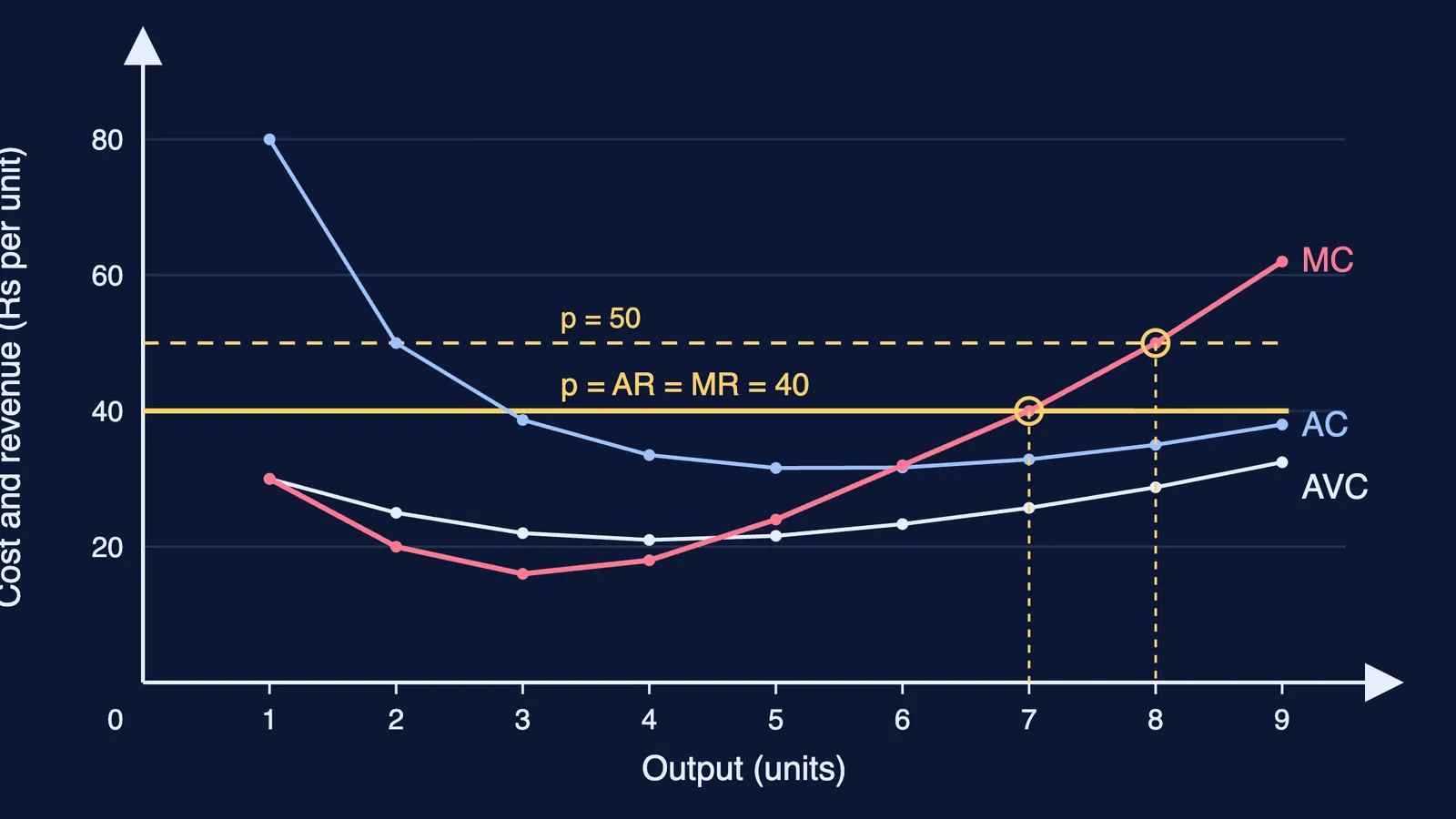
MC: 30, 20, 16, 18, 24, 32, 40, 50, 62
AVC: 30, 25, 22, 21, 21.6, 23.33, 25.71, 28.75, 32.44
AC: 80, 50, 38.67, 33.5, 31.6, 31.67, 32.86, 35, 38
The market price is Rs 40, so MR is Rs 40 for every unit.
Units 1 to 6 each add more to revenue (Rs 40) than to cost, so profit rises.
The seventh unit has MC = Rs 40 = MR, so the firm produces q = 7.
The eighth unit costs Rs 50 but earns Rs 40, cutting profit by Rs 10.
Profit at q = 7: π = TR − TC = 280 − 230 = Rs 50. Check: (40 − 32.86) × 7 ≈ Rs 50.
What are the conditions for producer's equilibrium?
NCERT sets three conditions at the profit-maximising output q0:
p = MC (for this firm, the same as MR = MC).
MC is non-decreasing at q0. Price meeting the falling part of MC (units 1 to 3 here) is never the answer.
p > AVC in the short run (p > AC in the long run), as NCERT prints it; its supply-curve section lets the firm keep producing while price is at least minimum AVC. Here AVC at 7 units is Rs 25.71.
Since p is above AC (Rs 32.86), the firm earns super-normal profit. NCERT treats normal profit as part of total cost; the break-even point is minimum AC (Rs 31.60 at 5 units here). The short-run shut-down point is minimum AVC (Rs 21 at 4 units): below that price, output is zero.
How do you get the supply curve and its elasticity?
A firm's short-run supply curve is the rising part of its MC curve from minimum AVC upward, with zero output at prices below minimum AVC, according to NCERT. At Rs 50, MC of the eighth unit equals price, so the firm supplies 8 units. So (Rs 40, 7) and (Rs 50, 8) lie on its supply curve.
The curriculum asks for the percentage-change method: eS = percentage change in quantity supplied ÷ percentage change in price.
Change in quantity = (8 − 7) ÷ 7 × 100 = 14.29%.
Change in price = (50 − 40) ÷ 40 × 100 = 25%.
eS = 14.29 ÷ 25 = 0.57.
Since eS is below 1, supply is inelastic here. NCERT also covers the long-run supply curve, determinants of supply (technology, input prices, a unit tax) and market supply; for elasticity, the curriculum names only the percentage-change method, so practise that.
Practice questions to try
(1 mark) For a price-taking firm, why does MR equal AR?
(3 marks) Price falls to Rs 32 in the table above. Find the output, then explain your answer using all three conditions.
(3 marks) At Rs 32, does the firm earn super-normal profit, normal profit or a loss? Show TR and TC.
(4 marks) A firm supplies 200 units at Rs 20 and 260 units at Rs 25. Find eS by the percentage-change method and say whether supply is elastic.
(4 marks) Distinguish the shut-down point from the break-even point, with a diagram.
Answers: (2) 6 units, where MC = 32 and rising; (3) TR = 192, TC = 190, profit Rs 2; (4) 30% ÷ 25% = 1.2, elastic.
First revise short-run cost curves; then the law of supply and market equilibrium and the four forms of market compared take these ideas into Unit 7.
Not sure where to start? Fermi's AI tutor can work out what you already know and build a plan for the session.