On this page
The Story of Indian Farming is Chapter 1 of the new Class 7 Social Science book and opens its first theme, on land and people. It sits in Exploring Society: India and Beyond, Part II (book code gees2, first edition November 2025, Reprint 2026-27), on pages 1 to 28.
Classes 6 to 8 follow the NCERT book. CBSE's 2026-27 curriculum page lists documents for Classes 9 to 12 only, so the chapter is assessed by the school.
What is the chapter about?
The chapter PDF asks three big questions: what marks Indian agriculture, how farming, climate, soil and water connect, and how old and new practices can work together.
Key figures from the chapter:
Agriculture and allied activities produce a little over 18 per cent of GDP (2022-2023).
About 46 per cent of Indian workers earn their living from them (2022-2023).
Women make up over 75 per cent of rural farm workers (2025).
The average landholding is about three-fourths of a hectare, close to a football field.
How far back does Indian farming go?
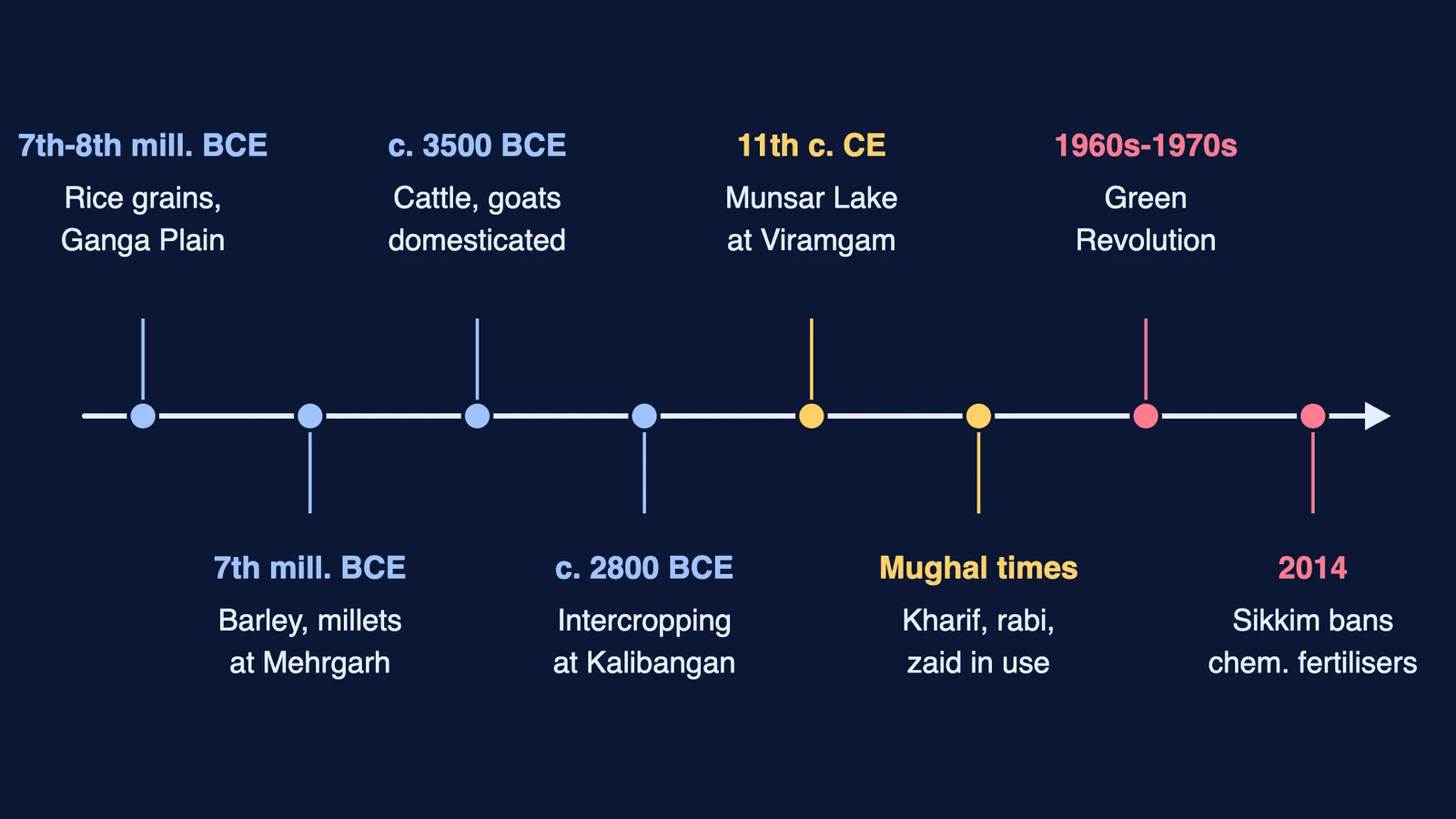
To prehistory. Rice grains in the Ganga Plain date to the 7th or 8th millennium BCE (systematic cultivation may have come later, the book notes), barley and millets at Mehrgarh to the 7th millennium BCE, and crossing furrows at Kalibangan show intercropping around 2800 BCE. Later texts such as the Arthashastra and the Vrikshayurveda advise on seeds, soils and watering.
What are kharif, rabi and zaid crops?
They are India's three cropping seasons, and the chapter says these Arabic terms have been used since Mughal times.
Kharif (monsoon crops): rice, maize, jowar, bajra, sugarcane, groundnut and cotton. They need the southwest monsoon, which rains from June to September.
Rabi (winter crops): wheat, barley, peas, mustard and gram.
Zaid (summer crops): watermelon, cucumber, muskmelon and pumpkin.
The northeast monsoon (October to December) waters the east and south; with monsoon rain plus irrigation, rice is grown all year in states such as Tamil Nadu, West Bengal and Andhra Pradesh. India has 15 agroclimatic zones that guide planners on what to grow.
Worked example: trace one thali back to the field
Take roti, rice, chana dal and watermelon, and use the chapter's season chart and soil-crop lists.
Roti (wheat): rabi. The chart marks it cool with less water, so northern farmers rely on groundwater, canals, ponds and soil moisture. Wheat is listed for alluvial soil.
Rice: kharif, fed by the southwest monsoon. It appears under several soil types.
Chana dal (gram): rabi, listed for alluvial soil.
Watermelon: zaid, a summer crop.
One meal draws on all three seasons; the book links this rhythm to steady food supply. It says the soil-crop lists need not be memorised, so learn the method.
What should you remember about soil, water and the Green Revolution?
Six soil types: alluvial, black, red, laterite, desert and mountain or alpine. Black soil holds moisture; alluvial soil is silt that rivers carry down, and is rich in nutrients.
Caring for soil: crop rotation, multiple cropping, contour ploughing and manure are traditional; terracing, afforestation and precise fertiliser use are current.
Water: rain-fed farming depends only on rain; irrigated farming adds water. Phad canals in Maharashtra and bamboo pipes in the northeast are traditional; drip and sprinkler systems are modern.
Seeds: traditionally saved and shared in families. The book says more farmers now buy high-yield, pest-resistant seed whose offspring often cannot be resown, which critics say makes farmers depend on seed companies.
Green Revolution (1960s and 1970s): high-yielding seeds, more irrigation, chemical fertilisers and pesticides, and machines. The book says grain output, especially wheat and rice, rose sharply and India became self-sufficient in food. The book also lists limits seen since: poorer soil, falling groundwater and polluted water. It presents sustainable farming, such as organic methods and neem-based pesticides, as a balance, and notes Sikkim's 2014 ban on chemical fertilisers and pesticides.
The chapter says ICAR has documented almost 5,000 traditional practices, tested over a hundred, and found more than 85 per cent of them backed by modern science. (The book prints "Indian Council for Agricultural Research"; the official name is the Indian Council of Agricultural Research.)
Practice questions and how the chapter connects
Marks are our suggestion; your school sets the real paper.
Name the three cropping seasons and give one crop for each. (2)
Why can parts of south India grow rice through the year? (2)
Explain two traditional ways of protecting soil. (3)
Compare rain-fed and irrigated farming, with one challenge of each. (3)
Give two gains and two limits of the Green Revolution, as the chapter describes them. (4)
The chapter builds on Part 1's climate and markets chapters. For the same topics in other books, see crops and seasons in Class 10 Agriculture and, from the older Class 8 book, land, soil and water in Class 8. For the monsoon in the new Class 9 book, read Atmosphere and Climate.
Not sure which part to revise first? Fermi's AI tutor works out what you already know and builds a plan for the session.