

On this page
Land, Soil, Water, Natural Vegetation and Wildlife Resources is chapter 2 of NCERT's Class 8 geography textbook, Resources and Development (read the chapter on NCERT's site). Check which book your school's current syllabus uses. The chapter asks the same three questions five times: what is this resource, what threatens it, and how do we conserve it?
What does Class 8 geography say about land and land use?
Land covers only about 30% of the Earth's surface, and not all of it is habitable (NCERT, chapter 2). The same chapter notes that 90% of the world's population lives on just 30% of the land area, while the other 70% of land is sparsely populated or uninhabited. Plains and river valleys are the densely populated areas.
Land use means the purposes land is put to, such as farming, forestry, mining, houses, roads and industry. Physical factors (topography, soil, climate, minerals, water) and human factors (population, technology) decide it. Land is either private or community land, and community land is also called a common property resource.
The threats NCERT lists are land degradation, landslides, soil erosion and desertification. The fixes are afforestation, land reclamation, controlled use of chemical pesticides and fertilisers, and limits on overgrazing.
What is a soil profile, and what forms soil?
Soil is the thin layer of grainy material covering the Earth's surface, made of organic matter, minerals and weathered rock (NCERT, chapter 2). A soil profile is the stack of layers you see when you cut down into the ground. From top to bottom:
Topsoil, with humus and vegetation
Subsoil, with sand, silt and clay
Weathered rock material
Parent rock
NCERT says it takes hundreds of years to make just one centimetre of soil, so soil lost to erosion is slow to replace. Five factors form soil. A memory line for them is “Rocks Change Really Over Time”:
Rock (parent rock): sets colour, texture, minerals and permeability
Climate: temperature and rainfall set the speed of weathering and humus formation
Relief: altitude and slope decide where soil builds up
Organisms: plants, animals and microbes set the speed of humus formation
Time: decides how thick the profile gets
Why is there water scarcity if water covers most of the Earth?
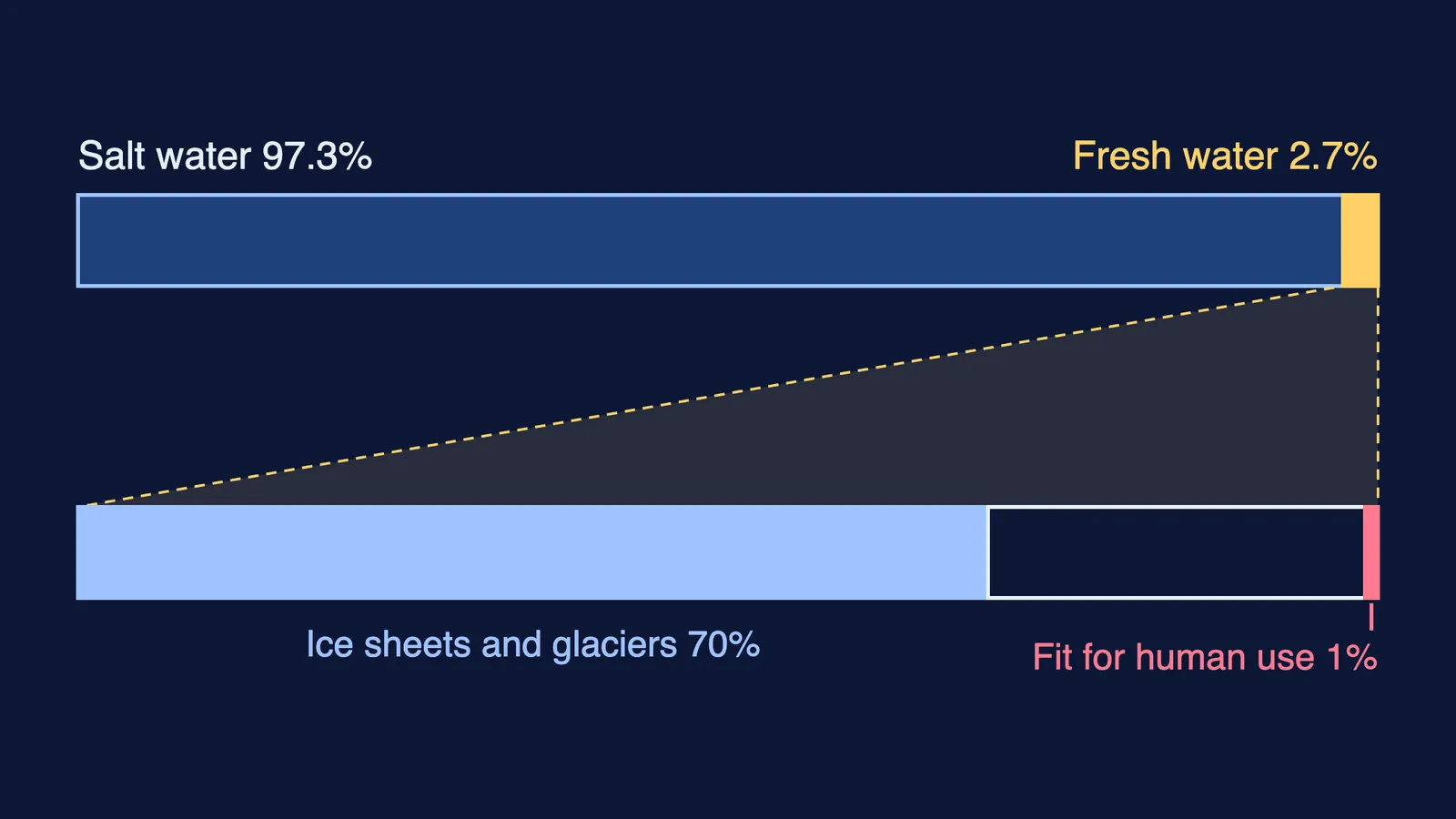
About three-fourths of the Earth's surface is covered with water, but fresh water makes up only about 2.7% of it (NCERT, chapter 2). Nearly 70% of that fresh water is locked in ice sheets and glaciers. Only 1% of fresh water is available and fit for human use. Scarcity comes from droughts and changes in seasonal or yearly rainfall, and from over-use and pollution by sewage, farm chemicals and factory waste.
Here is a worked example using the chapter's own figures. NCERT says an average urban Indian uses about 150 litres a day, with flushing and washing clothes at 40 litres each. A family of four at that rate uses 600 litres a day. NCERT also says a dripping tap wastes 1,200 litres a year. Fixing one tap therefore saves 1,200 ÷ 600 = 2 days of that family's water every year.
The conservation methods to learn are treating effluents before release, keeping forest cover, rainwater harvesting, lining canals, sprinklers, and drip irrigation for dry regions. Then read how rooftop rainwater harvesting recharges a borewell.
How are natural vegetation and wildlife conserved?
The biosphere is the narrow zone where land, water and air meet and life exists; the life-supporting system of interdependent living things is an ecosystem (NCERT, chapter 2). Temperature and moisture decide vegetation, and the four world types are forests, grasslands, scrubs and tundra.
Threats include deforestation, soil erosion, construction, forest fires, tsunamis, landslides and poaching for hides, skins, horns and feathers. NCERT gives the example of vultures in the Indian subcontinent dying of kidney failure after feeding on livestock treated with the painkiller diclofenac. Protection comes from national parks, wildlife sanctuaries, biosphere reserves, care for wetlands, and awareness. For India's own forest types, see natural vegetation and wildlife for Class 9.
How do you revise this chapter in one evening?
Use a five-by-three grid. The rows are land, soil, water, vegetation and wildlife. The columns are what it is, what threatens it, and how we conserve it.
Fill the grid from memory in 15 minutes, leaving gaps blank.
Open the chapter and fill the gaps in a different colour.
Draw the soil profile and label all four layers without looking.
Say the three water numbers aloud: 2.7%, 70%, 1%.
Redo the worked example with your own family's numbers.
If ideas like the water cycle or ecosystems feel shaky, the Fermi Concept Library has a lesson for each concept in physics, chemistry, biology, mathematics and computing. When you don't know where to start, Fermi's AI tutor can work out what you already know and build a plan for the session.
Land and soil come back in Class 10, so keep your grid and pick up from resources and development for Class 10.


