

On this page
In many Indian homes, rain on a concrete roof runs down a pipe and into a street drain. A recharge system sends it down through sand and stone instead, to top up the aquifer your borewell pumps from.
Natural recharge is rainwater seeping down and being stored in aquifers, according to the Central Ground Water Board's January 2025 guide on artificial recharge. Paving shrinks the area where this can happen, the guide notes; artificial recharge means building structures to increase it. For the bigger picture, read why groundwater levels are falling in many parts of India.
What are the parts of a rooftop rainwater harvesting system?
The CGWB guide lists seven components for a house:
The roof. RCC and tin sheets work best; asbestos is not suitable.
Gutters and downpipes.
A coarse mesh at each drain mouth to stop leaves (very fine mesh can waterlog the roof).
A first-flush valve to throw away the first spell of rain, with its dust and dry leaves.
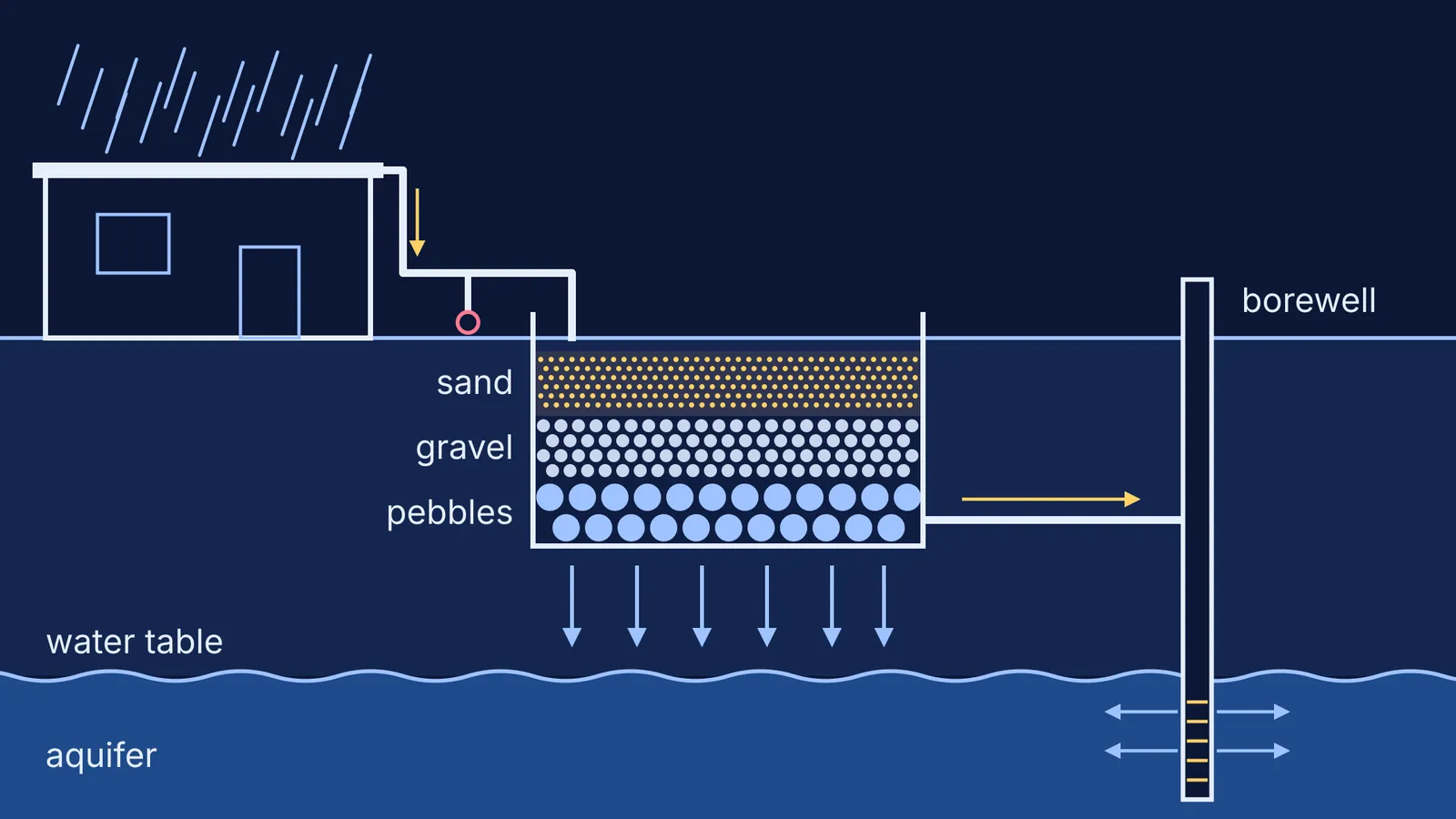
A wall-mounted filter: a PVC pipe packed with pebbles, gravel and sand.
A storage tank.
A recharge pit with its own filter, which sends water underground.
How does the sand and gravel filter clean the water?
The in-situ filter is a pit filled with three layers, pebbles at the bottom, gravel in the middle and coarse or fine sand on top, with water entering from the top and percolating down (CGWB guide).
The order matters. Sand has the smallest gaps between grains, so it catches silt first; the gravel and pebbles below drain quickly and hold the sand up. That is why the guide says to remove the top sand layer before every monsoon: the trapped dirt sits there. How easily water moves through each layer is the idea behind Henry Darcy's law of groundwater flow.
For scale, the guide suggests a filtration unit of about 2 m × 1 m × 1 m, around 2 cubic metres, for a roof of 100 square metres (about 1,000 sq ft).
Can rooftop rainwater recharge a borewell?
Yes. The CGWB guide says working and abandoned borewells, tubewells and dug wells can all be used, with conditions:
A borewell still in use should get only filtered rooftop rainwater, never overland flow from the yard or road.
Abandoned wells that dried up as the water level fell suit recharge best. Avoid wells abandoned for poor water quality, or that do not tap an aquifer.
Never send kitchen or toilet wastewater in, and keep the pit away from septic tanks and soak pits.
Skip recharge where the water level is shallower than 3 m below ground after the monsoon; store the water instead.
In limestone areas, avoid pits and borewells: dissolved cavities can carry water to the aquifer without passing through soil.
How much water can your roof send underground?
The CGWB formula is: water available (litres) = rainfall (mm) × roof area (m²) × 0.8, because about 80% of the rain falling on a roof can be harvested (CGWB guide).
The units work neatly: 1 mm of rain over 1 m² is 0.001 cubic metres, which is exactly 1 litre.
A worked example for a 100 m² terrace:
One 25 mm downpour: 25 × 100 × 0.8 = 2,000 litres.
A monsoon season of 600 mm: 600 × 100 × 0.8 = 48,000 litres.
Swap in your own district's rainfall from the India Meteorological Department's rainfall statistics.
Now compare. That one downpour delivers 2 cubic metres, the whole volume of the suggested filtration unit, which is mostly stone. It copes only because water keeps leaving through the bottom or the pipe to the borewell; if the sand clogs, the rest spills over. So the guide says to size the pit from roof area and rainfall to cope with peak rain, add more structures for large roofs, and clean the filter material.
What should you check before the monsoon?
A pre-monsoon checklist drawn from the CGWB guide:
Sweep the roof and clear the gutters.
Check that the mesh at each drain mouth is in place.
Check that the first-flush valve works, so the first spell of rain is diverted away from the filter.
Scrape off and replace the top sand layer of the recharge pit.
Clean the filter media once or twice a year, and the tank and pipes before each monsoon.
Make sure no wastewater or septic overflow can reach the pit.
Older systems use the same idea: see Anupam Mishra's work on traditional water harvesting ponds.
If flow through layers is hard to picture, the Fermi Simulation Lab has interactive simulations for ideas that are easier to see than to read, and the Fermi Concept Library gives every concept in physics, chemistry and biology its own lesson.


