

On this page
In the mid-19th century, European cities struggled to provide clean drinking water to their residents. Henry Darcy was born in 1803 and died in 1858 in France (Wikipedia). By 1840, he completed a closed aqueduct that brought pure water 12.7 kilometers from the Rosoir Spring to Dijon (Wikipedia).
This engineering feat made Dijon one of Europe's best-supplied cities, but Darcy's lasting scientific legacy came 16 years later. While studying how to filter the city's water through beds of sand, he discovered the fundamental mathematical relationship that dictates how fluids move through the earth.
What is the history of Darcy's law for groundwater flow?
Darcy did not initially set out to invent a new branch of physics. In 1856, Darcy published the engineering monograph *Les fontaines publiques de la ville de Dijon* (Wikipedia). The book detailed the design of the water system, down to pipe friction and reservoir construction.
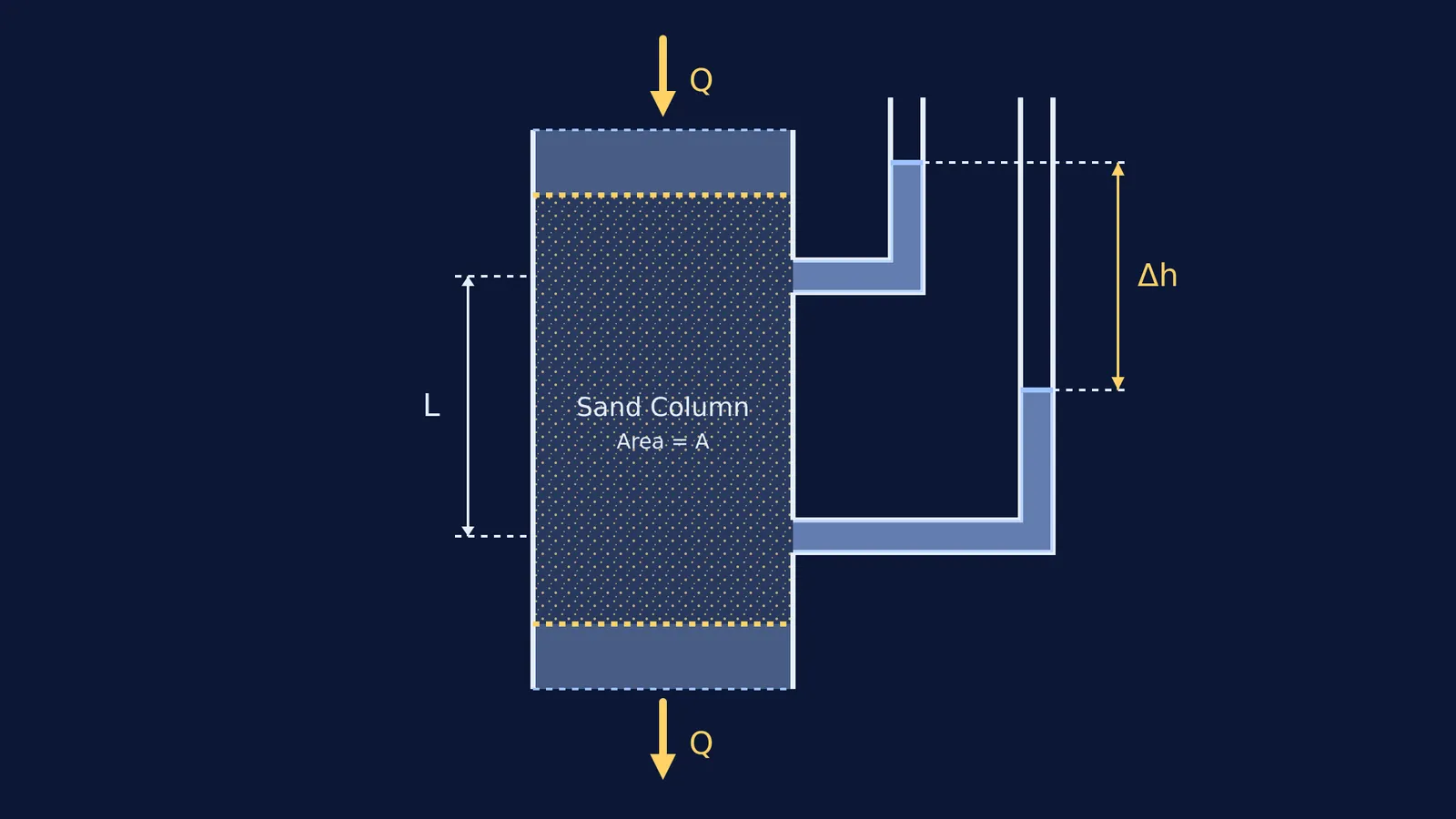
Tucked away in Appendix D of this work was a description of a modest but precise experiment. Darcy had packed a vertical cylinder with sand, run water through it, and measured how quickly it drained. By changing the depth of the sand and the pressure of the water, he found a perfectly linear relationship. This single appendix laid the groundwork for modern hydrogeology and petroleum engineering.
How does Darcy's law work?
Darcy's Law is an equation that describes the flow of a fluid through a porous medium (Wikipedia). His experiment relied on measuring the hydraulic head (the combined elevation and pressure of the water) at two points.
He found that the flow rate (Q) through the sand was directly proportional to the cross-sectional area (A) and the difference in hydraulic head (Δh), but inversely proportional to the length of the sand bed (L). The relationship is expressed as:
Q = −KA(Δh/L)
Q is the volumetric flow rate.
K is the hydraulic conductivity, a constant representing how easily water moves through the specific material.
A is the cross-sectional area.
Δh is the difference in head between the start and end of the flow.
L is the distance the water travels.
The negative sign indicates that water always flows down the pressure gradient, from high head to low head. Experimental tests confirm Darcy's Law is valid for porous media when the Reynolds number is up to 10 (Wikipedia). It operates on a vastly different scale than the massive currents seen in the ocean conveyor belt, focusing instead on microscopic, creeping flow.
Modelling invisible flow
Darcy succeeded because he built a physical model that isolated the variables he cared about. Groundwater is invisible, trapped under soil and rock, which makes it incredibly difficult to study directly. By bringing a core of sand into a courtyard and adding manometers (pressure-measuring tubes), he turned a hidden geological process into a measurable tabletop experiment.
Students studying physics today face a similar challenge: understanding fields and flows that cannot be easily pictured in a textbook. If you struggle to visualise these hidden systems, the Fermi Simulation Lab provides interactive simulations for the ideas that are easier to see than to read. Changing the permeability or pressure in a digital model helps build the same intuition Darcy gained from his metal column.
When you tackle complex numericals on fluid dynamics, Fermi's AI tutor teaches — it holds a line of reasoning across a whole session, notices where you are stuck, and decides whether to explain, ask, or show.
A framework for experimental physics
If you are setting up a practical experiment or studying a new physical law for an exam, follow Darcy's approach to isolating variables:
Fix the geometry: Darcy kept the cross-sectional area (A) constant while he varied the pressure. When studying an equation, hold all constants steady to see how just two variables interact.
Measure the extremes: Instead of trying to measure what happens inside the sand, he measured the state at the start (inflow) and the end (outflow). The difference (Δh) is what drives the change.
Determine the constant: Every medium has its own resistance. In Darcy's case, it was hydraulic conductivity (K). In electricity, it is resistivity. Finding this constant allows you to predict behaviour under any condition.


