

On this page
What is the engineering behind traditional ponds?
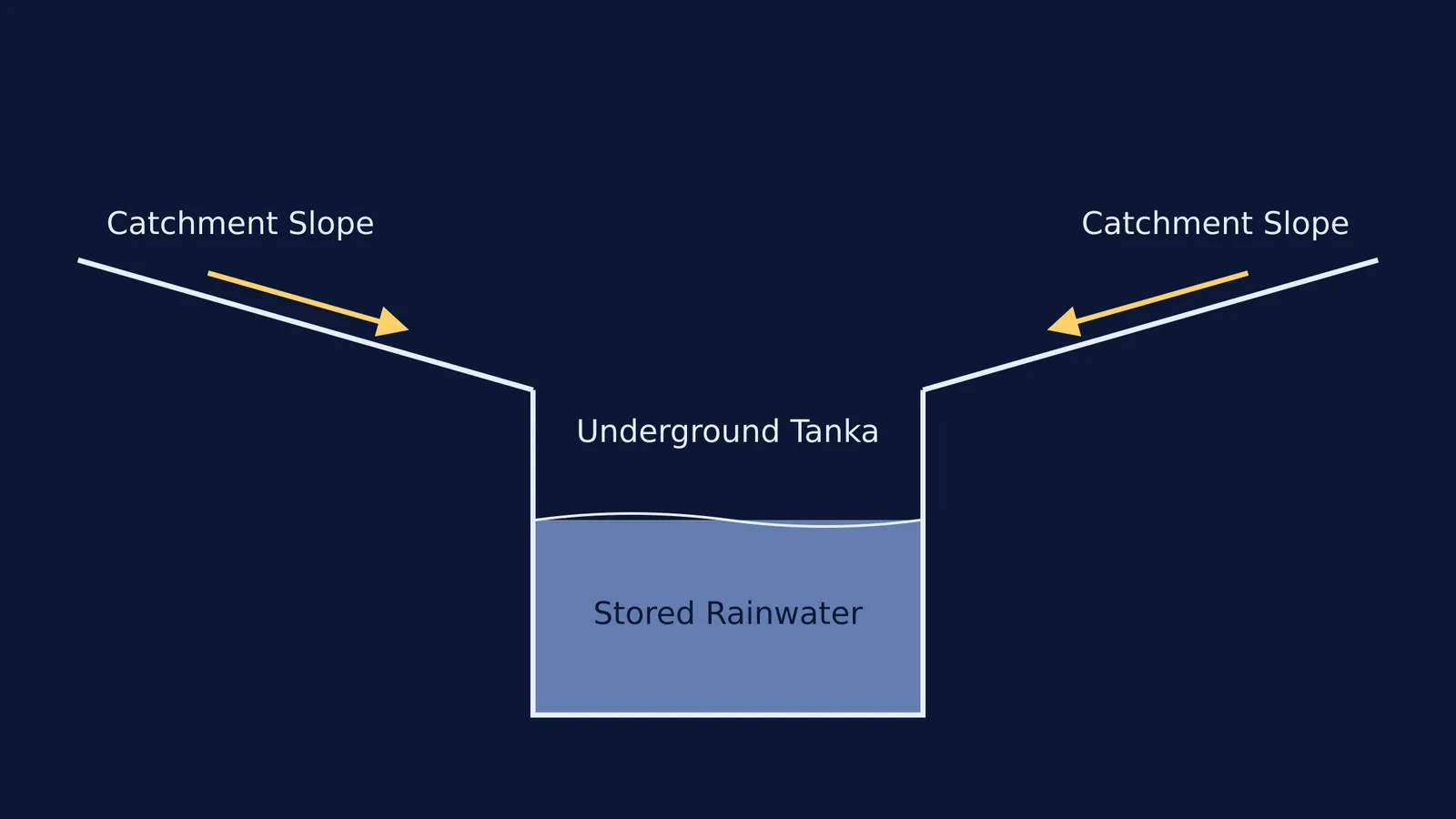
In 1993, environmentalist Anupam Mishra published *Aaj Bhi Khare Hain Talaab* (Ponds Are Still Relevant), a definitive text on traditional water harvesting across India. The book highlights how communities built sophisticated structures—like *tankas* (underground tanks), *kuis* (narrow wells), and *baolis* (stepwells)—without modern engineering degrees. By observing the flow of water, the porosity of sand, and the slope of the land, builders developed techniques that lasted over 400 years.
These structures were not just holes in the ground. A *kui* in the Thar desert, for instance, is dug specifically above a gypsum layer that prevents the collected rainwater from mixing with the deeper, saline groundwater. The builders understood the geology of the soil and the mechanics of capillary action, ensuring a fresh water supply in one of the most arid regions on Earth.
How did Anupam Mishra document water harvesting?
Mishra spent decades travelling across states like Rajasthan, Madhya Pradesh, and Uttar Pradesh to study these systems. He found that the success of these traditional ponds lay in a deep understanding of local physics and geography, passed down through generations.
For instance, in his 2009 TED Talk on ancient ingenuity, Mishra noted that the Jaigarh Fort near Jaipur could store six million gallons of rainwater using a precisely angled canal system. These builders did not memorise equations for fluid dynamics; they understood them intuitively. They knew exactly how much slope was needed to keep the water moving without causing erosion, and how to filter out silt before it reached the main storage tanks.
Can we learn physics from first principles?
This approach to traditional engineering is directly relevant to how we study science today. When students struggle with fluid mechanics or hydrodynamics, the gap is rarely a lack of formulas. It is usually a lack of physical intuition—an inability to "see" how pressure, velocity, and gravity interact in a real-world system. Modern education often skips the observation phase and jumps straight to the mathematics, leaving students with equations they do not truly understand.
Instead of rote learning, Mishra's subjects learned by doing and observing. The Fermi Simulation Lab offers interactive simulations for the ideas that are easier to see than to read. You can adjust the depth of a tank or change the diameter of a pipe to see exactly how the water's velocity and pressure respond in real time. This builds the same intuitive understanding that traditional builders used to design their canals and stepwells.
Why did these traditional systems last so long?
The longevity of these water harvesting systems comes down to active community participation, a concept that mirrors effective learning. In traditional Indian society, managing water was a collective responsibility. The society took ownership of its local environment rather than waiting for external help. Builders, farmers, and families worked together to maintain the ponds, clearing silt before the monsoons and repairing the catchment areas.
This communal approach to problem-solving is another powerful habit you can adopt. Discussing difficult concepts with peers, teaching a complex topic to a friend, and working through challenging numericals together can cement your understanding far better than studying in isolation. Just as a *tanka* requires a well-maintained catchment area to collect water, your brain requires active engagement to collect and retain knowledge.
How can you apply this lesson to your studies?
If you want to master physics or mathematics, follow Mishra’s example of looking closely at the fundamentals rather than memorising the end results. Here is a framework to apply this mindset to your daily studies:
Observe before you calculate. When faced with a physics problem about fluid flow or pressure, sketch the scenario. Think about what would happen if you changed a variable, much like an ancient builder considering a steeper canal.
Understand, don't just solve. It is easy to look up a solution when you are stuck, but that does not build lasting knowledge. If you get stuck on a tricky numerical, the Fermi Problem Library has worked problems with a step-by-step solver that explains the reasoning rather than printing an answer.
Link theory to reality. Connect the abstract equations you learn to physical phenomena. See how geography links to physics, and how physics links to mathematics. The Fermi Concept Library contains every concept in physics, chemistry, biology, mathematics and computing, each with its own lesson and its place in the map.
Learn from multiple sources. Traditional builders learned from the land, their elders, and their mistakes. Read widely and look for different explanations of the same concept to build a well-rounded understanding. For more on evidence-based study methods, read Ten study techniques rated: inside the 2013 Dunlosky review.
Mishra kept *Aaj Bhi Khare Hain Talaab* copyright-free, and it has since been translated into 19 languages, including Braille. Its lasting legacy is a reminder that the best solutions come from understanding the environment around us. Next time you face a tough problem, take a step back and look at the first principles, much like the builders of India's enduring ponds. To explore more about how early scientists understood fluids, look at Daniel Bernoulli and Hydrodynamica, the book behind the equation.


