

On this page
On the western slopes of the Western Ghats the forest stays green all year. In Rajasthan the trees thin into thorny scrub. NCERT's chapter on natural vegetation defines natural vegetation as a plant community left undisturbed long enough for its species to adjust to the local climate and soil, and sorts India's forests into five groups.
Is natural vegetation still in the Class 9 syllabus?
For 2026–27, NCERT's Class 9 social science books are Understanding Society: India and Beyond, Part I and Part II (contents of Part I). The geography chapter in Part II, Life on Earth, teaches biomes: large natural regions where certain plants and animals live under similar climatic conditions. It names the Andaman and Nicobar Islands and the north-eastern states as India's smaller rainforest regions. The detailed five-way split of India's forests is in NCERT's Class 11 book, India: Physical Environment.
What are the five forest types of India, and where does each grow?
Every figure in this section comes from NCERT's Class 11 chapter on natural vegetation.
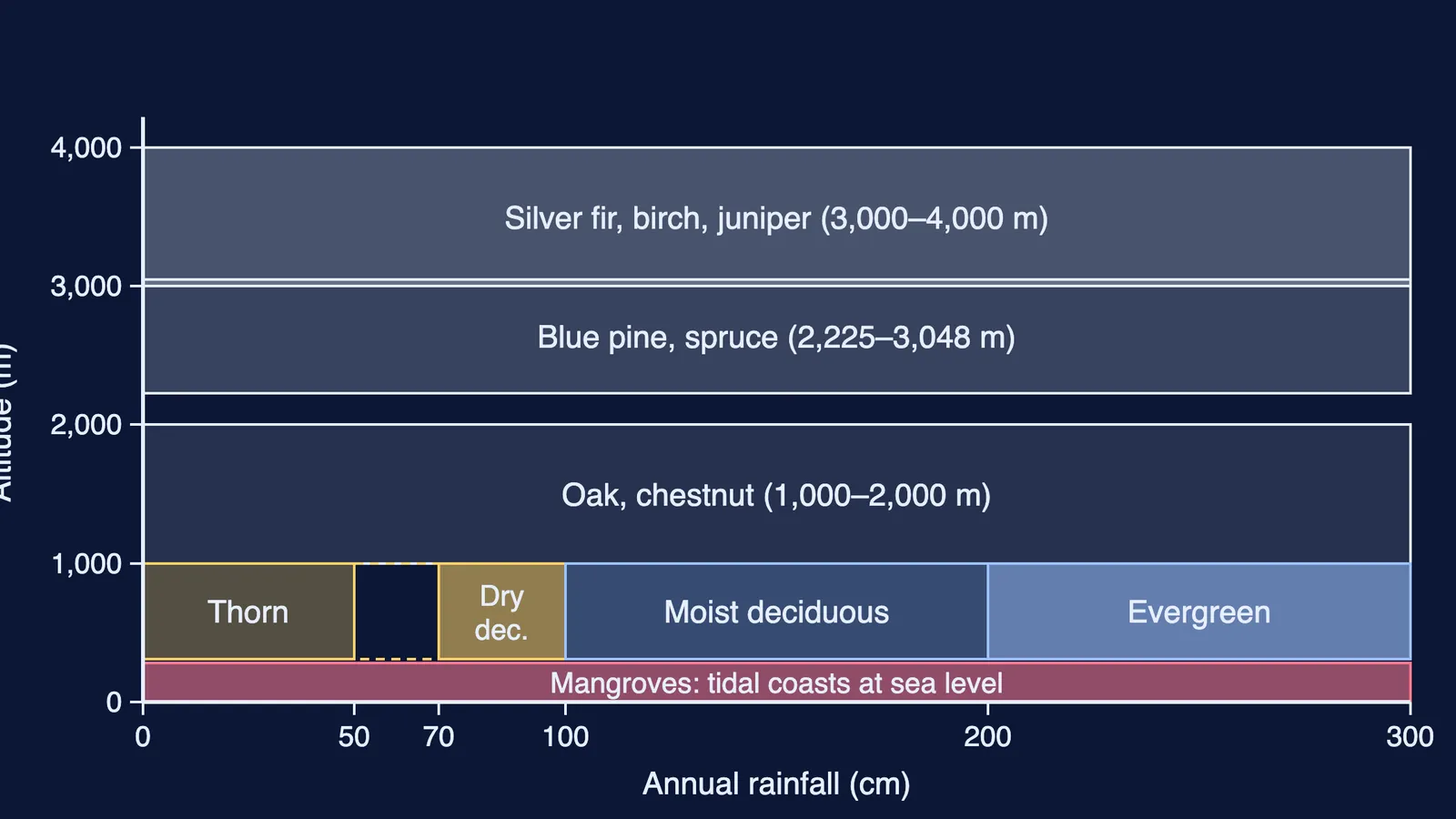
Tropical evergreen and semi-evergreen: evergreen forests need over 200 cm of rain a year and a mean annual temperature above 22°C, and grow on the western slope of the Western Ghats, in the hills of the north-east and on the Andaman and Nicobar Islands. Trees reach 60 m or more and have no fixed season for shedding leaves, so the forest stays green: rosewood, mahogany, ebony. Semi-evergreen forests grow in the less rainy parts of the same regions.
Tropical deciduous, or monsoon forests: 70–200 cm of rain, and the most widespread forests in India. Moist deciduous (100–200 cm) grow along the Himalayan foothills in the north-east, on the eastern slopes of the Western Ghats and in Odisha: teak, sal, sandalwood. Dry deciduous (70–100 cm) grow in the rainier parts of the Peninsula and on the plains of Uttar Pradesh and Bihar: tendu, palas, khair. See why many Indian trees drop their leaves in summer.
Tropical thorn: under 50 cm of rain, in semi-arid parts of south-west Punjab, Haryana, Rajasthan, Gujarat, Madhya Pradesh and Uttar Pradesh. Plants stay leafless for most of the year: babool, ber, khejri.
Montane: altitude, not rain, sets the type. In the Himalaya, oak and chestnut grow at 1,000–2,000 m, blue pine and spruce at 2,225–3,048 m, and silver fir, birch and rhododendron at 3,000–4,000 m, with alpine forests and pastures in the higher reaches. In the Nilgiri, Anaimalai and Palani hills, the temperate forests are called sholas; read about the Nilgiri shola-grassland ecosystem.
Littoral and swamp: salt-tolerant mangroves along tidal creeks, mud flats and estuaries, best developed in the Sunderbans and the Andaman and Nicobar Islands, and also in the Mahanadi, Godavari and Krishna deltas. The textbook puts India's mangroves at 4,992 sq km, 7% of the world's. Read how mangroves protect coasts.
Why does rainfall decide most of India's forests?
A tree that keeps its leaves all year needs water all year, so evergreen forest needs the most rain. Where the dry season is long, trees drop their leaves to get through it. With too little rain for forest, grasses and thorny shrubs take over. In the mountains, NCERT's chapter explains, temperature falls with height and the vegetation changes. The southern slopes of the Himalaya are more thickly forested than the north-facing slopes because they get more rain.
If the plant biology underneath feels shaky, the Fermi Concept Library covers every concept in physics, chemistry, biology, mathematics and computing.
How do you work out a region's forest type?
Ask four questions, using the rainfall bands from NCERT's chapter:
Is it a tidal coast, delta or estuary? Mangrove.
Is it high in the mountains? Montane, and the height picks the trees.
Otherwise, how much rain a year? Over 200 cm evergreen, 100–200 cm moist deciduous, 70–100 cm dry deciduous, under 50 cm thorn.
Between 50 and 70 cm? NCERT says dry deciduous forest turns into thorn forest on its drier margins, so expect a mix.
Try it:
The Sunderbans, a tidal delta, stops at question 1: mangrove.
The Nilgiri hills stop at question 2: montane, with sholas.
The plains of Bihar reach question 3, and NCERT lists them under dry deciduous, the 70–100 cm band.
To plan the whole chapter, Fermi's AI tutor can work out what you already know and build a plan for the session, so you start with a clear next step.
How is India's wildlife protected?
NCERT's Class 11 chapter estimates that about 4–5% of all known plant and animal species are found in India. The Wildlife Protection Act of 1972 protects endangered species and gives national parks and sanctuaries legal backing. India has 18 biosphere reserves, 12 of them in UNESCO's World Network. Project Tiger began in 1973, and India's tiger population rose from 1,411 in 2006 to 3,682 in 2023.
India's forest policy aims for 33% of the land under forest; the India State of Forest Report 2023 puts forest cover at 21.76% of the geographical area.
Next, shade the five types on an outline map of India and check it against NCERT's map.


