On this page
Drive up to Ooty or walk the upper Nilgiris and the hills look stitched together: rolling grass on the ridges, and tight, dark patches of forest folded into the valleys. That pattern is the shola-grassland mosaic, and the sharp line between forest and grass is not random.
What are shola forests?
Shola forests are patches of stunted evergreen forest set among undulating grassland in the high hills of the Western Ghats, according to a 2015 PLOS ONE study by Das, Nagendra, Anand and Bunyan. The mosaics they studied range from about 500 m to 2,695 m above sea level. Elevation was the most important predictor of what grows where. Above 2,000 m, only 28% of their sample points were forest, against about 50-60% in mosaics below 2,000 m.
So "shola" is the forest, and the mosaic is the whole patchwork. The grassland is an ecosystem in its own right; if that part is hazy, revise the components and food chain of a grassland ecosystem first.
Why does the forest stay in the valleys?
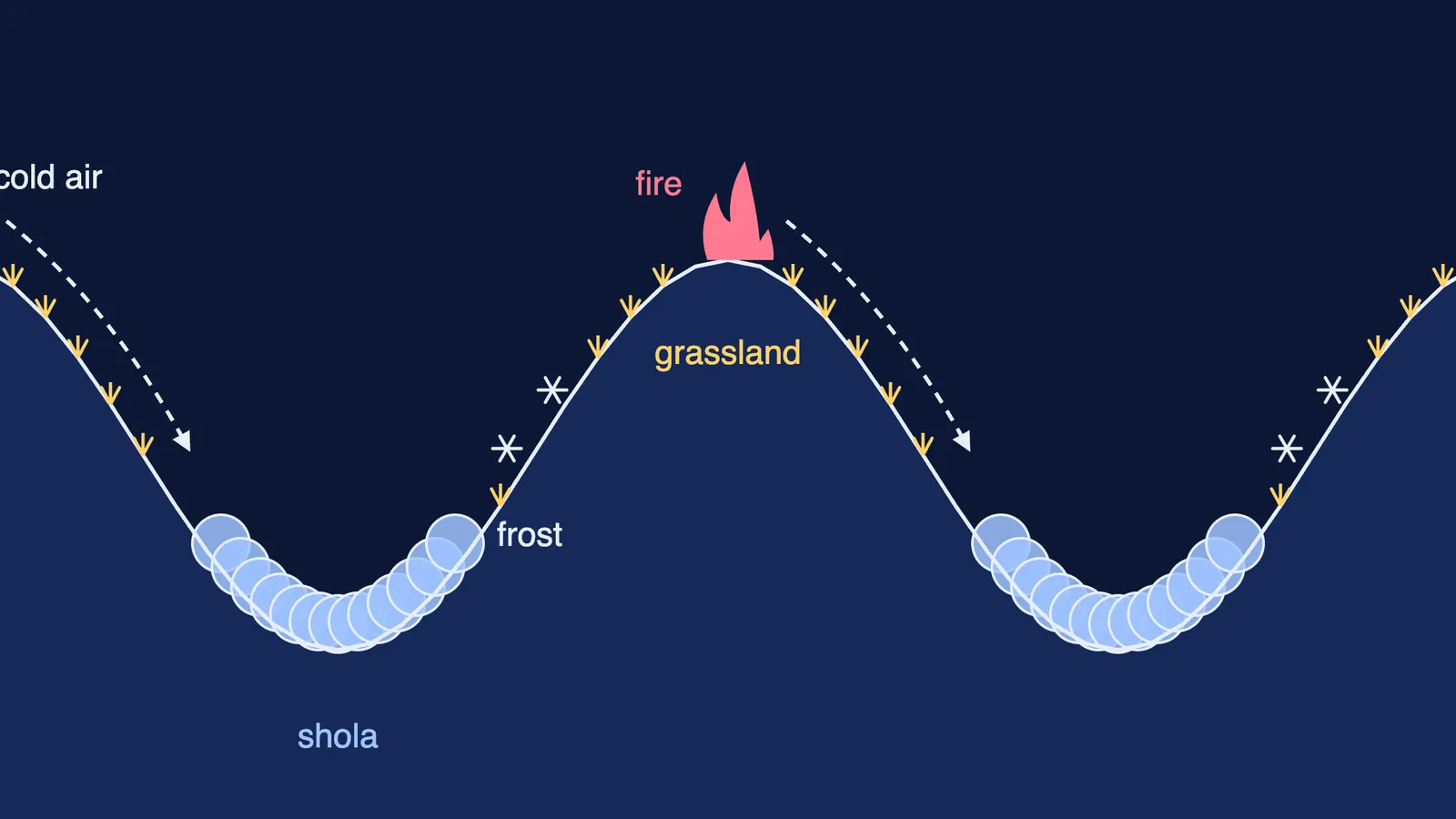
The same PLOS ONE study describes forest patches in valleys, depressions and sheltered sites, and grassland on ridges, hilltops and exposed areas. Two forces help explain the pattern: frost and fire.
Start with frost. Ground frost occurs above 2,000 m between November and February, the 2015 study notes. Here is the twist: valley bottoms are more frost-prone than higher ground, because cold air sinks and pools there. So why would trees survive in the frostiest spot?
A field experiment by Joshi, Ratnam and Sankaran in the Journal of Ecology (2020) points to the answer. Seeds of native trees germinated better in the grassland than in the forest. But native seedlings in grassland suffered high mortality after winter frosts and freezing temperatures, while in the adjoining forest freezing temperatures did not occur. Once a forest stands somewhere, it seems to keep freezing nights off its own seedlings.
Fire pushes the same way. Forests that sit beside more flammable vegetation are often found in places that slow fire, such as rocky outcrops, valleys and slopes sheltered from fire-bearing winds, the 2015 PLOS ONE study notes, summarising earlier research on such mosaics. Terrain steers those winds and breaks up fuel, so sheltered folds burn less easily.
What is changing the shola grasslands?
The frost balance can tip. In the Joshi experiment, seedlings of the alien tree Acacia suffered much lower winter mortality than native seedlings. Night-time warming raised the over-winter survival of all seedlings, but far more for Acacia. The authors expect warmer winters to favour trees spreading into grassland, non-native Acacia most of all; compare India's invasive alien species and why they win.
Planting and invasion have already moved the line. Arasumani and colleagues (Biological Conservation, 2019) mapped the Shola Sky Islands from Landsat images of 1973, 1995 and 2017, with 840 ground-truth points. They found substantial landscape modification, 7% to 60%, on the large high-elevation plateaus over four decades.
Why does the Nilgiri tahr need the grassland?
The Nilgiri tahr lives on open montane grassland and rocky cliffs, mostly in the Nilgiri and Anamalai Hills, at about 1,200 to 2,600 m, and is listed as Endangered on the IUCN Red List, as its Wikipedia entry, citing the IUCN, summarises. The entry names habitat loss and invasive species as its main threats.
A first-of-its-kind synchronised Tamil Nadu-Kerala survey in 2024 estimated 1,031 tahr in Tamil Nadu, with 203 in Mukurthi National Park and 278 in Grass Hills National Park, and 827 in Eravikulam National Park in Kerala, DT Next reported. These hills sit in the Western Ghats, one of India's biodiversity hotspots.
How do you explain the shola mosaic in an exam answer?
Use four steps:
Describe the pattern: forest in valleys and sheltered folds, grass on ridges and exposed slopes.
Name the drivers: frost (tree seedlings in open grass die over winter) and fire (sheltered terrain checks it).
Explain the feedback: each vegetation type keeps its own microclimate, so both are stable alternate states.
Add the threat: plantations, invasive Acacia and warmer nights favour trees, so grassland and its animals, such as the Nilgiri tahr, lose ground.
Worked example. Question: "At 2,200 m in the Nilgiris, a hillside has forest in a gully and grass on the ridge above. Native saplings planted on the ridge mostly die. Why?"
Answer: At this height, ground frost occurs in winter. In the Joshi experiment, native seedlings in grassland died heavily after frosts, whatever the soil type, while the adjoining forest did not freeze. The ridge has no forest to shelter them. Fire on the exposed ridge adds a second risk.
If microclimate or alternate states still feel slippery, the Fermi Concept Library gives every concept in biology its own lesson and its place in the map. Unsure where to start the ecology chapter? Fermi's AI tutor can work out what you already know and build a plan for the session.
Next time you see a hill with forest only in its folds, ask where the cold air goes at night.