

On this page
Lantana, Parthenium, water hyacinth and African catfish are the classic Indian examples of invasive species in Class 12 ecology. Naming them is easy. Explaining why each one wins is what earns marks.
What are invasive alien species?
An alien species is one carried by people outside its natural range; it becomes invasive when it spreads on its own and harms native species or people. The IPBES global assessment on invasive alien species, approved in September 2023, calls them one of the main direct drivers of biodiversity loss worldwide.
Of more than 37,000 alien species recorded worldwide, around 3,500 are invasive, and invasives were a major factor in 60% of recorded plant and animal extinctions, as Down To Earth's report on the assessment sets out.
How did Lantana take over India's forests?
Lantana camara is a thicket-forming shrub that arrived in India as a garden plant in the early 1800s, as Mongabay India reported on the 2020 Wildlife Institute of India study. That study, by Ninad Mungi, Qamar Qureshi and Y. V. Jhala in Global Ecology and Conservation, found Lantana in about 154,000 sq km of forest, more than 40% of India's tiger range. Its models put another 300,000 sq km of forest at risk.
How it wins:
Fruit-eating birds, monkeys and bears carry its seeds deep into forests.
It also regrows from its rootstock and nodes, so cutting the top off does not kill it.
It replaces the grasses of the forest floor, which changes how forest fires burn.
The paper's title names two factors behind its success: an expanding niche and degrading forests.
Why is Parthenium so hard to get rid of?
Parthenium hysterophorus, called gajar ghas or Congress grass, has invaded about 35 million hectares of India, according to the Indian Council of Agricultural Research (ICAR). ICAR says it came in with wheat imported from the USA in the early 1950s. It causes skin allergy, hay fever and breathing problems in people and animals.
A 2014 review by Kaur and colleagues explains why it spreads so well. One plant can produce up to 25,000 seeds, building a large seed bank in the soil. It releases parthenin, a chemical that stops seeds of other plants germinating and their roots growing. Using chemicals to hold back rival plants is called allelopathy.
How does water hyacinth choke a lake?
Water hyacinth (Eichhornia crassipes) floats on the surface and spreads by runners and seeds. Its seeds can lie dormant in the mud for years. Its populations can double in as little as two weeks, according to the University of Florida's aquatic plant centre. Dense mats block air and light and use up oxygen, pushing out native plants and fish.
A worked example shows why lakes seem to clog overnight.
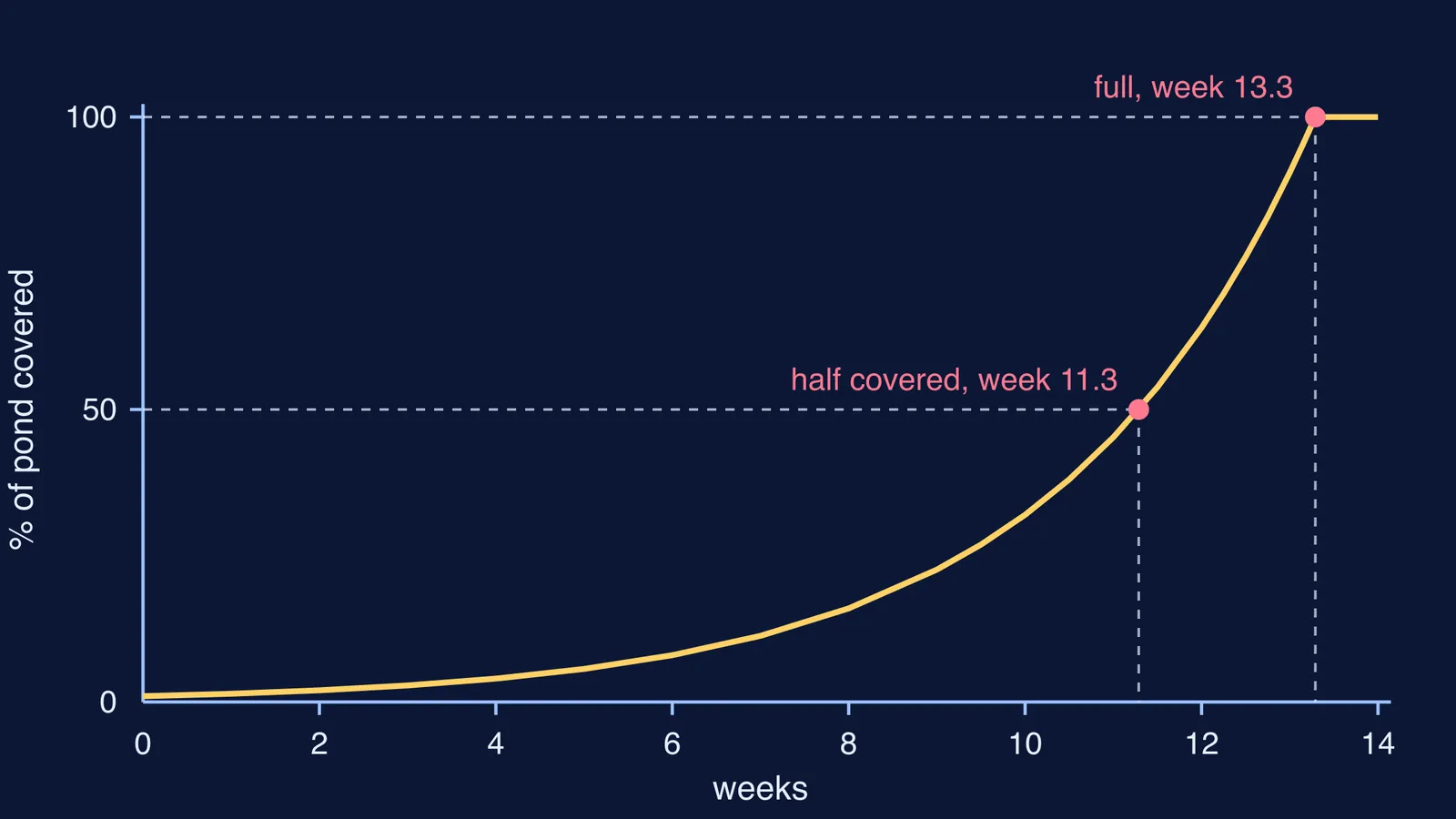
Suppose a mat covers 1% of a pond and doubles every two weeks.
After 2, 4, 6, 8, 10 and 12 weeks it covers 2, 4, 8, 16, 32 and 64%.
Full cover needs 2 to the power n to equal 100, so n = log2(100), about 6.6 doublings, or roughly 13 weeks.
The pond is half covered at about week 11 and full two weeks later.
For two months the mat looks small; by the time anyone notices, the damage is nearly done. This is exponential growth.
Why is African catfish banned in India?
African catfish (Clarias gariepinus) was smuggled in from Bangladesh by private fish traders in the late 1980s or early 1990s for fish farming, writes Unmesh Katwate of the Bombay Natural History Society. It eats native fish, fish eggs, amphibians, reptiles and even birds, breeds heavily, grows fast and tolerates poor water. Native fish, including mahseer, have been reported to disappear from rivers it has taken over.
Its culture and trade are banned under the Environment Protection Act, 1986, and the National Green Tribunal reinforced the ban in an order dated 22 January 2019. Illegal farms still exist.
How do you remember all four for exams?
Ask three questions about each species: how it came, how it wins, what it harms. The figures come from the Kaur review and the University of Florida page cited above.
Lantana: garden plant; birds and mammals spread its seeds and it regrows from roots; forest understorey.
Parthenium: with imported wheat; up to 25,000 seeds per plant and parthenin; crops, native plants and health.
Water hyacinth: floating plant; doubles in about two weeks; oxygen, light, fish.
African catfish: fish farming; predator that breeds fast and tolerates dirty water; native fish such as mahseer.
Invasion is one of the evil quartet of biodiversity loss, and fast breeders like these fit the pattern in r-selected vs K-selected species.
If allelopathy, niche or exponential growth still feel shaky, the Fermi Concept Library covers every concept in biology, each with its own lesson. For growth sums like the pond example, the Fermi Problem Library has a step-by-step solver that explains the reasoning rather than printing an answer.


