

On this page
When a population faces a changing environment, species adapt through one of two distinct evolutionary strategies to ensure their survival. Ecologists classify these as r-selection and K-selection.
What are r-selected species?
Species that follow the r-selection strategy thrive in unstable or unpredictable environments. Their primary goal is to reproduce as quickly and abundantly as possible, assuming that most offspring will not survive to adulthood.
These species are characterised by small body sizes, rapid maturation, and little to no parental care. For instance, a female housefly (*Musca domestica*) lays 75 to 150 eggs in a single cluster, and can produce hundreds of eggs over her short lifetime. Because their habitats frequently change—such as seasonal ponds drying up or food sources rotting away—insects and other r-strategists rely on a boom and bust population model. The few offspring that do survive the immense early mortality go on to repeat this rapid cycle, allowing the species to quickly exploit temporary resources before conditions deteriorate. Other examples include weeds, bacteria, and many small fish, all of which prioritise explosive population growth over individual longevity.
What are K-selected species?
In stable, predictable environments where competition for resources is fierce, species use the K-selection strategy. Instead of quantity, these animals and plants invest heavily in the quality of their offspring.
K-selected species typically have large bodies, long lifespans, and extensive parental care. A prime example is the African elephant, which has a 20 to 22-month gestation period. Mothers typically wait three to nine years between calves, investing immense energy and time into raising a single offspring to ensure it reaches adulthood. Because these species live near the maximum capacity their environment can support, their survival depends on outcompeting others rather than breeding quickly. They inhabit old-growth forests, stable coral reefs, and other predictable ecosystems. Humans, whales, and large birds of prey also follow this K-selected strategy, dedicating years to teaching their young the skills needed to survive in a highly competitive habitat.
What is the difference between r and K selection?
The core difference lies in how species allocate their biological energy. r-selected species invest energy in producing a vast quantity of offspring, while K-selected species invest in parental care and the long-term survival of a few.
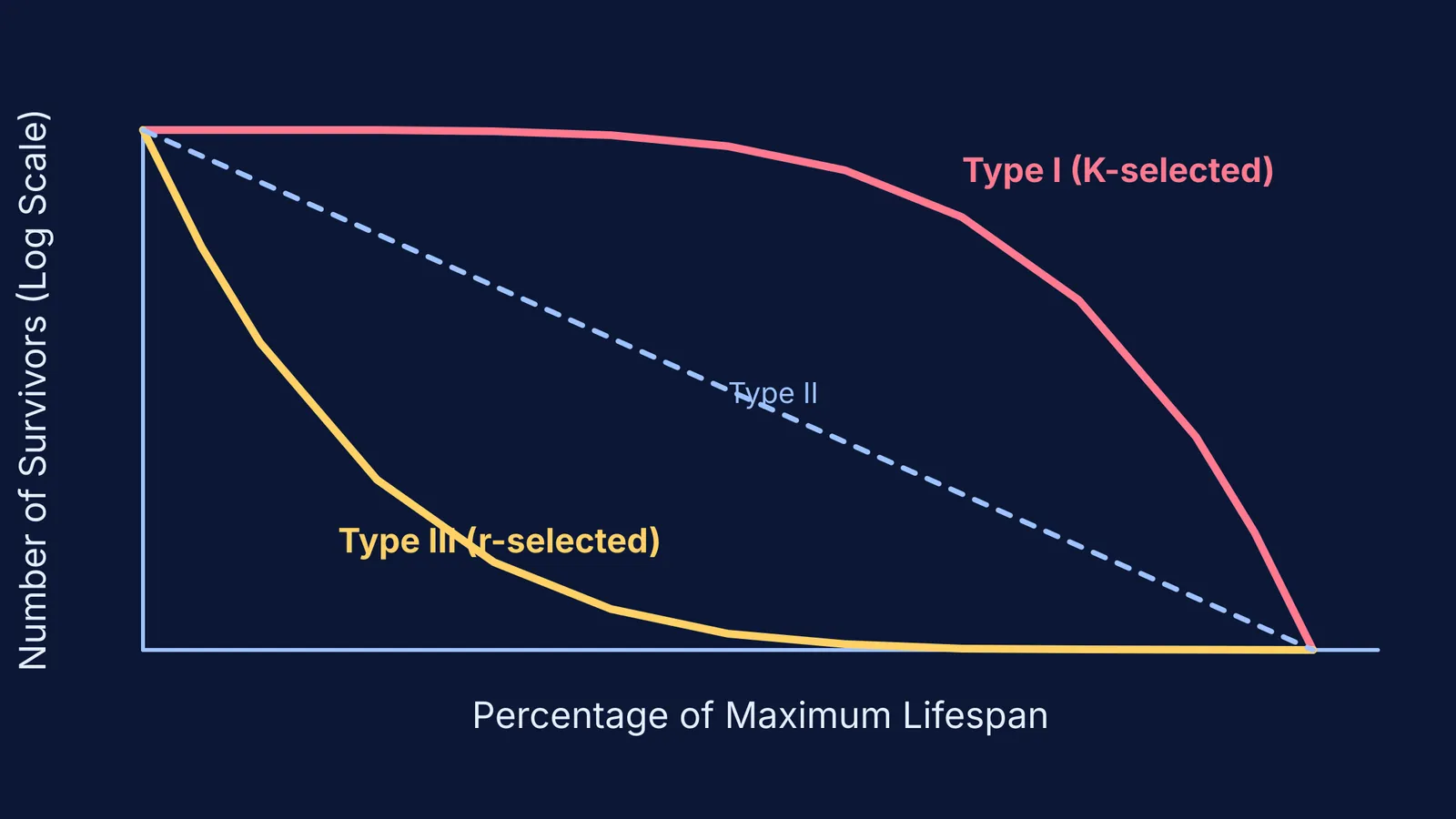
Survivorship: r-selected species exhibit a Type III survivorship curve, where most individuals die young. K-selected species follow a Type I curve, where most individuals survive into old age.
Population growth: r-selected populations typically experience exponential growth followed by sudden crashes when resources run out. In contrast, K-selected populations exhibit logistic growth, where the population size levels off as it approaches the carrying capacity of the habitat.
Competition: r-strategists face low competition because their populations are often kept in check by external environmental factors. K-strategists face high competition, governed by the competitive exclusion principle.
Environmental stability: While r-selected species can colonise disturbed habitats rapidly, K-selected species dominate stable ecosystems where Shelford's law of tolerance dictates the strict limits they are adapted to.
Ecologists now view these strategies as a continuum rather than rigid boxes. Sea turtles, for example, live long lives like K-strategists but lay hundreds of eggs with zero parental care, sharing traits with r-strategists. Asking Does Evolution Have a Goal or Direction? helps clarify this: neither strategy is inherently better, as each is simply the most successful adaptation to a specific set of environmental pressures.
How to remember r and K selection for exams?
When preparing for biology exams, confusing the two strategies is a common mistake. Use this simple framework to lock in the differences:
Map the letters: Remember that r equals rapid reproduction, while K equals care (and carrying capacity).
Anchor to extreme examples: Always associate r-selection with an insect (like a mosquito or fly) and K-selection with a large mammal (like a human or elephant).
Trace the energy: If the exam asks about parental investment, picture the energy split. Is it divided into hundreds of tiny eggs or one large calf?
If you are struggling to map ecological strategies and survivorship curves, the Concept Library connects every biology concept to its place in the syllabus. When you need to test how changing the environment affects a population's growth rate, Fermi's AI tutor can run the simulation and check your understanding as it goes.


