

On this page
A tiger beetle will not lay its eggs just anywhere. Victor Shelford found that females laid eggs only when several conditions were right at once. From beetles like these he built one of ecology's first general rules: every species has limits on both sides.
What is Shelford's law of tolerance?
Shelford's law of tolerance states that a species can live only between a minimum and a maximum level of each environmental factor, and does best within a range of optimum between them. He set it out in a 1911 paper, Physiological animal geography, in the Journal of Morphology, and restated it in his 1913 book Animal Communities in Temperate America, where he called it the "law of toleration".
His key sentence, on page 304 of that book, is: "The geographic or local range of any species is limited by the fluctuation of a single factor (or factors) beyond the limit tolerated by that species."
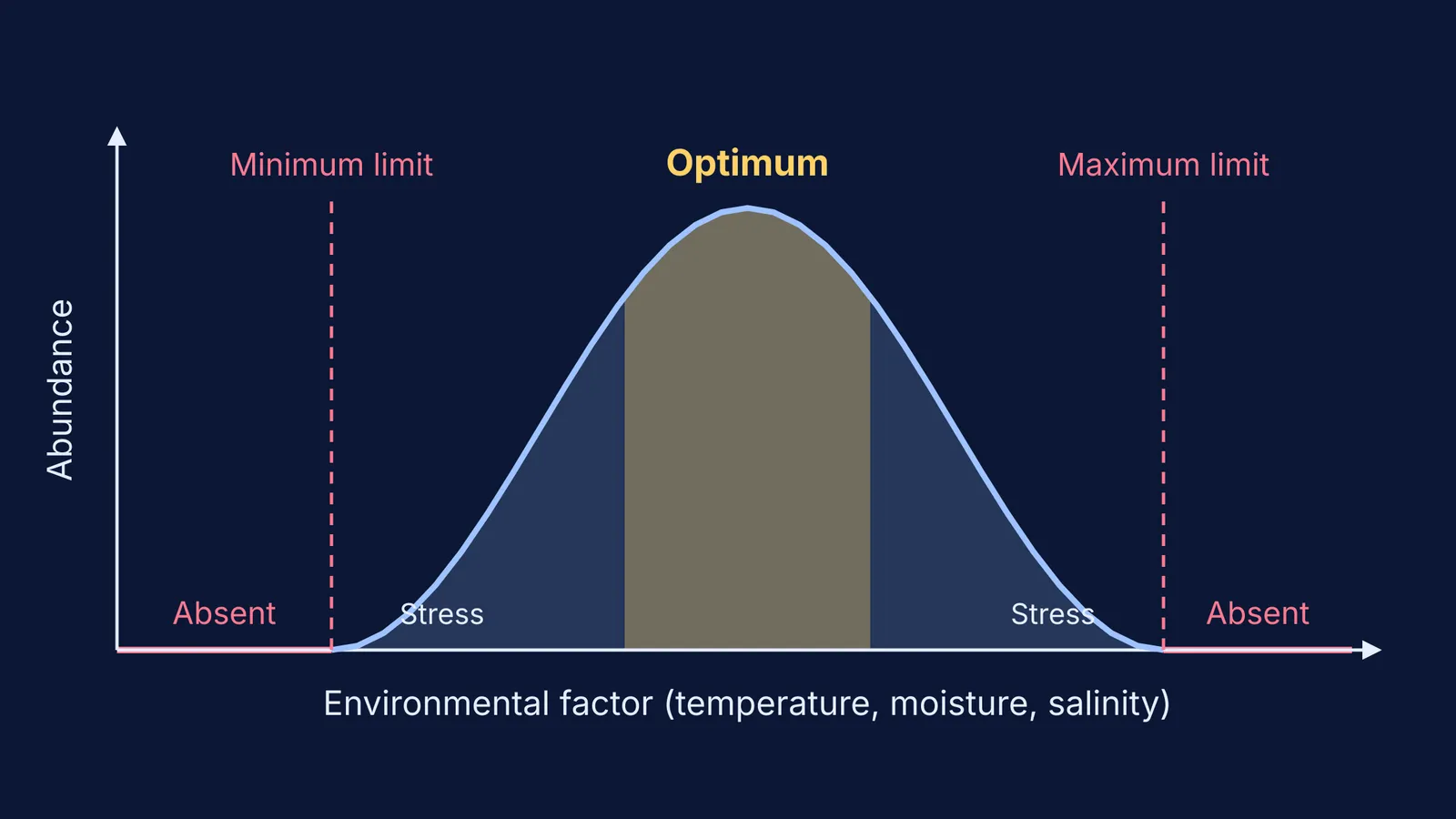
On page 303 the book sketches the idea as a line: greatest abundance in the "range of optimum", decreasing numbers on either side, and absence beyond the "minimum limit of toleration" and "maximum limit of toleration".
Shelford quotes Liebig's law of the minimum on page 68, and on page 303 writes that "the law of minimum ... is but a special case of the law of toleration" (Shelford, 1913). His example: food acts on the minimum side, waste products on the maximum side.
Who was Victor Shelford?
Victor Ernest Shelford was born in Chemung, New York, in 1877 and died in 1968, according to the Ecological Society of America's history page. He earned his PhD at the University of Chicago in 1907 with a thesis on tiger beetles, taught there until 1914, then taught at the University of Illinois until 1946. He was the first president of the Ecological Society of America.
Shelford found that tiger beetles lay eggs only when temperature and light are both suitable and the soil is moist, and that these conditions must last about two weeks for the eggs to hatch and the larvae to reach the surface (Shelford, 1913). Failure, he noted, could come from any one of those factors.
He also wrote 1912 papers on ecological succession, the idea behind our guide to primary, secondary and climax communities.
How do you read a tolerance curve?
Put abundance on the vertical axis and one factor, say water temperature, on the horizontal axis. The curve rises from zero at the minimum limit, peaks across the optimum, and falls to zero at the maximum limit. Between the optimum and each limit, the organism survives but is stressed.
Ecologists describe the width of that range with two prefixes: "eury-" for a broad tolerance range and "steno-" for a narrow one, as this ecology lecture on tolerance explains. A eurythermal species tolerates a wide band of temperatures; a stenohaline one tolerates only a narrow band of salinity.
Shelford added a detail that is easy to miss: in species that do not migrate, the limits are set by "the activity which takes place within the narrowest limits (usually breeding)" (Shelford, 1913). An adult may survive where its young cannot.
How do you apply the law of tolerance to a habitat?
A practice problem with made-up numbers: a freshwater fish survives between 8 °C and 32 °C, but breeds only between 18 °C and 24 °C. Where can it keep a population going?
Pond A ranges from 5 °C in winter to 20 °C in summer. Winter drops below the minimum limit, so the fish dies out. Absent.
Pond B ranges from 15 °C to 28 °C. Adults survive all year, and spring passes through 18 to 24 °C, so they breed. Present.
Pond C stays between 26 °C and 30 °C all year. Adults survive, but the water never enters the breeding range, so no young replace them. Absent in the long run.
Use this checklist on any tolerance question:
Name the factor and its units.
Write down the species' minimum, optimum and maximum.
Compare the habitat's full yearly range, not its average.
Check the most sensitive stage: eggs, larvae or breeding adults.
Conclude in one word: absent, stressed or thriving.
If the curve still feels abstract, the Fermi Simulation Lab has interactive simulations for ideas that are easier to see than to read, and the Fermi Concept Library gives each biology concept its own lesson.
Is the law of tolerance in the Class 12 syllabus?
The CBSE Biology syllabus for 2025-26 lists Class 12 Chapter 11, Organisms and Populations, as population interactions (mutualism, competition, predation, parasitism) and population attributes (growth, birth rate, death rate, age distribution). It does not name abiotic factors or tolerance ranges, and other boards may differ.
Our notes on organisms and populations cover the chapter as examined now, and the story of G. Evelyn Hutchinson and the ecological niche as a shape is a natural next read.
Next time you draw a bell-shaped curve in an ecology answer, label both ends. That second limit was Shelford's addition.


