

On this page
"Why did the giraffe get a long neck?"
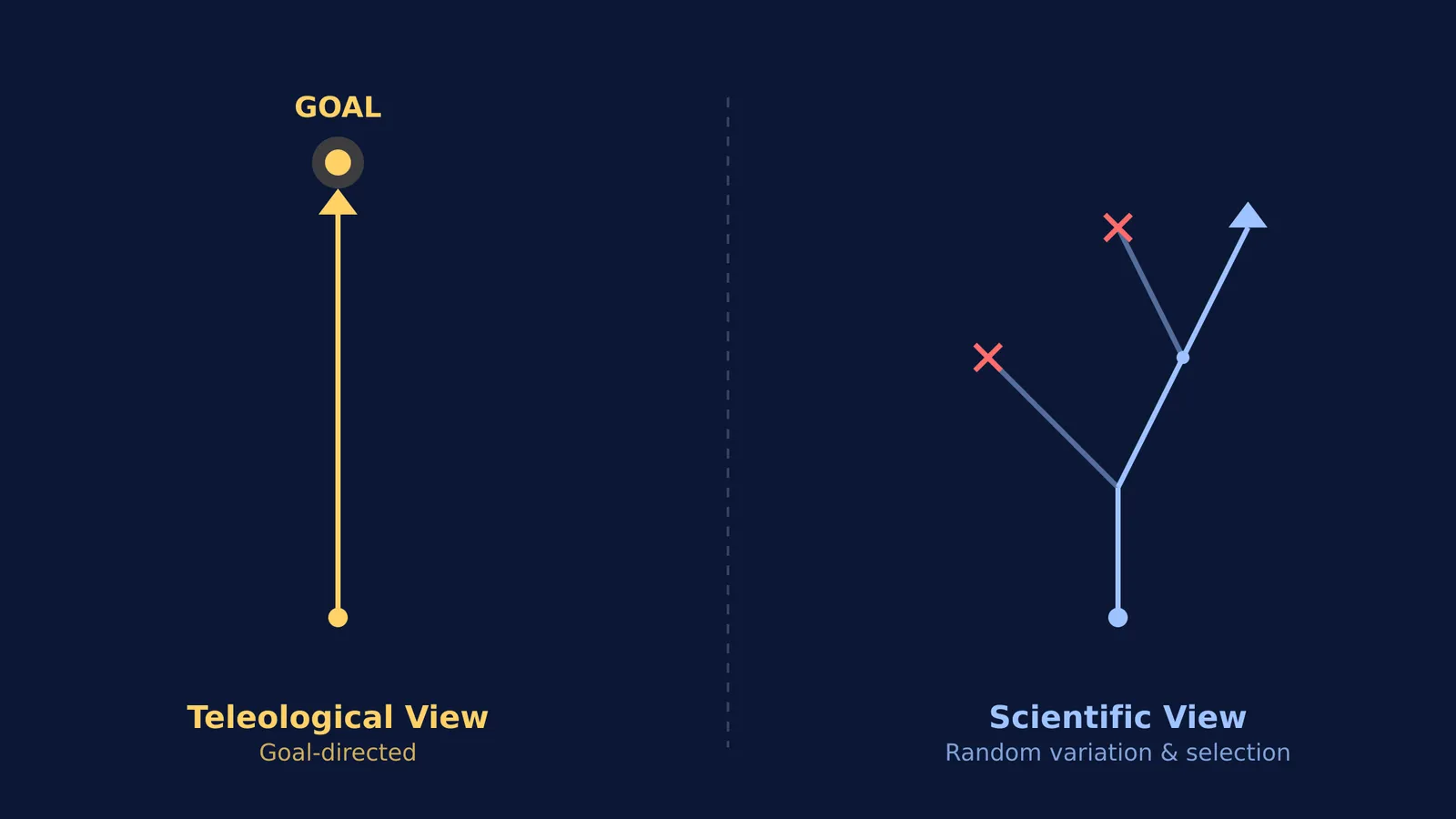
It is easy to answer, "So that it could reach the high leaves." But this answer is fundamentally wrong. Evolution has no mind, no plan, and no endpoint. The assumption that biological traits exist because they are "needed" or are striving towards a future goal is called *teleological thinking*. It is an intuitive trap, and it makes learning biology much harder than it needs to be.
Does evolution have a goal or direction?
No. Evolution is a blind process. It has two main steps: random variation (which generates new traits without any plan) and natural selection (which passively filters them). The environment does not create a trait because an animal needs it; it simply kills off the organisms that lack it. If a population faces a new predator and no random mutation provides a defense, the population does not evolve a solution—it goes extinct.
Despite this, our brains are wired to see purpose everywhere. A study published in *Cognition* found that even when given time to reflect, over 50% of university undergraduates endorsed scientifically unwarranted "purpose-driven" explanations for natural phenomena (Kelemen & Rosset, 2009). This cognitive bias is so deeply ingrained that it never truly disappears. In a follow-up study, professional scientists from top universities accepted roughly twice as many teleological errors when placed under time pressure compared to when they were unhurried (Kelemen, Rottman, & Seston, 2013).
Why do we assume evolution plans ahead?
We are natural toolmakers. When we look at a hammer, we know it exists *to* hit nails. When we apply this same "design stance" to biology, we assume lungs exist *to* breathe air.
This misconception is a major hurdle for biology students, especially those preparing for exams like NEET where precise mechanistic reasoning is required. When you believe evolution is goal-directed, you accidentally slip back into Lamarck's theory of evolution: what he got right and wrong. Lamarck suggested that organisms change because of an internal striving. Darwinian evolution, on the other hand, operates purely on what already exists. The genetic variations happen first, entirely by accident, and the environment selects them later.
How textbook wording misleads students
The way we teach biology often accidentally reinforces this bias. A 2022 study analyzing 31 children's books on evolution found that the vast majority conveyed teleological misconceptions (Adler et al., *PLOS ONE*). Specifically, 45% of the books used the verb "change" and 74% used the verb "become" to describe evolutionary processes.
Why is this dangerous? Words like "change" or "become" imply that a single organism transforms to meet a challenge. In reality, individuals do not evolve; populations do. When textbooks use shorthand like "bacteria developed resistance to survive antibiotics," they give the illusion of conscious strategy. If you are studying Evolution for NEET: natural selection, Hardy-Weinberg and evidence, untangling this shorthand is crucial for answering assertion-reason questions correctly.
Spotting teleology: a checklist for reading biology
To succeed in genetics and evolution, you have to read your textbook defensively. Use this checklist to catch teleological shorthand and translate it into accurate science:
Watch out for "in order to". If a sentence says a plant evolved a toxin *in order to* stop insects, rewrite it: "Plants that happened to mutate a toxin survived insect attacks."
Check the subject. Is the book describing an *individual* adapting, or a *population* shifting over generations? Only populations evolve.
Replace active verbs. When you see verbs like "strives," "needs," or "develops," substitute them with "is selected for" or "randomly arises."
Remember the graveyard. For every trait that succeeded, thousands of random mutations failed. As explored in Theodosius Dobzhansky and evolution seen through genetics, evolutionary success is simply what is left over after the environment does its culling.
How Fermi Concept Library helps
When you are trying to rewire years of intuitive thinking, reading a textbook is not always enough. This is where the Fermi Concept Library steps in. If you get stuck on the difference between Lamarckian "need" and Darwinian "selection", Fermi's AI tutor works out what you know and builds a plan for the session. Rather than just printing an answer, it holds a line of reasoning, checking your understanding as it goes. By drawing out the exact difference between "needing" a trait and "selecting" a trait, the tutor ensures you master the core mechanism.


