

On this page
Some villages along India's cyclone coasts have a living wall between them and the sea: a belt of mangrove forest. India's mangrove cover is 4,991.68 square kilometres, about 0.15% of the country's area, according to figures from the India State of Forest Report 2023 given to Parliament in February 2025 (Down To Earth). West Bengal, home to India's part of the Sundarbans, has the largest share at 42.45%. We cover that forest in the special features of the Sundarbans mangrove ecosystem.
How do mangroves reduce waves?
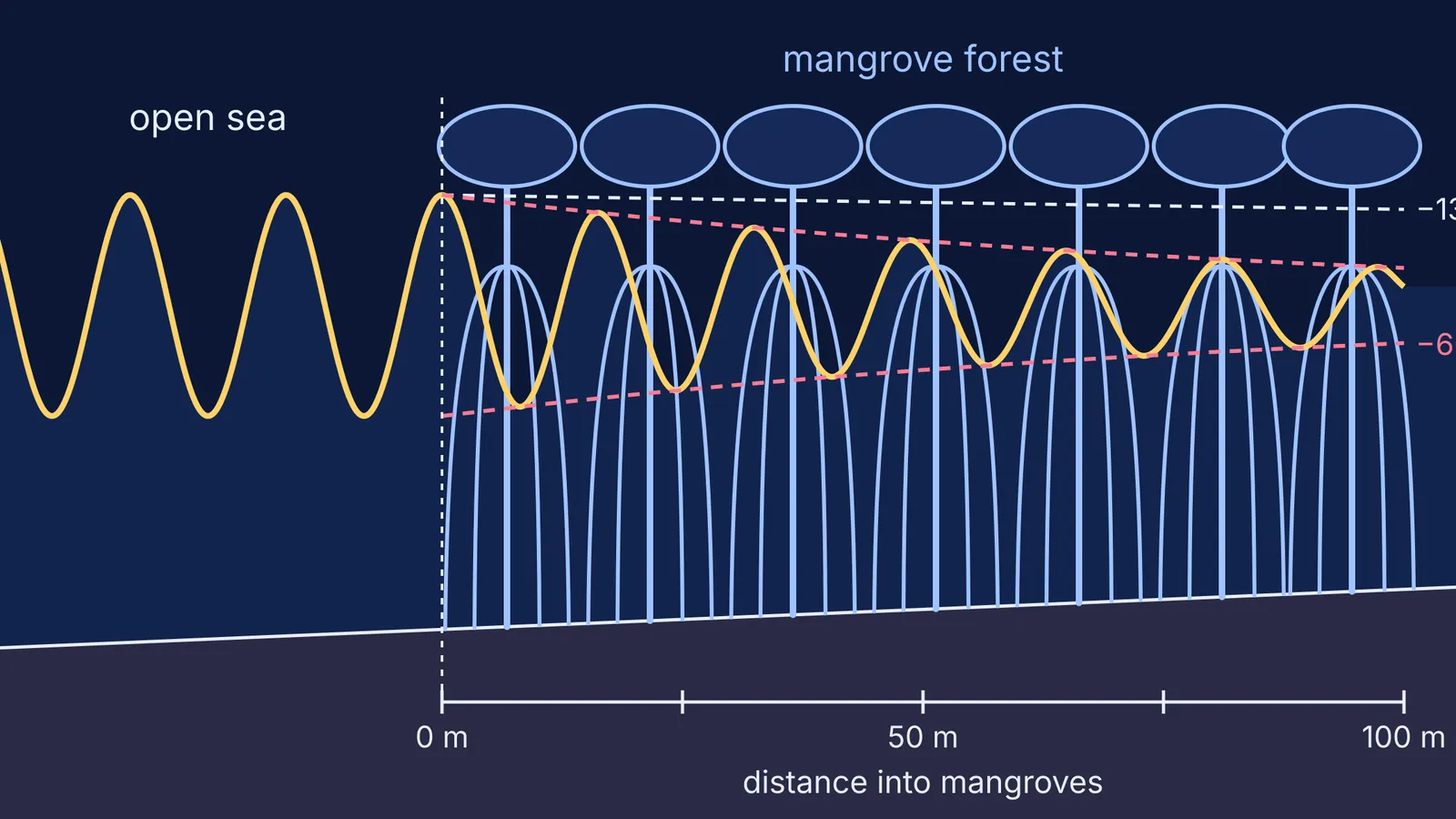
A wave carries energy towards the shore. Inside a mangrove forest, the water must squeeze past thousands of trunks, arching prop roots and pencil-like breathing roots. Each obstacle drags on the flow and stirs it into eddies, so the wave loses energy with every metre.
Wave height can fall by 13% to 66% over 100 metres of mangroves, according to a report by McIvor and colleagues for Wetlands International and The Nature Conservancy (Reduction of wind and swell waves by mangroves, 2012). The same report found the steepest drop happens near the forest edge, that waves shrink fastest where obstacles are densest, and that mangroves with aerial roots damp waves in shallow water faster than those without.
A review of field measurements worldwide found mangroves reduce wave heights by 31% on average, with a 95% confidence interval of 25% to 37% (Narayan et al., PLOS ONE, 2016). The same review estimated that, for waves up to half a metre high, mangrove projects in Vietnam can be three to five times cheaper than a breakwater.
Why waves steepen in shallow water at all is covered in why sea waves break near the shore.
Can mangroves stop a storm surge?
A storm surge is not a single wave but a dome of sea water pushed ashore by a cyclone's winds and low pressure. Mangroves slow it; they do not stop it.
When Hurricane Wilma hit South Florida in 2005, a 6 to 30 km wide mangrove forest reduced surge height by 40 to 50 cm per kilometre of forest, and by about 20 cm per kilometre where mangrove islands were mixed with open water (Zhang et al., Estuarine, Coastal and Shelf Science, 2012). The same study found three limits worth knowing:
The surge at the front edge of the forest rose by about 10% to 30%, because the trees block the water.
The first extra widths of forest gave large reductions (15% to 30%), while later widths added less than 5%.
In the study's model runs, the forest could not fully hold back the surge of a slow-moving Category 5 hurricane.
Did mangroves save lives in the 1999 Odisha super cyclone?
They did, according to a study of 409 villages in Kendrapara district by Saudamini Das and Jeffrey Vincent (PNAS, 2009). Villages with wider mangroves between them and the coast had significantly fewer deaths, even after controlling for other factors. The average mangrove width there had shrunk from 5.1 km in 1944 to 1.2 km by 1999. The authors also found that the government's early warning saved more lives than the mangroves did, so the lesson is forests plus warnings, not forests instead of warnings.
At global scale, mangroves provide flood protection worth more than US$65 billion a year, and without them 15 million more people would be flooded each year (Menéndez et al., Scientific Reports, 2020). Vietnam, India and Bangladesh receive the greatest benefits in terms of people protected.
How do mangrove roots hold mud in place?
Slow water drops the silt it carries. Mangroves trap and retain this mineral sediment and add organic matter and root volume to the soil, which lets the forest floor build upwards as the sea rises (Krauss et al., New Phytologist, 2014). So the forest, and its protection, need not drown.
Those roots did not evolve to guard villages. They are adaptations to soft, salty, oxygen-poor mud: props for support and breathing roots for air, as explained in why pneumatophores grow upwards. Coastal protection is a side effect.
Worked example: what does a mangrove belt buy a village?
Take a 1 m wave reaching a 100 m mangrove belt. Using the 13% to 66% range from the McIvor report, between 0.34 m and 0.87 m of wave height is left on the far side.
Now take a storm surge crossing 2 km of dense mangroves. At Zhang's 40 to 50 cm per kilometre, it is 0.8 to 1.0 m lower when it reaches the village. That is rough: extra width does not help in a straight line.
For an exam answer on mangroves and coasts, check you have covered:
Drag from trunks and roots reduces wave height, most strongly near the forest edge.
Wide forests lower storm surge by tens of centimetres per kilometre.
Roots trap sediment, so the forest floor builds up as the sea rises.
Limits: the forest edge, slow intense storms and the need for early warning.
Waves losing energy is easier to see than to read. The Fermi Simulation Lab has interactive simulations for ideas like that, and the Fermi Concept Library gives each concept in biology and physics its own lesson.


