

On this page
If you have ever stood on a beach watching the sea, you know the familiar rhythm: ocean waves roll in smoothly from the deep water, steepen as they approach the shore, and finally curl and crash into white foam. But why does a wave that travelled intact for thousands of kilometres suddenly topple over the moment it reaches the beach?
The answer lies in the physics of wave speed, water depth, and energy conservation. As the ocean floor slopes upward towards the land, it triggers a physical chain reaction that forces the wave to break.
How do water particles move in a wave?
To understand why a wave breaks, you first need to look at what is actually moving. When a wave travels across the deep ocean, the water itself is not moving forward with the wave. Instead, the water particles move in circular orbits. As the wave crest passes, the water particles are lifted up and pushed forward; as the trough passes, they drop down and slide backward.
In deep water, these circular orbits get smaller the deeper you go, eventually fading away completely. However, as the wave approaches the shore, the water becomes shallower. The circular orbits of the water particles at the bottom begin to scrape against the seabed. This interaction flattens the circles into ellipses and introduces friction, which fundamentally changes how the wave behaves.
What happens to wave speed in shallow water?
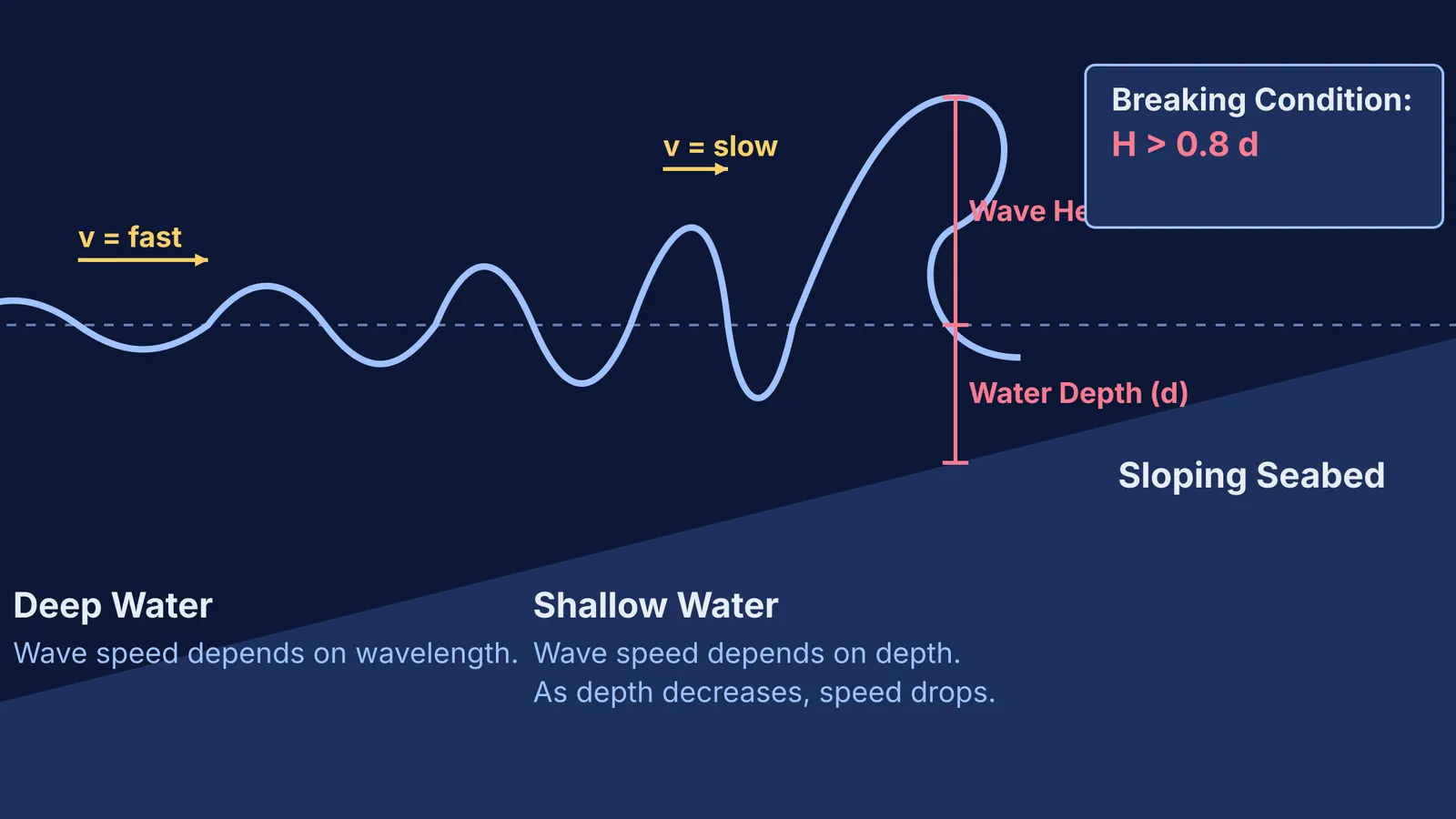
In deep water, the speed of an ocean wave depends entirely on its wavelength (the horizontal distance between two crests). Longer waves travel faster than shorter ones.
However, as the wave approaches the shore and the depth drops below one-twentieth of the wavelength 1, the wave enters the "shallow-water" regime. Here, the rules change. Its speed is no longer governed by its wavelength, but solely by the depth of the water:
v = √(gd)
In this formula, v is the wave speed, g is the acceleration due to gravity (9.8 m/s²), and d is the water depth. Because the depth d continuously decreases as the wave moves up the sloping beach, the wave speed v must also rapidly decrease. The wave acts like a car hitting the brakes.
Why do the waves grow taller?
As the front of the wave hits the shallow slope and slows down, the wave directly behind it is still in slightly deeper water and is therefore moving faster. This causes the back of the wave to catch up to the front.
As the wave compresses horizontally, its wavelength shrinks. However, the wave still carries the same amount of kinetic and potential energy it had in the deep ocean. With less horizontal space to occupy, the energy has nowhere to go but up. This forces the wave height to increase dramatically, a process known in coastal physics as shoaling.
Why do sea waves break near the shore?
A wave breaks because it becomes too steep to support its own structure. As shoaling compresses the wave, the decreasing depth drastically slows the base of the wave. Meanwhile, the water particles at the crest (the very top of the wave) are still propelled forward at a high velocity.
Eventually, the water at the crest outruns the slower-moving base beneath it. The wave literally trips over itself and topples forward.
Scientists use two main criteria to predict exactly when this instability will cause a crash:
The depth limit: In shallow water, a wave breaks when its height is larger than 0.8 times the local water depth 1. For example, if the water is 2 metres deep, a wave will collapse once it grows to about 1.6 metres tall.
The steepness limit: In deep water, a wave will also break if the ratio of its height to its wavelength exceeds about 0.17 1. When a wave becomes too steep, the crest simply cannot hold itself together.
Simulating wave physics at home
Many physical ideas are easier to see than to read. You can explore interactive simulations for waves and mechanics in the Fermi Simulation Lab. Changing the parameters yourself helps build intuition before you start calculating square roots or dealing with complex equations.
If you are studying for physics exams, you can test your understanding of wave mechanics by calculating the expected speed drop as a wave approaches the shore.
A worked example: finding the speed of a shallow wave Imagine a sea wave moving over a coastal reef where the water depth is 4 metres.
Using the shallow water formula v = √(gd), the speed is √(9.8 × 4) = √39.2 ≈ 6.26 m/s.
As it moves closer to the beach, the depth drops to just 1 metre.
The new speed becomes √(9.8 × 1) ≈ 3.13 m/s.
Because the wave speed has halved, the back of the wave plows into the front. This compresses the wavelength and forces the crest upward until it hits the 0.8 limit and crashes onto the sand.


