

On this page
In short
The Sundarbans mangrove ecosystem is defined by extreme adaptations to tidal floods and salty mud. Its special features include salt-tolerant trees with breathing roots (pneumatophores), a physical structure that protects coastlines from cyclonic storms, and a semi-aquatic Royal Bengal tiger population.
The Sundarbans delta stretches across India and Bangladesh, where the Ganges, Brahmaputra and Meghna rivers meet the Bay of Bengal. It is not just a dense forest; it is an active, shifting border between fresh river water and the salty sea.
Covering 10,000 square kilometres, it is the largest area of mangrove forests on Earth. For students studying biology or ecology, the Sundarbans offers a perfect case study in extreme adaptation. When you read about plant survival in the Fermi Concept Library, you learn that every species here is shaped by two immense challenges: daily tidal floods and choking, salty mud.
What are the special features of the Sundarbans mangrove ecosystem?
A mangrove ecosystem differs from inland forests because it is subjected to daily tides. The soil is constantly saturated, which forces the plants to find unique ways to anchor themselves and breathe. The ecosystem acts as a massive carbon sink and supports species that exist nowhere else.
If you are asked to list its special features in an exam, focus on three things: the breathing roots (pneumatophores) of the trees, its role as a natural cyclonic barrier, and its unique tiger population.
How do mangrove trees survive in tidal mud?
Ordinary roots need oxygen from the soil to survive. However, the tidal mud of the Sundarbans is waterlogged and anaerobic (lacking oxygen). To stay alive, many trees in the Sundarbans have developed a specialized root system.
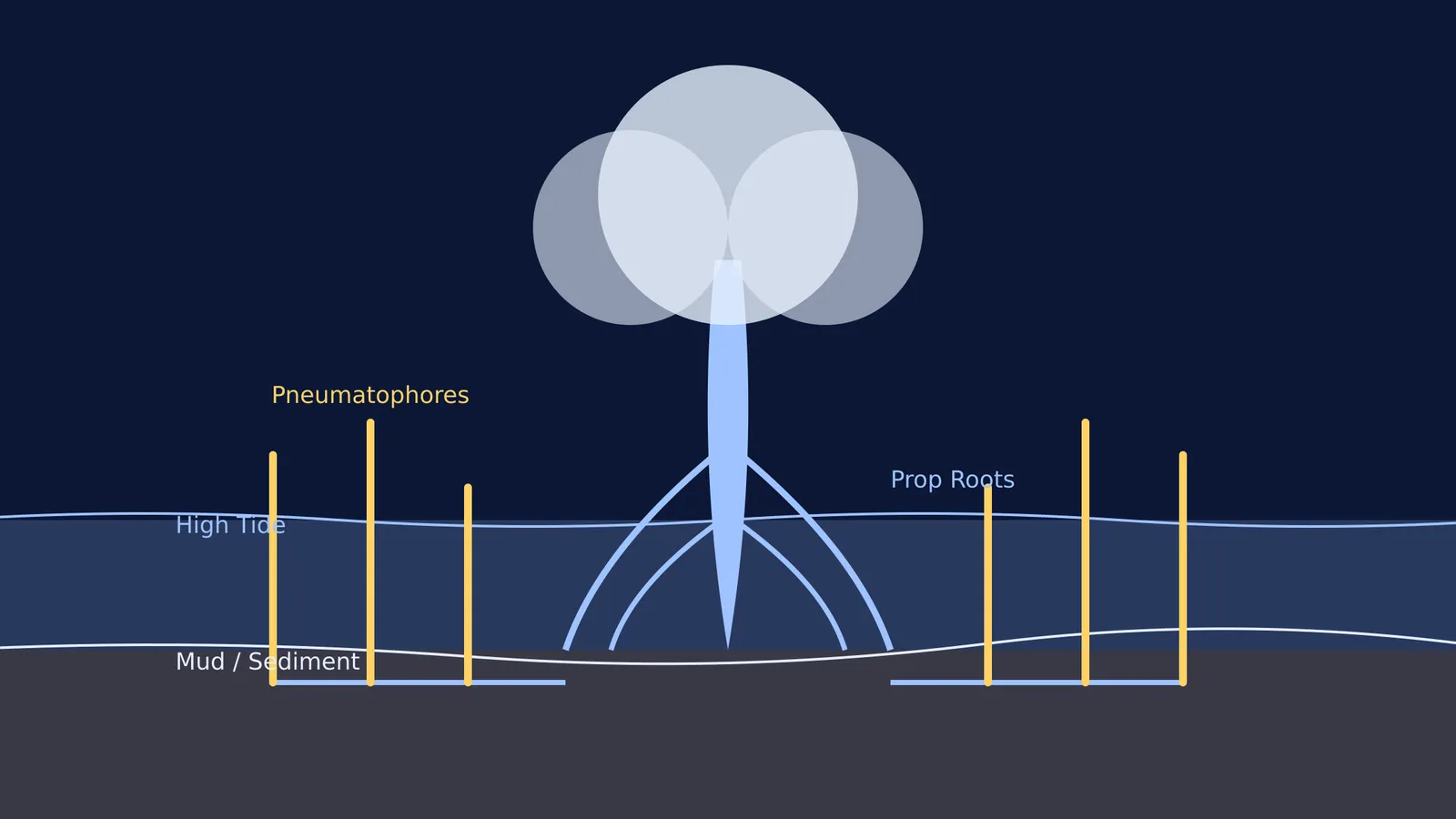
Instead of growing entirely downward, these trees send up woody spikes called pneumatophores, or breathing roots. These roots rise vertically out of the mud and above the high-tide water line. They are covered in tiny pores known as lenticels, which take in oxygen directly from the atmosphere during low tide. The oxygen then travels down through spongy tissue into the submerged roots.
The trees also develop sprawling prop and stilt roots that fan out over the mud. These act like architectural buttresses to keep the trees upright in the unstable, shifting delta sediment. When you are studying plant morphology, visualizing these root structures helps you remember why they form.
*Related reading: Respiration as an amphibolic pathway: where fats and proteins enter*
Why do the Sundarbans tigers swim?
The Sundarbans is the only mangrove habitat in the world where tigers are found. Living in a swamp means the Royal Bengal tigers of the Sundarbans have had to adapt to a semi-aquatic lifestyle.
The terrain is a fractured maze of mudflats and tidal channels. To hunt prey like spotted deer, wild boar and water monitor lizards, the tigers must swim. They are powerful swimmers, routinely crossing broad rivers and creeks. Their unique existence proves how a specialized environment forces top predators to change their ordinary habits. Instead of stalking through dry grassland, they navigate thick vegetation and muddy banks, making them a distinct population in both behaviour and habitat.
How do mangroves protect coastlines from storms?
Mangroves are not merely biological marvels; they are a physical shield for the millions of people living inland.
The Sundarbans acts as a natural shelter belt. According to the UNESCO World Heritage Centre, the forest protects people from storms, cyclones and tidal surges. When cyclonic storms roll in from the Bay of Bengal, the dense canopy of the mangrove trees absorbs the wind's energy.
Beneath the surface, the thick, tangled web of prop roots and pneumatophores acts as a friction barrier that slows down ocean waves and traps sediment. This natural infrastructure prevents severe soil erosion and drastically weakens the impact of the surge before it reaches human settlements. A healthy mangrove forest is often more effective at coastal defence than concrete sea walls.
The next time you review adaptations in biology, remember that the Sundarbans is an entire ecosystem built on survival. If you are reviewing how organisms cope with environmental stress, you can explore the topic in the Fermi Concept Library, which connects these physical adaptations directly to their underlying biological principles.
*Related reading: Biological magnification: how pesticides build up, Class 10*


