

On this page
Swampy, marshy areas pose a unique problem for plants: the waterlogged mud is practically devoid of oxygen. Because roots need oxygen to survive and carry out respiration, a typical downward-growing root system would suffocate in these conditions.
To survive, some mangrove plants have evolved a structural workaround: roots that reverse direction and grow out of the mud into the air.
What are pneumatophores in Rhizophora?
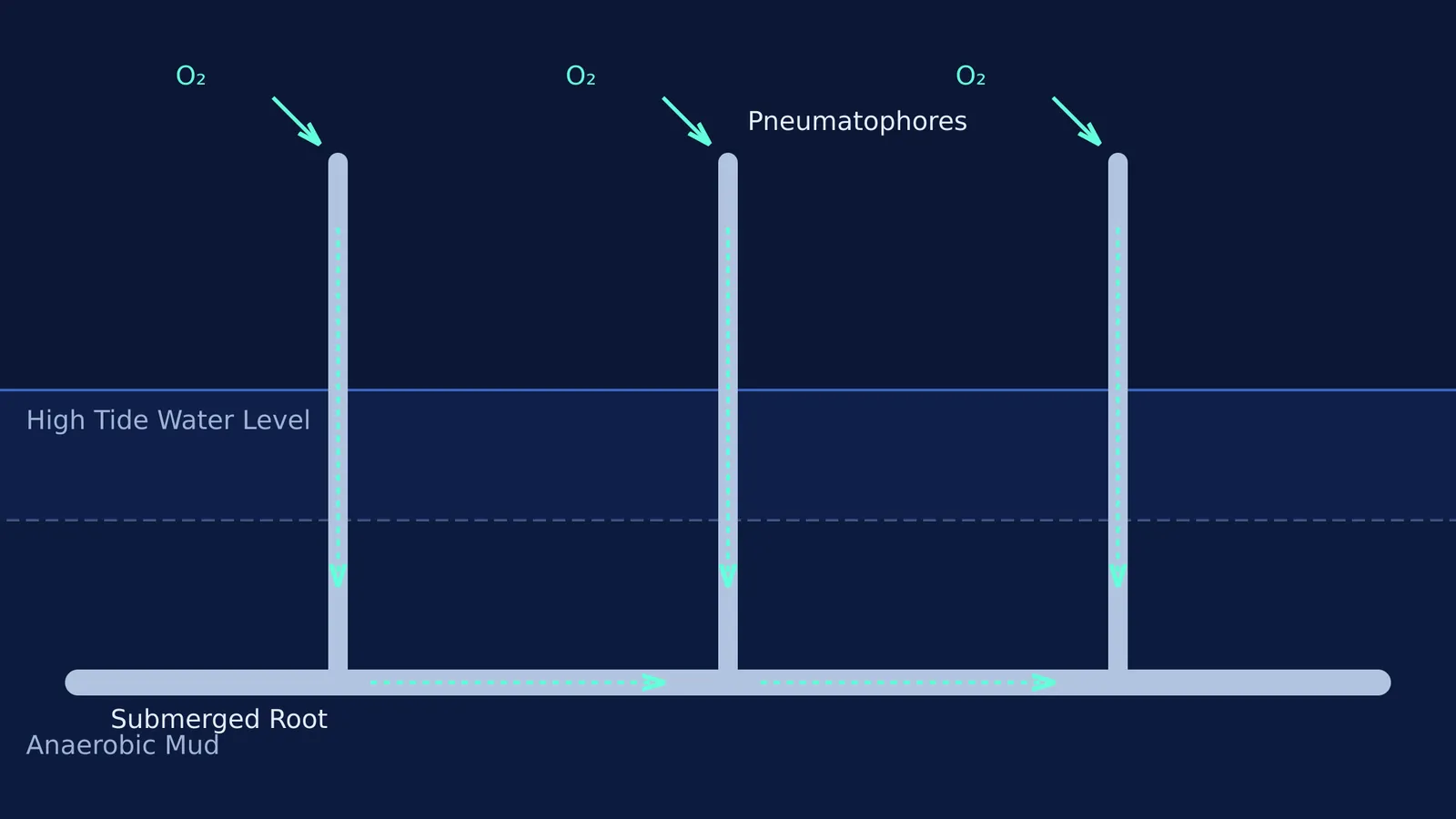
The NCERT Class 11 Biology textbook (Chapter 5, Morphology of Flowering Plants) defines this adaptation clearly: "In some plants such as *Rhizophora* growing in swampy areas, many roots come out of the ground and grow vertically upwards. Such roots, called pneumatophores, help to get oxygen for respiration."
Because they grow upwards against the pull of gravity, pneumatophores are negatively geotropic. This is the exact opposite of a normal root's behaviour, which grows downwards to find water and nutrients (you can read more about this in our guide to phototropism, geotropism and other tropic movements in Class 10).
By pointing upwards, pneumatophores break the surface of the mud and the water during low tide, giving the plant direct access to the atmosphere.
How do pneumatophores transport oxygen?
Once the root is above the water line, it needs a way to let air in and move it to the parts of the plant that are buried in the mud.
Pneumatophores are covered in small, specialised pores called lenticels. During low tide, when the roots are exposed to the air, atmospheric oxygen enters through these lenticels. The oxygen then travels into a network of spongy internal tissue called aerenchyma. This highly porous tissue acts as a low-resistance pipe, allowing the oxygen to diffuse down into the submerged underground cable roots and feeding roots. The aerenchyma also stores oxygen, ensuring the plant has a reserve to draw on when the tide comes in and covers the lenticels.
The number of these breathing structures can be immense, creating a dense field of spikes around the tree. For instance, in the mangrove species *Avicennia marina*, the density of pneumatophores can reach over 500 per square meter of ground, ensuring the entire underground root system receives a steady oxygen supply even in the most hostile, anaerobic mud.
How can you remember plant modifications for exams?
When studying plant morphology for competitive exams, memorising lists of examples (*Rhizophora* = pneumatophores, carrot = taproot modification) can quickly become overwhelming. Rote learning often fails when an exam question twists the wording, asks for the underlying reason, or requires you to identify the functional advantage of a structure.
Instead of memorising isolated facts, you need to understand the environmental problem the plant is trying to solve. If you understand that swamp mud has no oxygen, it makes logical sense that a root would have to grow upwards to breathe. Once you grasp the "why," the "what" becomes much easier to recall.
If you are struggling to build these mental models, the Fermi Concept Library gives you a clear, step-by-step lesson for every concept in the biology syllabus. Rather than just giving you a list of examples to memorise, Fermi's AI tutor works with you to connect the structure of a plant to its function and environment, checking your understanding as you go.
How do normal roots compare to pneumatophores?
If you are revising for a biology test, use this framework to spot the key physiological and anatomical differences instantly:
Direction of growth: Normal roots are positively geotropic (they grow downwards); pneumatophores are negatively geotropic (they grow upwards).
Primary function: Normal roots anchor the plant and absorb water and dissolved minerals; pneumatophores primarily gather oxygen for aerobic respiration.
Environment: Normal roots thrive in aerated soil with pore spaces; pneumatophores are a specific evolutionary adaptation to waterlogged, anaerobic swamps.
Surface structures: Normal roots feature delicate root hairs for maximum absorption area; pneumatophores have lenticels (pores) and a thicker outer layer specifically for gas exchange.
By connecting the structure (lenticels and upward growth) to the environment (anaerobic swamps), you turn a rote textbook fact into a logical, easily remembered rule.


