On this page
Chapter 6 of NCERT's new Class 7 book, Exploring Society: India and Beyond, Part 2 (code gees2, First Edition November 2025, Reprint 2026-27), is the only chapter in its Governance and Democracy theme. CBSE has no separate 2026-27 curriculum for Classes 6 to 8; they follow the NCERT book, and this chapter is assessed by the school.
How is a state different from a government?
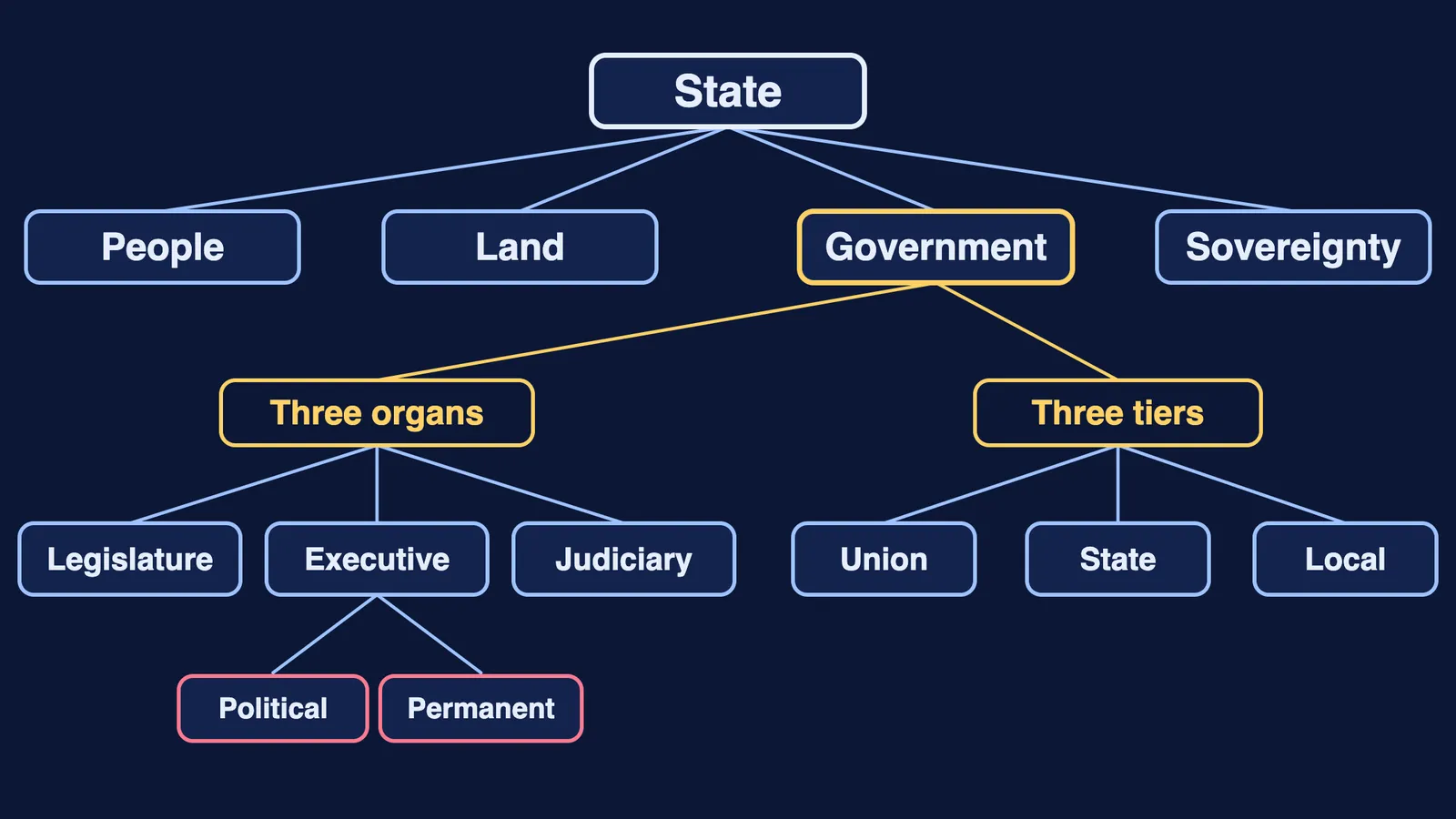
In the chapter, a state is a political body with the power to rule a fixed area and the people who live there. It has four features: a permanent population, a fixed territory, a government and sovereignty. Sovereignty means the state makes its own laws with no outside interference.
The government is one part: the leaders, ministers and officials who make and enforce laws and settle disputes. A government can change after an election, but the state carries on, much as a cricket club stays the same club when its committee is voted out.
The government has three organs:
Legislature: makes laws. Parliament legislates for the country; each state legislature, for its state.
Executive: carries out laws and makes policy. The political executive is the elected leadership: prime minister, chief ministers and ministers. The book also places the president and governors here, in mostly formal roles. The permanent executive is civil servants chosen through examinations such as the UPSC's, who stay whichever party wins.
Judiciary: independent of control by the government or politicians. It settles disputes, interprets laws, protects rights and guards the Constitution through judicial review.
(The label in the book's Fig. 6.6, on page 147, is printed "Judicary"; the correct spelling is judiciary.)
Why is India called a democratic republic?
Democracy means rule by the people, who choose their government at free and fair polls. A republic's head of state gets the post by election, direct or indirect, not by birth, and a constitution limits the rulers' power. India's president is elected indirectly, by elected representatives, so India is both.
The chapter notes that the UK, Canada and Sweden each have a monarch, so they are democracies without being republics. A republic also guards against the "dominance of the majority". The book's example is a resident welfare association that banned deliveries after 9 pm by majority vote, then exempted food and medicines after an elderly resident could not get her medicine in time.
What are the three tiers of government in India?
The book calls India a federal country with 28 states, 8 union territories and over 1.4 billion people, so power is spread across three levels:
Union: defence, foreign affairs, currency.
State: police, land, health, agriculture.
Local: panchayats and municipalities, for water, drainage, streetlamps and parks.
The Constitution first had two levels; early-1990s amendments made local government the third tier. This decentralisation brings more participation, local knowledge and accountability.
How can citizens make the government work for them?
The book gives the government three roles (protector, provider, regulator) and six ways for citizens to engage:
File a grievance with the department or on the Public Grievances Portal.
Ask for facts under the Right to Information (RTI) Act.
Raise the issue in the media, including social media.
Join or start a civil society organisation.
Write to your elected representatives.
Vote once you are old enough.
In the book, an RTI request in Bagepalli, near Bengaluru, got residents the figures on poorly done roadwork, which was then completed properly. In Kerala's Silent Valley, a 1970 hydroelectric plan met a public campaign, and the Central Government cancelled it in 1983.
Worked example: who fixes the school handpump?
A village school's handpump has been broken for three weeks.
Which tier? The book lists water as a local matter, so this sits with the panchayat.
Which organ? The executive: its officials deliver services and handle grievances.
Which of the six ways fit? A grievance to the department, an RTI request asking how much was spent on village handpumps, or a letter to the local representative.
How does Chapter 6 connect to the rest of the book?
It builds on Grade 6's three organs and three levels and Part 1's chapter on types of government; Grade 8 goes deeper into Parliament, the executive and the judiciary. The old book covered how a state government works; our guide to the judiciary in Class 8 and the Class 9 chapter on governance and public policy take it further.
Practice questions (mark values are our suggestion):
Name the four features of a state. (1 mark)
Why can a government change while the state stays the same? (2 marks)
A country's people elect its parliament, but a queen is its head of state by birth. Is it a democracy, a republic, both or neither? Explain. (2 marks)
Your street floods after heavy rain. Which tier should act, and which two of the chapter's ways would you use? (3 marks)
Compare the political and permanent executive: how members are chosen and how long they stay. (5 marks)
Not sure which idea to revise first? Fermi's AI tutor works out what you already know and builds a plan for the session.