

On this page
Your Class 7 chapter "How the State Government Works" follows one story: a water shortage and a diarrhoea outbreak in a district called Patalpuram, and how the state government responds. Retell that story with the right words and you have the raw material for the exercises. This guide adds the constitutional facts behind it and a 20-minute revision plan.
Who is an MLA and how is the person elected?
The NCERT Class 7 chapter explains that every state is divided into areas called constituencies, and the people of each constituency elect one representative, a Member of the Legislative Assembly (MLA).
NCERT defines a constituency as "a particular area from which all the voters living there choose their representatives" (NCERT, Chapter 3 glossary).
MLAs usually stand for election from political parties, though some win as independents. The Constitution sets the limits: a Legislative Assembly has not more than 500 and not less than 60 members, chosen by direct election from territorial constituencies (Article 170). An Assembly normally lasts five years (Article 172), and a candidate for it must be at least 25 years old (Article 173).
How does an MLA become Chief Minister?
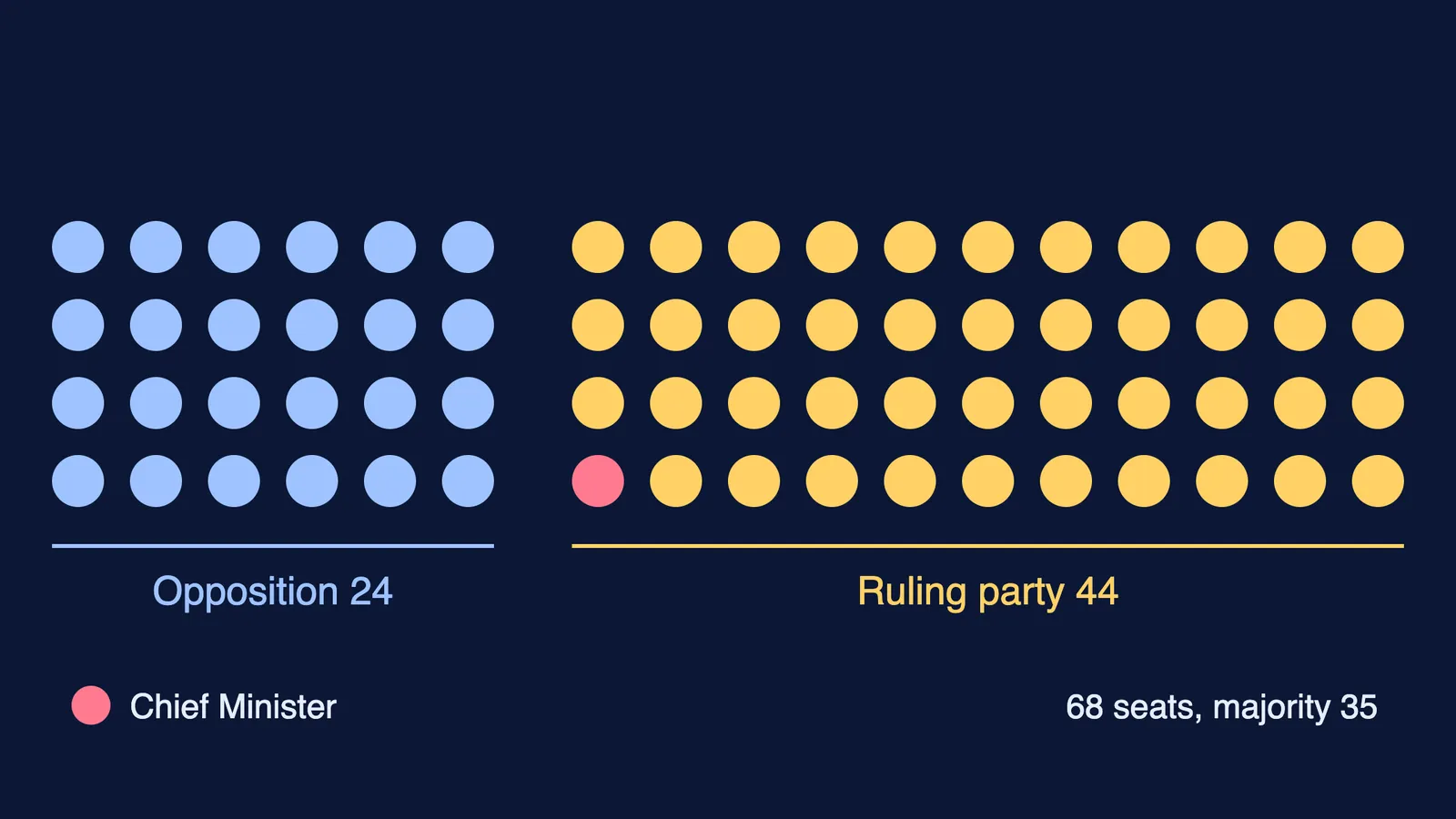
The textbook uses Himachal Pradesh, which has 68 assembly constituencies (NCERT). In its table of the 2017 results, the BJP won 44 seats, the INC 21, the CPI(M) 1 and independents 2.
Here is the reasoning, step by step:
Find the majority. A majority means more than half. Half of 68 is 34, so a party needs at least 35 MLAs.
Name the ruling party. The BJP, with 44, became the ruling party; the other 24 MLAs formed the opposition.
Choose the leader. The ruling party's MLAs elect their leader, who becomes Chief Minister. In 2017 they chose Jairam Thakur, as the chapter records.
Appoint the government. The Governor appoints the Chief Minister, and the other ministers on the Chief Minister's advice (Article 164).
The Governor is the head of the state, and the executive power of the state is vested in the Governor (Article 154). In practice, a Council of Ministers with the Chief Minister at its head aids and advises the Governor (Article 163).
When no party has a majority, several parties can govern together: a coalition.
What happens in a debate in the Legislative Assembly?
In the chapter, students watch the Assembly debate the diarrhoea outbreak and water shortage. Some MLAs raise deaths from diarrhoea, hospitals without doctors and women walking kilometres for water; others reply that tankers and ORS packets are being supplied. A minister then replies.
Why does this matter? Because the Council of Ministers "shall be collectively responsible to the Legislative Assembly" (Article 164(2)). The ministers run departments, but MLAs can question them, debate issues and decide where money is spent. NCERT puts it simply: the decisions of the Chief Minister and ministers have to be approved by the members of the Legislative Assembly.
The Assembly also makes state laws, which departments such as Health or Public Works then carry out.
What is the difference between the legislature and the executive?
Exercise 5 asks about this, so learn the two sides.
Legislature: all the MLAs meeting together in the Legislative Assembly. They make laws, ask questions and approve or check the government's work.
Executive: the Chief Minister, the ministers and the departments they head. They make day-to-day decisions and put them into action.
An MLA who is also a minister does both jobs: speaks for a constituency in the House and runs a department.
The government also answers to the public: in the chapter, the health minister holds a press conference. Compare the levels of government in our post on how a school gets built, from panchayat to Parliament, and see where these rules come from in our guide to the Class 8 Constitution chapter.
A 20-minute revision plan
Minutes 0-5: Write the four glossary words (constituency, majority, opposition, press conference) and "ruling party", and explain each aloud in one sentence.
Minutes 5-10: Find your state's Assembly size and work out the majority number and the minister limits, as in the Himachal example.
Minutes 10-15: Play the debate. One person is an opposition MLA asking about a local problem (water, a school, a road), the other is the minister replying.
Minutes 15-20: Answer the five exercise questions in two or three lines each.
If a word like "majority" or "represent" keeps tripping you up, Fermi's AI tutor can work out what you already know and build a plan for the session, and it checks your understanding as it goes. For another Class 7 social science chapter told through one example, see Markets around us for Class 7.


