On this page
The Role of the Judiciary in Our Society is Chapter 4 of *Exploring Society: India and Beyond*, Part II, the new NCERT Social Science textbook for Class 8 (book code hees2, First Edition, June 2026). You can read the full chapter free on the NCERT site.
CBSE publishes no separate 2026-27 curriculum for Classes 6 to 8, which follow the NCERT book; this chapter is assessed by the school. NCERT updates its PDFs from time to time, so check your copy against the current NCERT PDF.
What is the chapter about?
It belongs to Theme D, Governance and Democracy. Laws are general rules that a government sets for everyone, and breaking them has consequences such as a fine, compensation or prison. The judicial system is what lets an affected person complain and be heard.
Two ideas carry the whole chapter:
Substantive justice asks whether the final outcome is fair and reasonable.
Procedural justice asks whether everyone involved got a full hearing before the court decided. Linked to this, every person is presumed innocent until proved guilty.
The NCERT chapter adds that India has repealed over 1500 colonial-era laws, naming the Criminal Tribes Act, 1871 and the Vernacular Press Act, 1878. It also cites Jim Crow laws in the United States and apartheid laws in South Africa as unjust laws later repealed.
How are courts arranged in India?
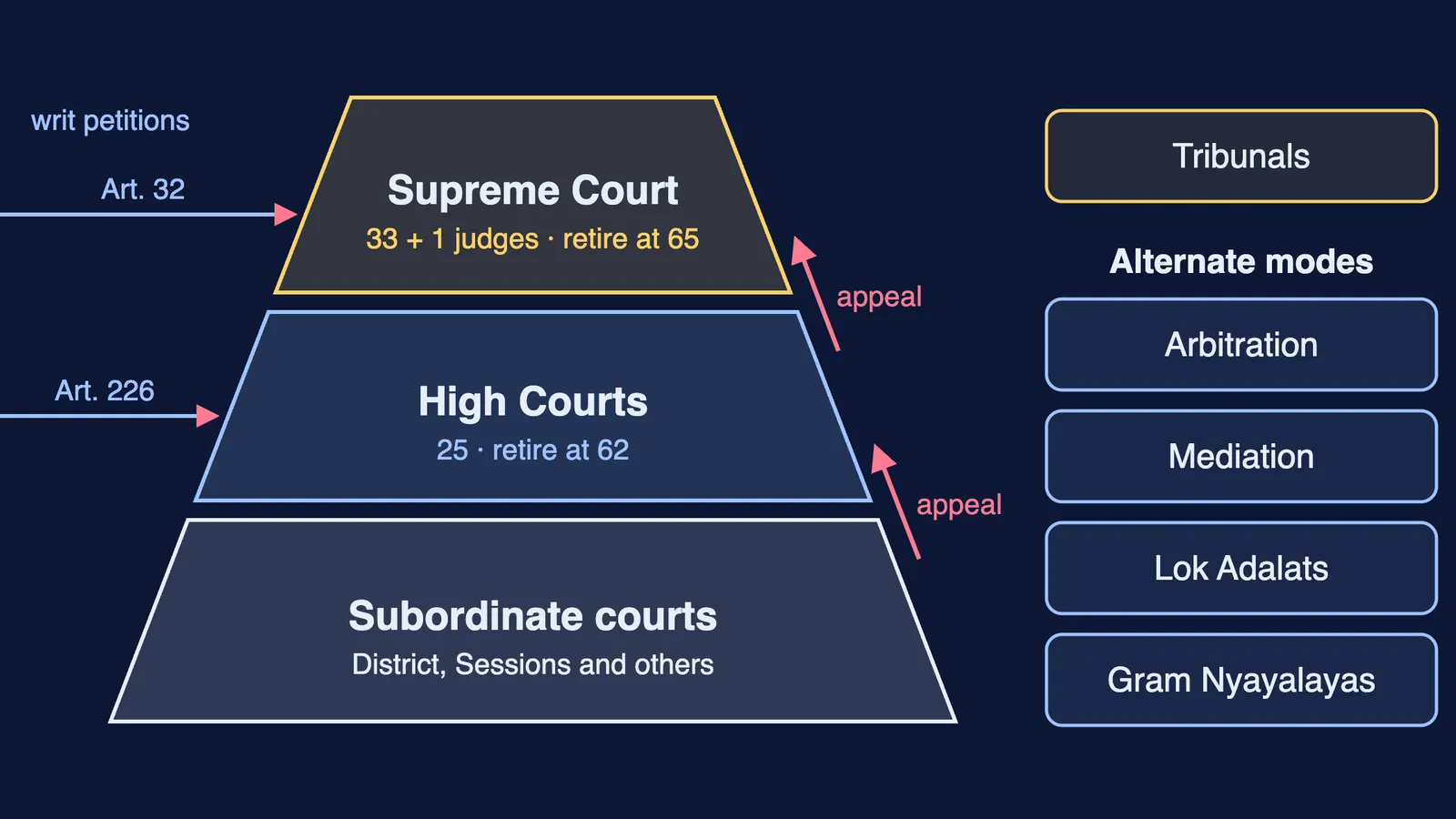
The book calls India's judiciary a unified system with three levels. All figures below are from the NCERT chapter.
Supreme Court (Article 124), in New Delhi, working since 26 January 1950. Strength: 33 + 1, the Chief Justice of India and 33 judges. Judges retire at 65. It is the final interpreter of the Constitution, and its law binds all courts in India (Article 141).
High Courts (Article 214). India has 28 States but 25 High Courts, because some States and Union Territories share one. Judges retire at 62. Each High Court supervises the courts and tribunals in its area (Article 227).
Subordinate courts, such as District, Sessions, Revenue and Small Causes Courts. The Governor appoints District Judges in consultation with the High Court (Article 233).
Supreme Court jurisdiction types: writ (Article 32), original (Article 131, Centre-State or inter-State disputes), appellate, advisory (Article 143, at least five judges) and Special Leave Petitions (Article 136). The book's first reported Public Interest Litigation (PIL), filed by lawyer Kapila Hingorani, led to guidelines for releasing almost 40,000 under-trial prisoners.
What are the alternative ways to settle disputes?
Besides the three levels of courts, the chapter describes tribunals: quasi-judicial bodies for specific kinds of dispute, such as the National Green Tribunal for environmental issues and Consumer Fora for consumer disputes.
It then turns to alternate modes of dispute resolution. The book names arbitration, mediation or conciliation, negotiation and Lok Adalats, and also describes Gram Nyayalayas:
Arbitration: an independent arbitrator decides, and the decision binds both sides (Arbitration and Conciliation Act, 1996).
Mediation: a neutral mediator helps the parties agree but cannot impose a decision (The Mediation Act, 2023).
Lok Adalats: people's courts for amicable settlement (Legal Services Authorities Act, 1987).
Gram Nyayalayas: mobile village-level courts with a simple procedure (Gram Nyayalayas Act, 2008).
The chapter also lists digital steps such as e-filing and live streaming, and notes that three 2023 laws replaced the Indian Penal Code, the Code of Criminal Procedure and the Indian Evidence Act.
Worked example: which forum fits which dispute?
This is a reading exercise, not legal advice: it only tests whether you can match a made-up case to the forum the chapter describes for that kind of dispute. Real cases depend on facts and law beyond the chapter.
Two States disagree over sharing a river's water (State against State). Chapter match: the Supreme Court's original jurisdiction (Article 131).
A citizen says her Fundamental Right was violated within one State. Chapter match: a writ petition before the High Court (Article 226).
A shopper's new mixer fails and the shop refuses a refund (a consumer dispute). Chapter match: Consumer Fora.
Two neighbours argue over a shared wall and want to reach their own settlement. Chapter match: mediation or a Lok Adalat.
Residents object to waste being dumped in a local wetland (an environmental issue). Chapter match: the National Green Tribunal.
What practice questions can you try?
Mark labels are our suggestion; your school sets the real paper.
Define procedural justice in one sentence. (1 mark)
Why does India have fewer High Courts than States? (2 marks)
Compare arbitration and mediation using one difference. (2 marks)
Name the three levels of courts and one job of each. (3 marks)
Explain how Public Interest Litigation can help people who cannot reach court themselves. (5 marks)
For the older NCERT version of this topic, see our Class 8 guide to courts, independence and PIL. For the law-making side, read why we need a Parliament; for Class 9, the governance and public policy guide.
Not sure where to begin your revision? Fermi's AI tutor works out what you already know and builds a plan for the session.