On this page
This guide follows Chapter 2 of NCERT's *An Introduction to Indian Art, Part II* (Reprint 2026-27, per the book's prelims) and maps it to Unit 1 of the CBSE 2026-27 Fine Arts curriculum, which does not name a textbook.
What does the Rajasthani schools chapter cover?
The NCERT chapter uses the label for painting made in the princely states and thikanas of present-day Rajasthan and parts of Madhya Pradesh, mostly from the sixteenth to the early nineteenth century. It notes that Anand Coomaraswamy coined "Rajput Paintings" in 1916, and that scholars now use the narrower terms Rajasthani and Pahari instead.
Its themes include Krishna stories from the Bhakti movement, the *Gita Govinda*, *Rasikapriya*, Baramasa and Ragamala albums. A Ragamala family is headed by a male raga with six raginis, and the book names six main ragas: Shri, Megha, Dipak, Hindol, Malkos and Bhairava.
In the 2026-27 curriculum, the Class 12 theory paper carries 30 marks. Unit 1 carries 15 marks, and that figure is shared by four topics: the Rajasthani, Pahari, Mughal and Deccan schools. Graphics and Sculpture use the same Class 12 theory syllabus as Painting.
How were Rajasthani miniatures made?
The book's process fits five steps:
Paper: wasli, thin handmade sheets glued in layers to the thickness needed.
Drawing: the master sketched the outline in black or brown and marked colours with notes or small patches.
Colour: mineral pigments, gold and silver, bound with glue and applied with brushes of camel or squirrel hair.
Team: pupils and specialists painted portraits, architecture, landscape or animals before the master added final touches.
Finish: the sheet was burnished with an agate for an even sheen, and a scribe added the verse.
Which sub-schools should you know?
One or two features and a date each, from the NCERT chapter:
Malwa (1600–1700 CE): flat, two-dimensional style; no single centre, with many works found in the Datia Palace collection.
Mewar: a 1605 Ragamala painted by Nisardin at Chawand; Sahibdin and Manohar under Jagat Singh I (1628–1652); bright reds and yellows. Nathdwara made cloth pichhwais.
Bundi: the Chunar Ragamala of 1591; lush vegetation, fine elephants, petite women with round faces.
Kota: split from Bundi in 1625; famous for hunting scenes, with landscape treated as a subject in its own right.
Bikaner: Mughal-influenced, softer palette; master-led studios called Mandi; portraits of artists and many inscriptions.
Kishangarh: founded in 1609; elongated figures, arched eyebrows, lotus-petal eyes, lavish green and wide landscapes.
Jodhpur (Marwar): a strong folk idiom alongside Mughal-style portraits; a late phase under Man Singh (1803–1843).
Jaipur: began at Amer; Sawai Jai Singh founded Jaipur city in 1727; large formats, life-size portraits and much gold by the early nineteenth century.
A note on the book: the Raga Dipak caption prints 1519, but the text twice dates the Chunar Ragamala to 1591. 1519 appears to be a misprint; use 1591.
Which five paintings are on the 2026-27 syllabus?
The curriculum lists five works with painter and sub-school; some titles differ from the book's headings. The book's Malwa Bhagvata Purana folio and Aniruddha Singh portrait are not on the list.
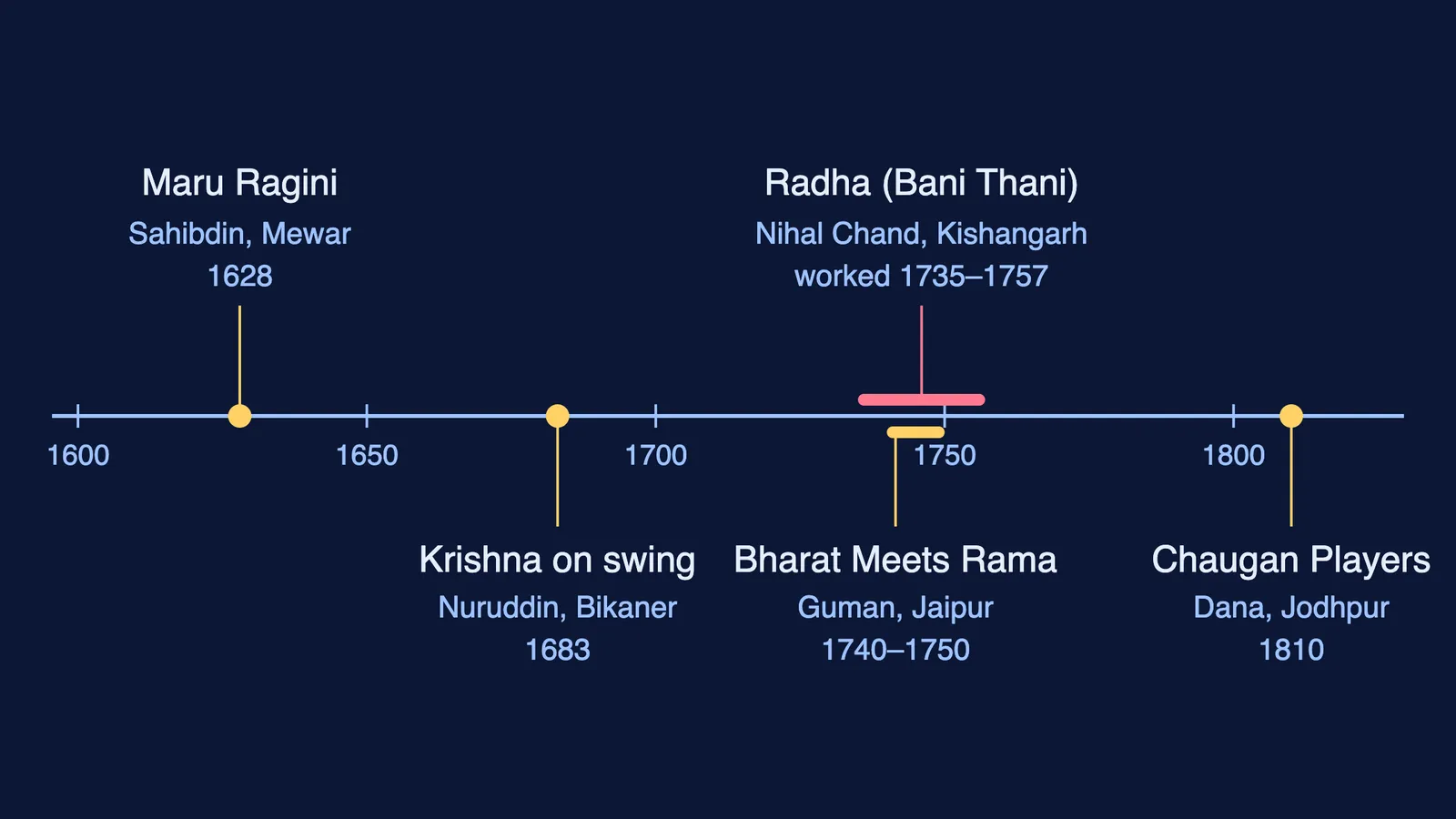
Maru Ragini, Sahibdin, Mewar: its inscription records artist, patron (Rana Jagat Singh), place (Udaipur) and Samvat 1685, which the book converts to 1628 CE. It shows Dhola and Maru escaping on a camel.
Chaugan Players, Dana, Jodhpur (1810): a princess and her companions play polo on horseback; the book reads Mughal, Deccani, Bundi and Kishangarh traces in it, set on a flat green ground.
Krishna on swing, Nuruddin, Bikaner (1683): a mound across the middle separates the indoor scene above from the countryside below. The book titles it "Krishna Swinging and Radha in Sad Mood".
Radha (Bani Thani), Nihal Chand, Kishangarh: the book heads it "Bani Thani" and dates only Nihal Chand's work for Sawant Singh (1735–1757). It says the Kishangarh face, with curved eyes, arched brows and pointed nose, is believed to derive from her features.
Bharat Meets Rama at Chitrakuta, Guman, Jaipur (1740–1750): a continuous narrative read from left to right, with every figure labelled. The book titles it "Rama meets Members of his Family at Chitrakut" and names no sub-school; Jaipur is the curriculum's attribution.
Practice questions for Class 12 Fine Arts
Our own questions; mark labels are our suggestion.
Explain why Coomaraswamy's term "Rajput Paintings" is no longer used. (2 marks, our suggestion)
List the five stages of making a Rajasthani miniature, naming one material in each. (3 marks, our suggestion)
Identify the sub-school from these clues: elongated figures, lotus-petal eyes and lavish green. Name one painter from it. (2 marks, our suggestion)
How does Nuruddin use a single landscape feature to tell two parts of a story? (4 marks, our suggestion)
Compare Mewar and Bikaner painting in colour, documentation and outside influence. (6 marks, our suggestion)
For background, revisit our Class 9 introduction to the history of arts and how the Ajanta paintings were made. Planning art after school? See BFA admission after 12th.
Not sure where to begin revising? Fermi's AI tutor works out what you already know and builds a plan for the session.