On this page
The Modern Olympic Games is Chapter 11 of *Khel Praveen*, the new NCERT Physical Education and Well-being book for Class 9 (First Edition, April 2026), and it closes the book's Unit 3, Olympism (NCERT Khel Praveen prelims and contents). It covers how the Games were revived, how they grew, and what the Olympic symbols mean.
How many marks is The Modern Olympic Games in Class 9?
The CBSE 2026-27 curriculum gives theory 20 marks and practical work 80 marks. Each unit carries 2 marks of objective or short-answer questions, which makes 16 marks across 8 units, and a viva adds 4 (CBSE Physical Education and Well-being curriculum 2026-27). The subject is assessed in school. There is no separate figure for this chapter: the unit's 2 marks are shared with Chapters 9 and 10. The curriculum lists this material under Unit 6, Olympic Movement; the book calls it Unit 3, Olympism.
How were the modern Olympic Games revived?
The NCERT chapter starts with Coubertin, a young French educator who thought sport could build courage, discipline and respect and bring nations closer (NCERT Khel Praveen, Chapter 11).
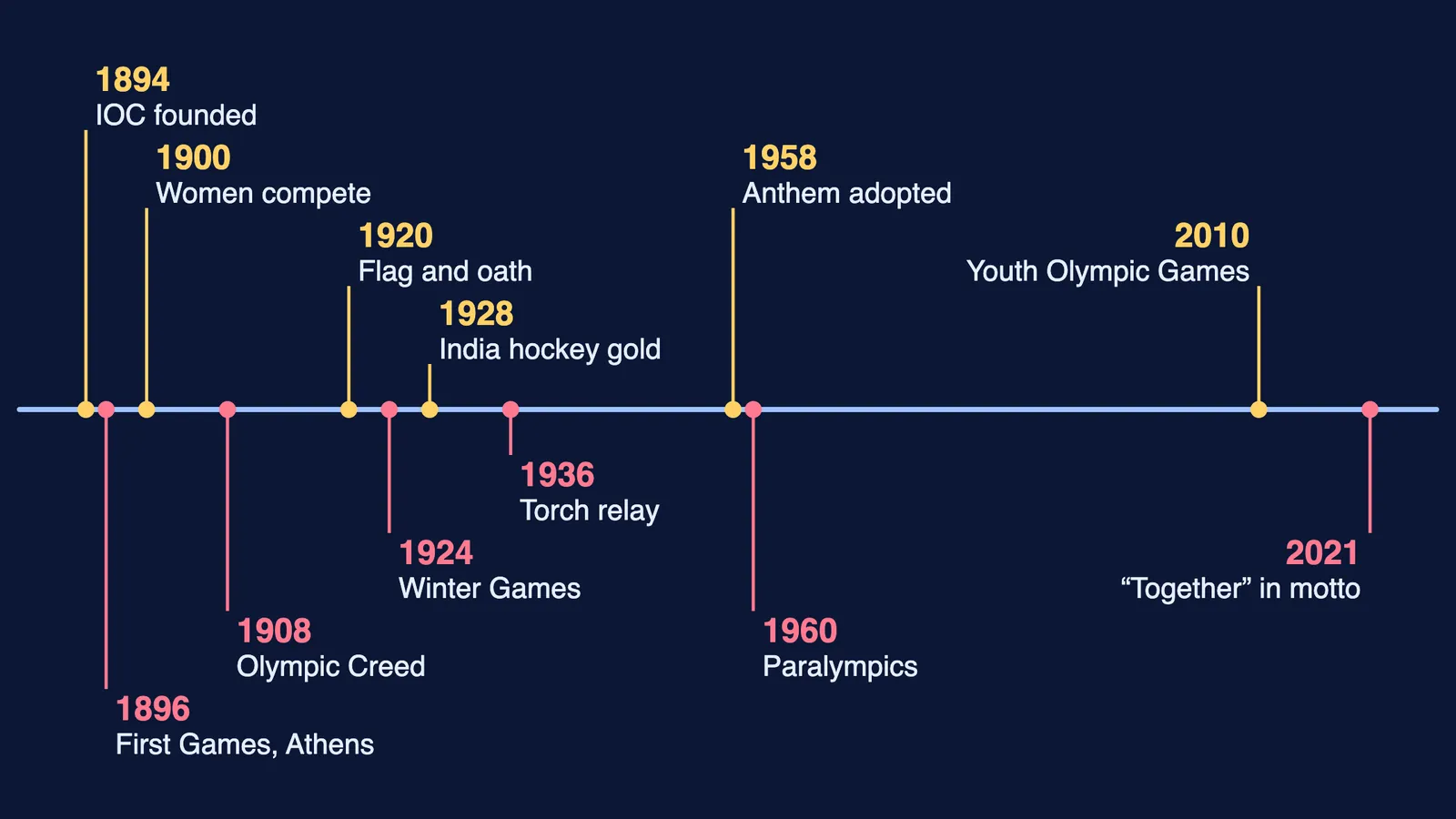
1894, Paris: Coubertin and delegates from twelve countries set up the International Olympic Committee (IOC) and chose Athens for the first Games.
April 1896, Athens: athletes from 13 countries competed in 43 events. Spyridon Louis, a Greek water carrier, won the marathon.
1900, Paris: the second Games, and women's first participation, in sports such as tennis and golf. Norman Pritchard won two silver medals in athletics for India.
The book adds that the Games stopped during the World Wars and then resumed, and that only one woman took part in 1896, unofficially.
How did the Olympic Movement grow, and where does India fit?
The chapter lists three new branches (NCERT Chapter 11):
Winter Olympics: began in 1924, with sports such as skiing and ice hockey.
Paralympic Games: started in 1960 for athletes with disabilities.
Youth Olympic Games: first held in 2010.
Today, the book says, more than 200 countries take part. For India, it gives these steps: a National Olympic Committee formed in 1927, a team at the 1928 Amsterdam Games, and that year's men's hockey gold under Dhyan Chand. India won eight Olympic hockey golds between 1928 and 1980. For Class 11 depth, see our Olympism guide for Class 11 PE.
What are the Olympic symbols, motto, flag, oath and anthem?
In brief, from the chapter (NCERT Chapter 11):
Creed: taking part with effort matters more than winning. Bishop Ethelbert Talbot first spoke it at London in 1908, and Coubertin later adopted it.
Rings: five linked rings on white (blue, yellow, black, green, red), standing for five continents. Coubertin designed them in 1913, chosen because every national flag holds at least one of those colours.
Flag: the rings on a white background. Presented at the 1914 Paris Olympic Congress, first used at Antwerp in 1920.
Motto: "Citius, Altius, Fortius" (Faster, Higher, Stronger), first proposed by Father Henri Didon. In 2021 the IOC added "Communiter" (Together).
Oath: first taken at Antwerp in 1920 by the Belgian fencer Victor Boin. It is now taken on behalf of coaches and judges as well as athletes. The current wording includes sport without doping or cheating.
Emblem: each Games has its own, approved by the IOC. The first official one appeared at Paris in 1924.
Anthem: music by Spyros Samaras, words by the Greek poet Kostis Palamas, first performed at Athens in 1896, officially adopted by the IOC in 1958. (The book prints his first name as "Kostas"; the usual spelling is Kostis.)
For more on doping, see our Class 11 guide to training and doping.
What questions can you practise?
Our own questions; the mark labels are our suggestion.
(1 mark) In which year was the IOC founded, and in which city?
(1 mark) Which word did the IOC add to the Olympic motto in 2021, and what does it mean?
(1 mark) In which year and city did women first compete officially at the Olympics?
(2 marks) Give two reasons why the five ring colours suit a worldwide event.
(2 marks) Put these in order and add the year to each: Paralympics, Winter Olympics, Youth Olympic Games.
(2 marks) Who took the first Olympic oath, and how has the oath changed since then?
Answer to question 5: Winter 1924, Paralympics 1960, Youth Games 2010. For more on para-sport, read our Class 11 guide to sports for CWSN.
How can you revise it in a week?
Days 1-2: read the chapter and copy the timeline into your notebook.
Day 3: learn the seven symbols with one year each.
Day 4: learn India's dates: 1900, 1927, 1928.
Day 5: answer the six questions without notes.
Day 6: explain the creed and motto aloud, as in a viva.
Day 7: redo what you got wrong.
Keep mixing up the dates? Fermi's AI tutor works out what you already know and builds a plan for the session.