On this page
Chapter 7 of NCERT's *An Introduction to Indian Art* Part II follows Indian artists from colonial art schools to their own modern styles, then to installation and video. For the board paper, what matters most is ten works from this chapter on the CBSE list.
What does The Modern Indian Art chapter cover?
The NCERT Chapter 7 PDF (Reprint 2026-27) moves roughly decade by decade:
Shantiniketan: Kala Bhavana, the book's 'first nationalist art school', opened in 1919. Gaganendranath Tagore adapted Cubism and Rabindranath Tagore turned doodles into pictures; Benode Behari Mukherjee and Ramkinkar Baij portrayed the nearby Santhal community.
Individual modernists: Jamini Roy drew on Bengal folk art; Amrita Sher-Gil (1913–1941), trained in Paris, mixed miniature and mural traditions with European modernism.
Groups: the Calcutta Group (1943), the Bombay Progressives (1946) with F. N. Souza, M. F. Husain and S. H. Raza, and Group 1890 (1963).
Abstraction and Neo-Tantric art: Raza, Biren De, G. R. Santosh and K. C. S. Paniker.
Narrative figuration (from the 1970s): Baroda painters K. G. Subramanyan, Bhupen Khakhar and Gulam Mohammed Sheikh, and the 1981 show 'Place for People'.
From the 1990s: installation, video and photorealism.
Which works are on the 2026-27 CBSE list?
The CBSE Fine Arts curriculum 2026-27 gives Class 12 a 30-mark theory paper of 2 hours. The Graphics, Sculpture and Applied Art theory syllabi match Painting's. Unit 2 carries 15 marks shared by three topics: the Indian National Flag, the Bengal School and the modern trends. No separate figure is printed for modern trends.
The curriculum lists twelve modern works and says questions come only from that list. It names no textbook, so this guide follows the NCERT book and maps it to Unit 2. Ten works have feature pages in Chapter 7; Raja Ravi Varma's *Rama Vanquishing the Pride of the Ocean* and Jamini Roy's mother-and-child painting (*Woman with Child* in the book) are in NCERT Chapter 6.
How do you tell the ten Chapter 7 works apart?
Learn artist, year, medium and one visual clue for each (from the Chapter 7 feature pages).
Paintings
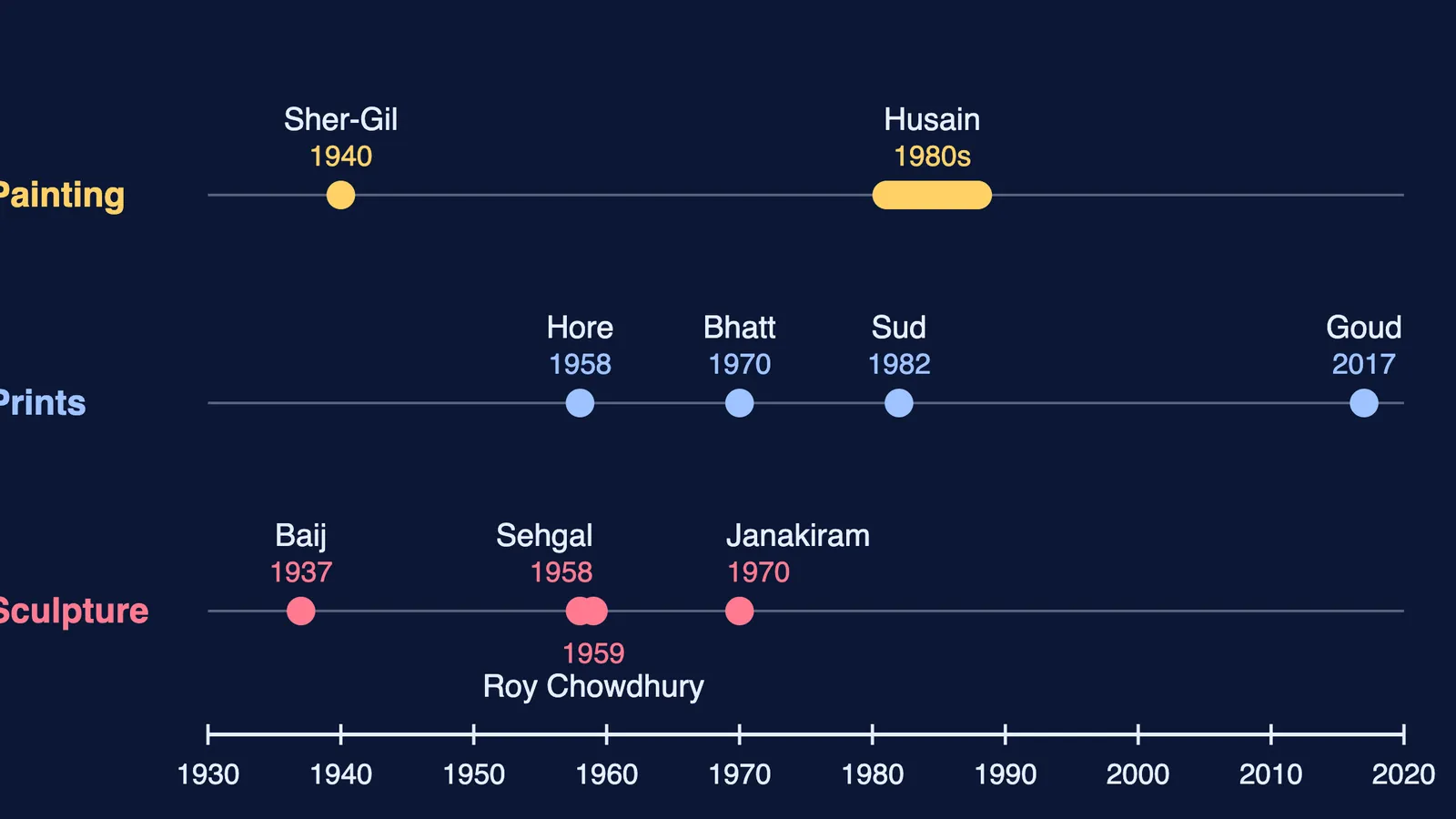
*Haldi Grinder*, Amrita Sher-Gil, 1940: women grinding turmeric, shaped by bright colour patches instead of outlines, with no depth; the book links it to Basohli painting and Gauguin (printed 'Gaugin' in the book).
*Mother Teresa*, M. F. Husain, 1980s: a repeated faceless figure in flat, cut-paper shapes; the central pose recalls Michelangelo's *Pieta*.
Graphic prints
*Children*, Somnath Hore, 1958: etching with aquatint in one colour; five thin standing children with no background, drawn from his memory of the 1943 famine.
*Devi*, Jyoti Bhatt, 1970: etching with a frontal woman's face at the centre, ringed by folk motifs and lettering.
*Of Walls*, Anupam Sud, 1982: zinc-plate etching of a woman with a hollowed-out face, sitting before a broken wall, with part of a sleeping man in the foreground.
K. Laxma Goud, 2017: a coloured, line-based etching of peasant figures among trees, from childhood memories, slightly puppet-like.
Sculptures
*Santhal Family*, Ramkinkar Baij, 1937: cement and pebbles over a metal armature, outdoors at Kala Bhavana, on a low pedestal. The book calls it the first public modernist sculpture in India.
*Cries Un-heard*, Amarnath Sehgal, 1958: bronze; three stick-like figures, read as a family, raise their arms for help.
*Triumph of Labour*, Debi Prasad Roy Chowdhury, bronze, installed at Marina Beach, Chennai, in 1959: four muscular men straining to move a rock, set on a high pedestal.
*Ganesha*, P. V. Janakiram, 1970: sheets of oxidised copper beaten into curved planes, with welded line detail; Ganesha plays a veena.
How do you write an appreciation answer?
The curriculum lists points such as main features, technique and symbolism. A five-step order covers them:
Identify: title, artist, year, medium.
Describe what you see, in two or three plain sentences.
Technique: how the material was used.
Style: which trend or tradition it connects to.
Meaning: what the work says about people or society.
Worked comparison. *Santhal Family* and *Triumph of Labour* both make working people into public sculpture. Baij chose cement and a low pedestal, so viewers share the figures' ground. Roy Chowdhury chose bronze, academic realism and a high pedestal, giving labour the place once kept for rulers' statues. Material, pedestal, style: one compare paragraph.
Practice questions
Marks are our suggestion.
Name the medium and year of Somnath Hore's *Children*, and the event behind it. (2 marks)
Why is *Santhal Family* called a public modernist sculpture? (2 marks)
Compare how Sher-Gil in *Haldi Grinder* and Husain in *Mother Teresa* flatten space. (4 marks)
Explain how Janakiram's *Ganesha* joins metalwork with temple tradition. (4 marks)
Write an appreciation of *Of Walls* using the five steps above. (6 marks)
Juggling several art histories at once? Fermi's AI tutor works out what you already know and builds a plan for the session.
Related: Bhakti-Sufi Traditions Class 12 History (background for Mukherjee's saints mural), Introduction to the History of Arts Class 9 and BFA admission after Class 12.