On this page
Chapter 1 of NCERT's An Introduction to Indian Art Part II (Reprint 2026-27) covers Indian painting in illustrated manuscripts. This guide maps it to the 2026-27 CBSE curriculum.
How much of this chapter is in the 2026-27 syllabus?
The CBSE 2026-27 Fine Arts curriculum sets the Class 12 theory paper at 30 marks and 2 hours, with one theory syllabus for Painting, Graphics, Sculpture and Applied Art-Commercial Art (codes 049 to 052). Unit 1, Miniature Paintings, carries 15 marks; the weightage table lists the Rajasthani, Pahari, Mughal and Deccan schools against them. The brief introduction to Western Indian and Pala sits in the same unit, so the 15 marks are shared, with no separate figure for this chapter.
The 2026-27 curriculum covers this chapter only partly. Unit 1 asks for a brief introduction to the Indian miniature schools and names Western Indian and Pala first, but none of the artworks it lists for appreciation come from this chapter. The curriculum names no textbook; this post follows the NCERT book (first edition August 2020) and maps it to Unit 1.
Learn the Western Indian and Pala sections well enough for a short introduction. Treat the rest as background reading.
What are manuscript paintings?
This section is background reading.
Medieval Indian paintings are called miniatures because they are small: held in the hand and studied up close, never hung on walls (walls carried murals). Many are manuscript illustrations, turning verses from an epic, religious, literary or music text into pictures, with the words in a boxed strip at the top or on the back.
A set was a cloth-wrapped bundle of loose folios for one text, such as the Ramayana or Gita Govinda. Its colophon page named who commissioned and made it, and when and where. Many colophons are lost and folios scattered, so scholars date undated sets from style.
The chapter also opens with the Chitrasutra, part of the fifth-century Vishnudharmottara Purana, a source book on painting whose limbs include roopbheda (appearance), pramana (proportion), bhava (expression) and varnikabhanga (brush and colour).
What are the features of the Western Indian school?
Where: mainly Gujarat, plus southern Rajasthan and western Central India; port trade made merchants wealthy patrons.
Jain school: largely Jain merchants paid for Jain themes. Shaastradaan, giving illustrated books to monastery libraries (bhandars), was valued as charity.
Texts: the Kalpasutra (lives of the 24 Tirthankaras), Kalakacharyakatha, Uttaradhyana Sutra and Sangrahini Sutra.
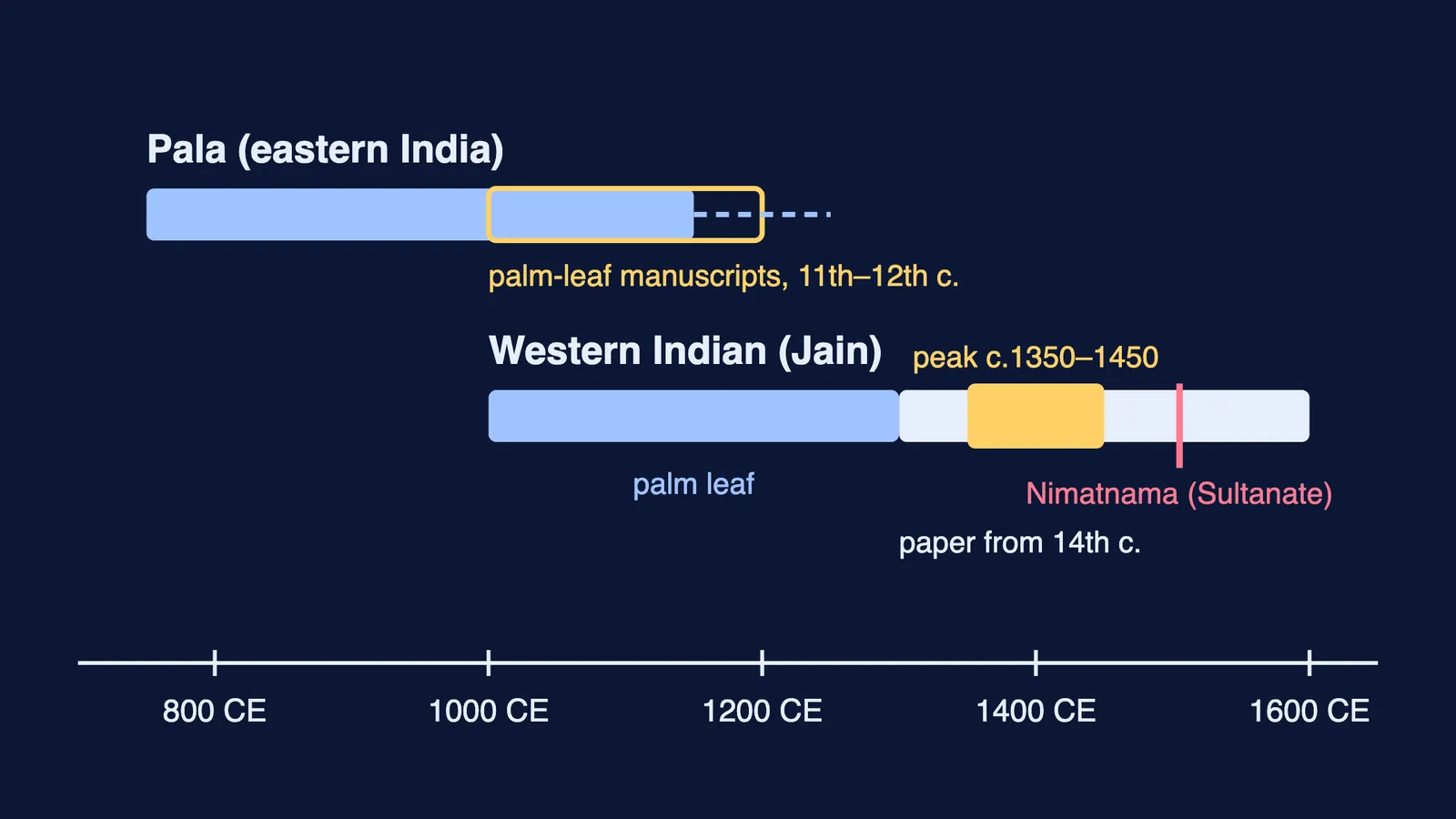
Material: palm leaf first (earliest surviving western example: eleventh century), paper from the fourteenth century. Pages were strung between painted wooden covers called patlis.
Style: thin, wiry lines; bright colours; textile patterns; space split into sections; a further eye added for depth; landscape only suggested; Sultanate domes and arches; gold and lapis lazuli.
Peak: the book names roughly 1350 to 1450 as the most creative phase.
Background reading: an indigenous "pre-Mughal" style (late fifteenth and sixteenth centuries), and the Sultanate school, which blended Persian and local features; its key example is the Nimatnama, a recipe book painted at Mandu under Nasir Shah Khalji (1500–1510 CE).
What are the features of the Pala school?
When: the Pala period ran from 750 CE to the mid-twelfth century, described in the book as Buddhist art's final great phase in India. Its illustrated manuscripts date from the eleventh and twelfth centuries.
Where: monasteries such as Nalanda and Vikramsila.
Subject: Buddhist themes and Vajrayana deities on palm leaves.
Style: a flowing, sinuous line in subdued colours, sharing a visual language with Pala sculpture.
Spread: visiting students and pilgrims took manuscripts and bronzes to Nepal, Tibet, Burma, Sri Lanka and Java.
Example: the Astasahasrika Prajnaparamita ("Perfection of Wisdom"), painted at Nalanda in King Ramapala's fifteenth regnal year (late eleventh century), with six illustrated pages.
End: the book records that Pala art ended during the thirteenth century's first half, when invaders attacked and damaged the monasteries.
How do you compare Western Indian and Pala paintings?
Region and setting: western India with Jain merchant patrons, against Buddhist monasteries in eastern India.
Theme: Jain canonical texts, against Buddhist texts and deities.
Line and colour: wiry line, bright colour, against flowing line, subdued tones.
Surface: both used palm leaf; Western Indian painting later moved to paper.
Practice questions for the theory paper
Mark labels are our suggestion.
On what surfaces were Western Indian manuscripts painted, and when did paper arrive? (2 marks)
Why did Gujarat's merchants patronise Jain manuscript painting? (2 marks)
Give three stylistic features of Jain manuscript paintings. (3 marks)
How did Pala art reach Nepal, Tibet and South East Asia? (3 marks)
Compare Western Indian and Pala painting on line, colour and theme. (6 marks)
Unsure where to start revising? Fermi's AI tutor works out what you already know and builds a plan for the session.
Further reading: our introduction to the history of Indian arts, how the Ajanta paintings were made and BFA admission after Class 12.