On this page
Chapter 8 of NCERT's *An Introduction to Indian Art, Part II* (Class 12, reprint 2026-27) turns from courts and dynasties to the art of ordinary people: wall paintings, story scrolls, metal casting and clay figures, often made by artists with no formal training (NCERT chapter PDF).
Is The Living Art Traditions of India in the 2026-27 Class 12 syllabus?
No. The 2026-27 CBSE Fine Arts curriculum (codes 049 to 052) sets one theory paper of 30 marks, common to Painting, Graphics, Sculpture and Applied Art-Commercial Art (CBSE Fine Arts curriculum 2026-27). Unit 1 (Rajasthani, Pahari, Mughal and Deccan miniatures) and Unit 2 (the Indian National Flag, the Bengal School and modern trends) carry 15 marks each. Neither unit names this chapter, and the curriculum does not name the NCERT book, so treat Chapter 8 as background reading from the book. It is not part of either theory unit, and no theory marks are attached to it.
Still, the Class 12 practical portfolios for Painting, Sculpture and Applied Art each ask for a work based on Indian folk art, and this chapter gives you its vocabulary.
What does Chapter 8 actually say?
The chapter's answer to who makes art far from art schools: skills passed down the generations, in work scholars have called folk, tribal, ritual, utility or minor art. The book traces it to prehistoric cave paintings and Indus-period pottery, notes a handicraft revival after Independence, and finds ritual meaning mixed with everyday use.
Which painting traditions should you know?
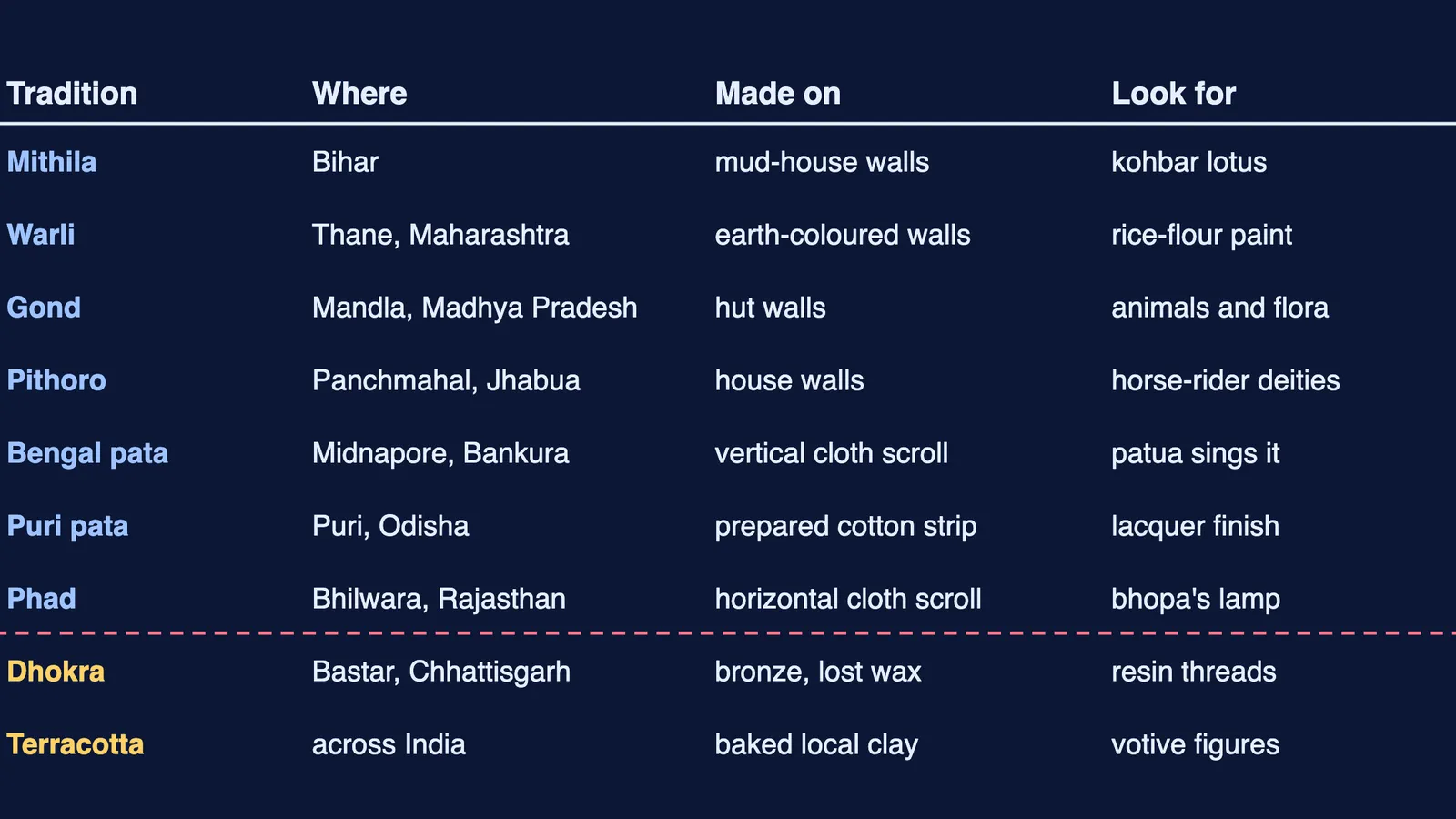
Mithila (Madhubani), Bihar: women paint the walls of mud houses for ceremonies, especially weddings. The richest work is in the kohbar ghar, where a blooming lotus on a stalk is painted with deities. No space is left empty, and the brush is a bamboo twig tipped with cotton or straw.
Warli, northern Maharashtra (mainly Thane district): married women paint the Chowk, centred on the fertility goddess Palaghat. Around her are scenes of hunting, fishing, farming and even buses and city life in Mumbai. The paint is rice flour on earth-coloured walls, and the brush is a chewed bamboo stick.
Gond, Mandla, Madhya Pradesh: once geometric votive drawings on hut walls, now colourful images of animals, humans and plants.
Pithoro, Rathva Bhils of Panchmahal (Gujarat) and Jhabua (Madhya Pradesh): rows of horse-rider deities. A wavy line divides the world of gods above from the earth below.
Bengal pata, West Bengal: a patua (also called chitrakar) displays a vertically painted cloth scroll and sings the stories shown on it.
Puri pata, Odisha: cotton strips are coated with stone powder and tamarind-seed glue, painted in flat colours, then lacquered over a charcoal fire.
Phad, around Bhilwara, Rajasthan: long horizontal scrolls honour bhomias, cattle heroes such as Gogaji and Pabuji. Bhopas perform them through the night with a lamp, while Joshi painters make them.
Spelling note: the book prints "Maharshtra" and "defied cattle heroes"; we write Maharashtra and deified.
How is a Dhokra figure cast, step by step?
Dhokra is lost-wax bronze casting, practised in Bastar (Chhattisgarh), parts of Madhya Pradesh and Odisha, and Midnapore (West Bengal). Bastar's casters are called ghadwa. The steps:
Shape a core from riverbank black soil, rice husk and water. Once dry, coat it with clay and cow dung.
Boil saal resin with mustard oil, strain it and keep it over water so it sets but stays soft. Warm small pieces and stretch them into threads.
Join the threads into strips, wrap the core in them and add details such as eyes and nose.
Seal it in three layers of clay (fine clay, clay with cow dung, then ant-hill clay with husk), then fix a clay receptacle to the base and seal a cup of metal pieces on the other side.
Fire it with saal wood or its coal, blowing in air for about 2 to 3 hours until the metal melts. Turn the mould over with tongs so the metal runs into the space the resin left, then cool it and hammer away the clay.
Terracotta is more widespread: potters shape local clay by hand, mould or wheel and bake it into votive gods, animals and birds.
How can you practise it?
Mark labels are our suggestion.
Name two painting traditions in the chapter that use cloth scrolls in performance. (1 mark)
Name two nature motifs in Mithila painting and two ideas such motifs signify. (2 marks)
Compare Warli and Pithoro paintings on who paints them, the main figure and the layout. (3 marks)
Put the five stages of Dhokra casting in order and explain why the resin is lost. (4 marks)
What do bhopas and Joshis each contribute to a phad, and how does it link to court painting? (4 marks)
For groundwork, see our Introduction to the History of Arts Class 9 guide and mediums and techniques in visual art, or read how BFA admission works after 12th.
Where should your revision start? Fermi's AI tutor works out what you already know and builds a plan for the session.