On this page
Chapter 7 of the new NCERT Class 7 book Exploring Society: India and Beyond, Part 1 (code gees1, First Edition April 2025) covers the Gupta Empire and its neighbours between the 3rd and 6th centuries CE. It closes Theme B, after Chapter 6. CBSE publishes no separate 2026-27 curriculum for Classes 6 to 8; these classes follow the NCERT book, and the chapter is assessed by the school.
Who were the Guptas, and how did they rise?
The book says the Kuṣhāṇa Empire in the north and northwest had begun to weaken by the 3rd century CE, and new kingdoms appeared (NCERT, Chapter 7). The Guptas probably began as regional rulers near present-day Uttar Pradesh, and their capital was Pāṭaliputra (present-day Patna).
The chapter introduces three rulers:
Chandragupta I, grandfather of Chandragupta II, helped the early expansion and is remembered for his coins and alliances.
Samudragupta, father of Chandragupta II, is praised in the prayāga praśhasti, a pillar inscription at Prayagraj written by the court poet Harisena. He fought many wars; many defeated kings got their thrones back and paid him tribute. One of his coins shows him playing the veena.
Chandragupta II was also called Vikramāditya. The Iron Pillar now at Mehrauli in Delhi, about 6 tonnes and over 1,600 years old, was put up in his reign and has not rusted. Our post on why the Delhi iron pillar doesn't rust explains the chemistry.
Do not confuse him with Chandragupta Maurya.
How did the Guptas run their empire?
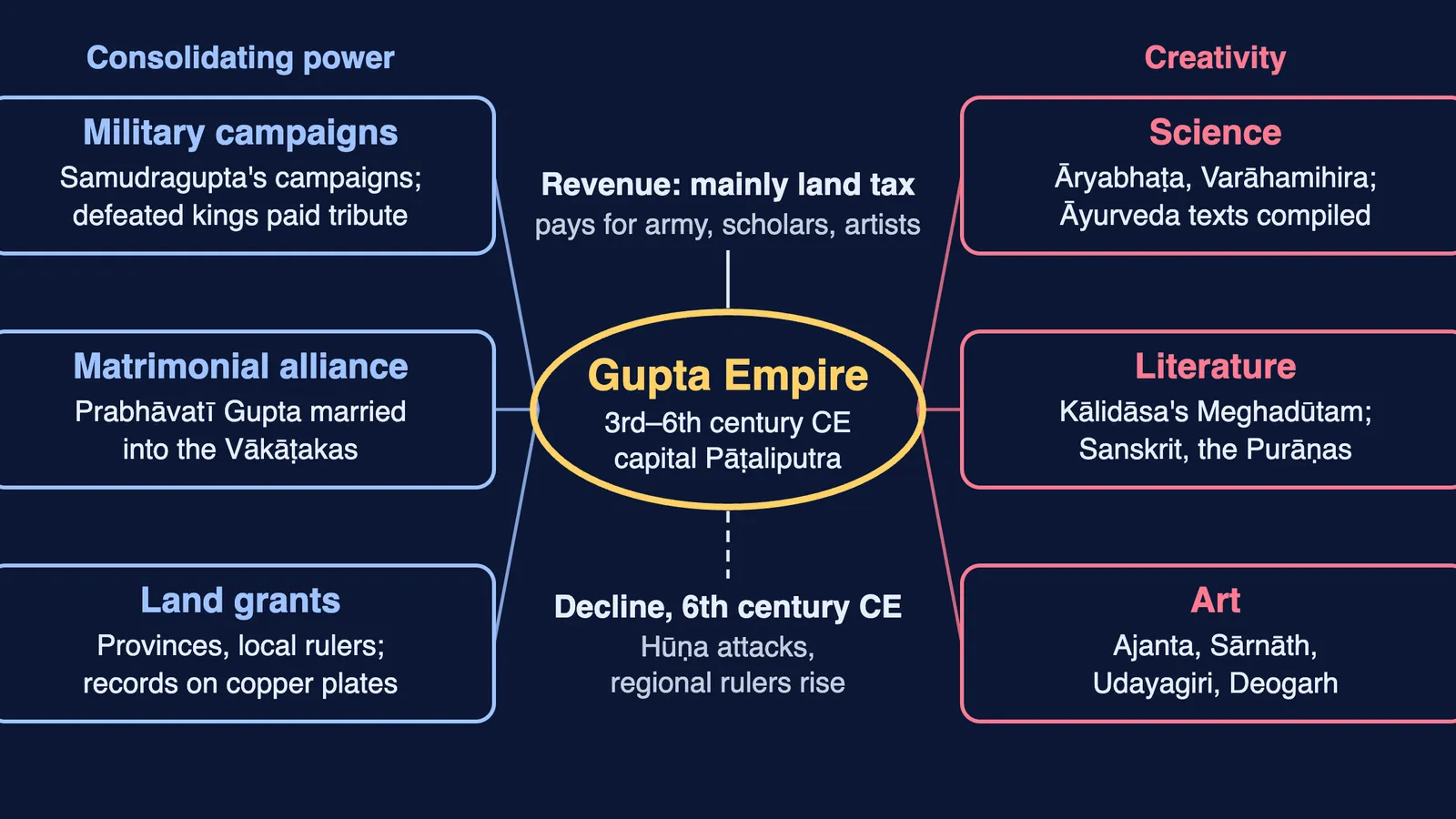
The chapter lists strategies including military conquest, diplomacy and alliances, marriage alliances among them (NCERT, Chapter 7). Kings took titles such as mahārājadhirāja. Prabhāvatī Gupta, daughter of Chandragupta II, married a Vākāṭaka prince; when he died early she ruled as regent and kept the two kingdoms close.
The empire was split into provinces, and land was granted to local rulers, priests and chieftains, with the grants written on copper plates. Land tax was the main income; fines and taxes on mines, irrigation, trade and crafts added more. Traders sent textiles, spices, ivory and gemstones to the Mediterranean, Southeast Asia and China, and the island of Socotra in the Arabian Sea shows traces of Indian traders.
The Chinese traveller Faxian visited in the early 5th century CE. He describes prosperous cities and care for the sick, but also harsh treatment of the chanḍālas, and the book reminds you to check one traveller's view against other sources.
Why is the Gupta period called the classical age?
The book says some historians use the label because long peace and stability brought achievements, and a stronger economy let the state fund scholars, artists and scientists (NCERT, Chapter 7).
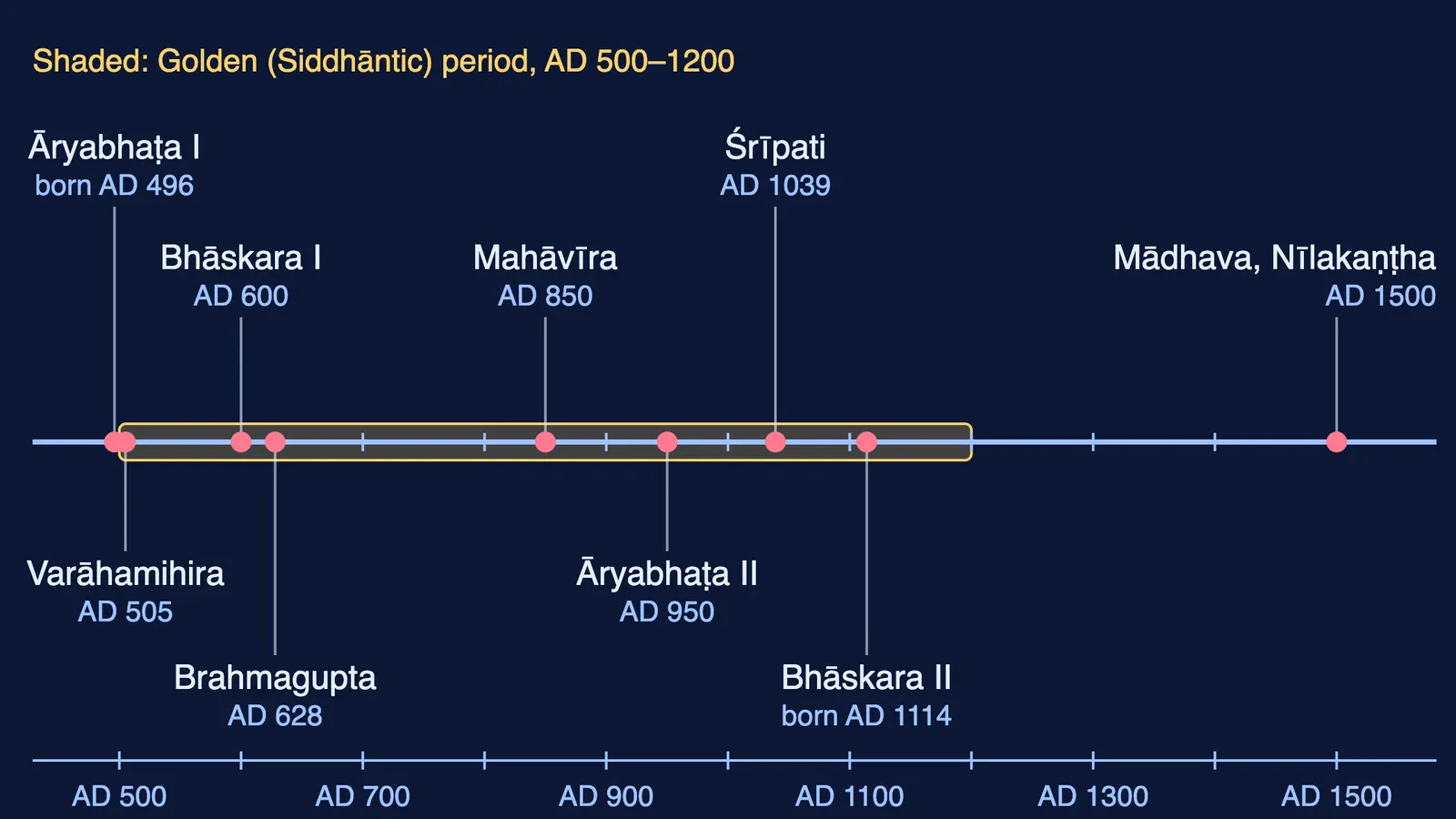
Science: Āryabhaṭa, in Kusumapura around 500 CE, wrote the Āryabhaṭīya, argued that the Earth rotates on its axis and explained eclipses correctly. Varāhamihira of Ujjayinī wrote the Bṛihat Samhitā. You can read more in our post on Āryabhaṭa's astronomy.
Medicine: the Charaka Saṃhitā and Suśhruta Saṃhitā took their final shape in this period.
Literature: Kālidāsa wrote Meghadūtam, where a yakṣha sends a message by cloud.
Art: Sārnāth sculptures, the Ajanta caves, Udayagiri's rock-cut caves and the Deogarh temple.
Worked example: how close was Āryabhaṭa's year? The book gives his year as 365 days, 6 hours, 12 minutes, 30 seconds, and the modern value as 365 days, 5 hours, 48 minutes, 45 seconds (NCERT, Chapter 7). 6 h 12 min 30 s minus 5 h 48 min 45 s: borrow one hour, so 72 min 30 s minus 48 min 45 s gives 23 min 45 s. His year was 23 minutes 45 seconds (1,425 seconds) too long. Against the book's modern value of 31,556,925 seconds, that is about 0.0045%, under 0.005%.
What was happening in the south and northeast?
The Pallavas, with their capital at Kānchipuram, rose after the Sātavāhanas and ruled parts of present-day Tamil Nadu, Karnataka, Telangana and Andhra Pradesh into the later 9th century CE (NCERT, Chapter 7). In the northeast, the Varman dynasty ruled the Kāmarūpa kingdom over the Brahmaputra valley. Samudragupta defeated rulers of both but left them on their thrones in return for tribute.
By the 6th century CE the empire was declining, under repeated Hūṇa attacks from central Asia and the rise of regional rulers. For the Class 9 view of the same centuries, see our guide to State and Society up to 1000 CE.
Practice questions for The Gupta Era Class 7
These are our own questions. Mark values are our suggestion only.
Name three strategies the Guptas used to expand and hold their empire, with one example of each. (3 marks)
What should a historian check before relying on Harisena's inscription? (2 marks)
Explain how copper-plate land grants helped the Guptas govern a large area. (2 marks)
Give one contribution each of Āryabhaṭa, Varāhamihira and Kālidāsa. (3 marks)
How did Samudragupta treat the Pallava and Kāmarūpa rulers after defeating them? (2 marks)
Not sure how the rulers, scholars and kingdoms fit together? Fermi's AI tutor works out what you already know and builds a plan for the session.