On this page
Chapter 4 of NCERT's Class 12 Fine Arts book, *An Introduction to Indian Art Part II*, follows painting at the courts of Ahmadnagar, Bijapur and Golconda. Here is where the style came from, how to spot it, the two prescribed paintings, and practice questions.
What does Chapter 4 cover and how many marks is it worth?
The CBSE Fine Arts curriculum for 2026-27 sets a 30-mark, two-hour theory paper for Class 12 Painting, and states that the Graphics, Sculpture and Applied Art (Commercial Art) theory syllabus is the same. Deccani painting sits in Unit 1 alongside the Rajasthani, Pahari and Mughal schools, and those four schools share 15 marks. The curriculum gives no separate figure for the Deccan.
The curriculum does not name a textbook. This post follows the NCERT chapter (Reprint 2026-27 of the August 2020 first edition) and maps it to Unit 1. Unit 1 lists eight points for each school, including origin, sub-schools, main features and identifying style and technique.
How did the Deccani schools of painting begin?
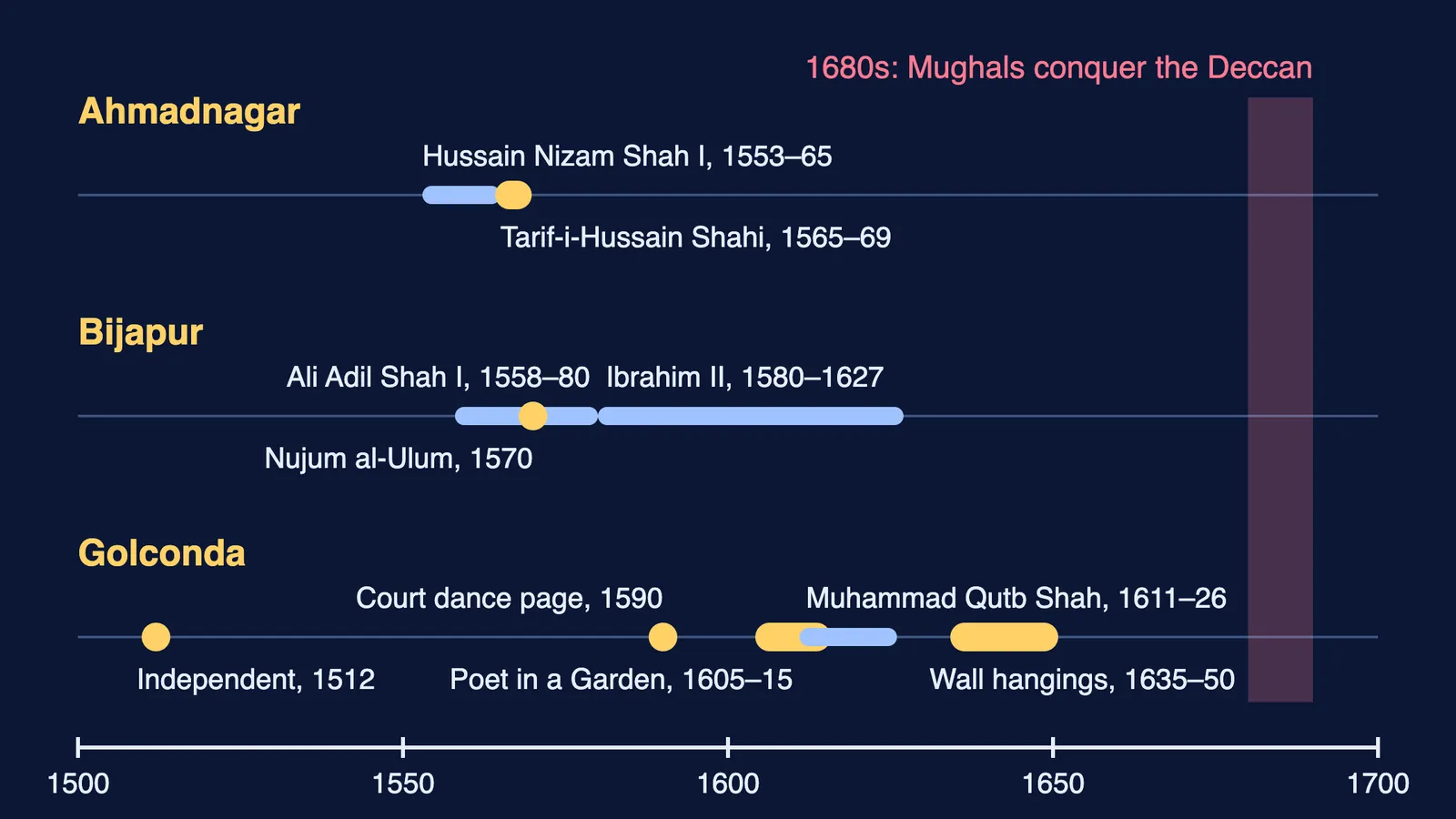
According to the NCERT chapter, the story runs from the late sixteenth century up to the 1680s, when the Mughals conquered the Deccan. Later echoes appear under the Asafiya dynasty and at smaller courts in the Nizam's Hyderabad. For a long time, art historians grouped this work with Indo-Persian art. The chapter argues it was a school in its own right, supported by sultans who hired artists to suit both their tastes and the needs of governing.
Ahmadnagar: the earliest examples are in a book of poems praising Hussain Nizam Shah I (1553–1565). Its 12 miniatures include scenes of the queen with rich colour; dress mixes northern costume with a southern scarf also seen in the Lepakshi murals.
Bijapur: the Nujum al-Ulum, an illustrated encyclopaedia dated 1570, holds 876 miniatures; many show weapons and utensils, others the constellations. The patrons were Ali Adil Shah I (1558–1580) and Ibrahim II (1580–1627), who also wrote a book on music, the Nauras-nama.
Golconda: independent from 1512, it was the wealthiest Deccan kingdom by the late sixteenth century, thanks to trade from its east-coast ports; diamonds found early in the seventeenth century added revenue. Its paintings show gold jewellery on men and women, and in the late seventeenth century Dutch merchants carried sultans' portraits to Europe.
What are the main features of Deccani painting?
Use this checklist when a question asks you to identify the style. Every point comes from the chapter.
Intense, glowing colour and a sensuous line, richer than many northern manuscripts.
Dense compositions with a romantic mood.
A high round horizon and golden sky, which the book traces to Persia.
Generous gold, sometimes with skies painted in separate gold and blue bands.
Tall, slender women in south Indian dress.
Deccani trees with tinted edges, and plants set against masses of dark foliage.
Symmetrical architecture, patterned carpets and unusual colour, such as purple tones and blue animals.
How do you write about the two prescribed paintings?
The curriculum lists two Deccan works, both with unknown painters. For each, cover subject, sub-school, collection and one visual feature.
Hazrat Nizamuddin Auliya and Amir Khusrau (sub-school: Hyderabad). This provincial painting, now in the National Museum, New Delhi, shows the thirteenth-century Sufi saint listening to music played by his disciple, the poet Amir Khusrau. The book calls it simple rather than polished court work, yet charming in the way it tells a popular story. It also notes that qawwali by Khusrau is still sung at the saint's dargah in New Delhi.
Chand Bibi Playing Polo (Chaugan) (sub-school listed as Golconda, printed "Gol Konda", in the curriculum). The book introduces Chand Bibi as Queen of Bijapur, a skilled ruler and sportsperson who resisted Akbar's attempts to take her state. She plays chaugan, another name for polo on horseback. The book says the painting looks provincial and probably later; it too is in the National Museum, New Delhi.
For background on the wider region, our Class 12 History guide to Vijayanagara, the imperial capital at Hampi gives useful background on the region. Class 9 students starting out can read our introduction to the history of arts.
Practice questions for Chapter 4
These are our own questions. The mark labels are our suggestion, not a CBSE pattern.
Name the three Deccan kingdoms whose court painting the chapter describes. (1 mark, our suggestion)
Which Bijapur manuscript dated 1570 contains 876 miniatures, and what do they show? (2 marks, our suggestion)
List four features that help you identify a Deccani painting. (2 marks, our suggestion)
Appreciate *Hazrat Nizamuddin Auliya and Amir Khusrau*: subject, sub-school and style. (4 marks, our suggestion)
Give two reasons the chapter offers for Golconda's wealth, and name one feature of Golconda painting. (3 marks, our suggestion)
Which dates or features keep slipping? Fermi's AI tutor works out what you already know and builds a plan for the session. If you are thinking about art after school, see our guide to BFA admission after Class 12.